

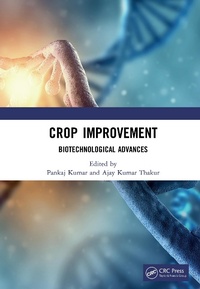
Crop Improvement
Biotechnological Advances
1st Edition
Published on 29. June 2021
270 pages
978-1-000-38123-8 (ISBN)
Description

Crop Improvement: Biotechnological Advances - Biomedical Science
The field of biotechnology is advancing at a fast pace. The availability of low-cost DNA/genome sequencing technologies has led to the discovery and functional characterization of myriad of genes imparting stress tolerance and quality traits. The 'omics' group of technologies including genomics, proteomics, transcriptomics and metabolomics has revolutionized the agricultural biotechnology sector. The Nobel Prize-winning technology, such as the genome editing technique, is being employed to edit various gene functions in plants aiding in crop improvement. This technology may be adopted very quickly by consumers compared with the transgenic technique because the genome-edited plants have no adverse effects on the genome of the plant itself and on the environment and related species/non-target organisms.
In this book, authors have attempted to compile the latest techniques of agricultural biotechnology and their applications in crop improvement. Certain chapters have been dedicated to describe the use of nanotechnology, a fast emerging new technique in the agriculture sector.
Features
Development, potential and safety issues in biotechnology
Advances in genomics, proteomics and transcriptomics in agriculture
Protein bioinformatics and its applications
Genetically modified (GM) technology and its implications
Genome editing in crop improvement
Marker-assisted selection (MAS) in crop improvement
Mutation breeding
Cryobiotechnology
Nanotechnology and biosensors
This book includes real-world examples and applications making it accessible to a broader interdisciplinary readership. We hope that it will serve as a reference book for researchers engaged in molecular biology and biotechnology and will act as a ready reckoner for postgraduate (PG) students in the biotechnology discipline.
The field of biotechnology is advancing at a fast pace. The availability of low-cost DNA/genome sequencing technologies has led to the discovery and functional characterization of myriad of genes imparting stress tolerance and quality traits. The 'omics' group of technologies including genomics, proteomics, transcriptomics and metabolomics has revolutionized the agricultural biotechnology sector. The Nobel Prize-winning technology, such as the genome editing technique, is being employed to edit various gene functions in plants aiding in crop improvement. This technology may be adopted very quickly by consumers compared with the transgenic technique because the genome-edited plants have no adverse effects on the genome of the plant itself and on the environment and related species/non-target organisms.
In this book, authors have attempted to compile the latest techniques of agricultural biotechnology and their applications in crop improvement. Certain chapters have been dedicated to describe the use of nanotechnology, a fast emerging new technique in the agriculture sector.
Features
Development, potential and safety issues in biotechnology
Advances in genomics, proteomics and transcriptomics in agriculture
Protein bioinformatics and its applications
Genetically modified (GM) technology and its implications
Genome editing in crop improvement
Marker-assisted selection (MAS) in crop improvement
Mutation breeding
Cryobiotechnology
Nanotechnology and biosensors
This book includes real-world examples and applications making it accessible to a broader interdisciplinary readership. We hope that it will serve as a reference book for researchers engaged in molecular biology and biotechnology and will act as a ready reckoner for postgraduate (PG) students in the biotechnology discipline.
More details
Edition
1. Auflage
Language
English
Place of publication
London
United Kingdom
Publishing group
Taylor & Francis Ltd
Target group
College/higher education
Professional and scholarly
Illustrations
28 Tables, black and white; 8 Line drawings, color; 13 Line drawings, black and white; 8 Illustrations, color; 13 Illustrations, black and white
ISBN-13
978-1-000-38123-8 (9781000381238)
Copyright in bibliographic data and cover images is held by Nielsen Book Services Limited or by the publishers or by their respective licensors: all rights reserved.
Schweitzer Classification
Other editions
Additional editions
Book
06/2021
1st Edition
CRC Press
€184.60
Shipment within 15-20 days
Persons
Dr. Pankaj Kumar is presently working as Assistant Professor (Biotechnology), Department of Biotechnology, Dr. Y.S. Parmar University of Horticulture and Forestry, Solan, Himachal Pradesh, India. Formerly, he has worked as SERB- National Post Doctoral Fellow (DST Young Scientist Scheme) at Council of Scientific & Industrial Research - Institute of Himalayan Bioresource Technology, Palampur, Himachal Pradesh. India. Dr. Kumar is working on plant secondary metabolite enhancement through cell and tissue engineering approaches; Identification of molecular cues linked with enhanced metabolites using comparative transcriptomics approach and also working on hydro-aero cultivation of medicinal plants for industrial importance. During Doctoral Studies; he (research team) has generated technology at Dr Yashwant Singh Parmar University of Horticulture & Forestry Nauni, Solan for developing insect pest resistant transgenic plants in economically important vegetable crops of cauliflower cv. Pusa Snowball, cabbage cv. Pride of India and broccoli cv. Solan Green Head (with cryIAa gene) for insect pest resistance. He has been awarded DST INSPIRE JRF/SRF Fellowship, Department of Science and Technology, Ministry of Science and Technology, Government of India for Ph.D. full doctoral program. He has qualified ICAR AICE-SRF (PGS), ICAR ASRB National Eligibility Test (NET). He has published 32 research/review papers in various journals of International and National repute, contributed 13 book chapters and 5 popular articles. Dr. Kumar has received many awards from various societies and scientific organizations for his scientific contribution i.e. Young Scientist Award Biotechnology-2018 by Society for Plant Research, Young Scientist Award -2019 by the Society of Tropical Agriculture, New Delhi, India, Excellence in Research Award -2019 by Agro Environmental Development Society, India. etc.
Dr. Ajay Kumar Thakur is presently working as Senior Scientist (Biotechnlogy) at ICAR-Directorate of Rapeseed-Mustard Research, Bharatpur, Rajasthan. He has obtained his graduation, PG and Doctoral degrees from Dr. Y.S. Parmar University of Horticulture & Forestry, Solan, H.P. He got induced into Agricultural Research Services (ARS) in 2008. He has published 40 research/review papers in various journals of International and National repute, authored one book 'Agricultural Biotechnology at a Glance', contributed 8 book chapters and 22 popular articles. He has developed high efficiency plant regeneration and genetic transformation protocols in a number of crops including Populus ciliata, P. deltoides, Punica granatum, Capsicum annum and Cucumis sativus. Dr. Thakur is associated with Brassica juncea improvement programme using biotechnological interventions from last eleven years. He has developed a core set of SSR markers for B. juncea genomics and is presently working on germplasm characterization and association mapping of various agronomically important traits in this oilseed crop. He has also filed one patent and associated in the development of a high yielding Indian mustard variety Giriraj, a white rust resistant Indian mustard genetic stock DRMR MJA 35, which is a Moricandia system- based cytoplasmic male sterile line of B. juncea, and a multiple disease (Alternaria blight, white rust and powdery mildew) resistant Indian mustard genetic stock, DRMRIJ 12-48. Dr. Thakur has received many awards from various societies and scientific organizations for his scientific contribution. He is also an elected Member of Plant Tissue Culture Association of India.
Dr. Ajay Kumar Thakur is presently working as Senior Scientist (Biotechnlogy) at ICAR-Directorate of Rapeseed-Mustard Research, Bharatpur, Rajasthan. He has obtained his graduation, PG and Doctoral degrees from Dr. Y.S. Parmar University of Horticulture & Forestry, Solan, H.P. He got induced into Agricultural Research Services (ARS) in 2008. He has published 40 research/review papers in various journals of International and National repute, authored one book 'Agricultural Biotechnology at a Glance', contributed 8 book chapters and 22 popular articles. He has developed high efficiency plant regeneration and genetic transformation protocols in a number of crops including Populus ciliata, P. deltoides, Punica granatum, Capsicum annum and Cucumis sativus. Dr. Thakur is associated with Brassica juncea improvement programme using biotechnological interventions from last eleven years. He has developed a core set of SSR markers for B. juncea genomics and is presently working on germplasm characterization and association mapping of various agronomically important traits in this oilseed crop. He has also filed one patent and associated in the development of a high yielding Indian mustard variety Giriraj, a white rust resistant Indian mustard genetic stock DRMR MJA 35, which is a Moricandia system- based cytoplasmic male sterile line of B. juncea, and a multiple disease (Alternaria blight, white rust and powdery mildew) resistant Indian mustard genetic stock, DRMRIJ 12-48. Dr. Thakur has received many awards from various societies and scientific organizations for his scientific contribution. He is also an elected Member of Plant Tissue Culture Association of India.
Content
Biotechnology in agriculture: development, potentials, and safety. Advances in Genomics and Proteomics in Agriculture. Integrated metabolome and transcriptome analysis: A new platform/technology for functional biology and natural products research. Recent Advances in Protein Bioinformatics. CBL-CIPK: The Ca+ signals during abiotic stress response. Transgenic technology and its progressive implication. PR Proteins: Key Genes for Engineering Disease Resistance in Plants. Approaches and techniques in Plant metabolic engineering. Genome Editing for Crop Improvement. Molecular Marker-Assisted Breeding for Crop Improvement. Biotechnological advances and advanced mutation breeding techniques for crop plants. Recent Advancement of Nanotechnology in Agriculture. Cryobiotechnology In Plants: Recent Advances And Prospects. Role of biotechnology in the improvement of cole crops. Application of Nanotechnology in Crop Improvement: An Overview. Biosensors in Food Industry: An Exposition of Novel Food Safety Approach. Advances in microbes use in agricultural biotechnology
