

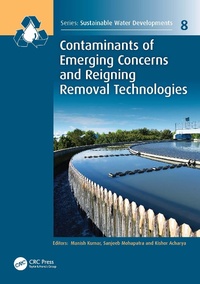
Contaminants of Emerging Concerns and Reigning Removal Technologies
1st Edition
Published on 30. June 2022
494 pages
978-1-000-55108-2 (ISBN)
Description

With an increased demand for wastewater reuse, groundwater recharge with treated wastewater has been practiced across the globe. As a result, groundwater quality deteriorates by emerging micropollutants from various anthropogenic origins, including untreated wastewater, seepage of landfill leachate, and runoff from agricultural lands. The fate of such emerging and geogenic contaminants in subsurface systems, especially in the groundwater, depends on several factors. Physicochemical properties of contaminants such as octanol-water partition coefficient, dissociation constant, water solubility, susceptibility to biodegradation under anaerobic conditions, and environmental persistence under diverse geological and pH conditions play a critical role during subsurface mass flow. Thus, advanced wastewater treatment techniques, followed by implementing stricter guidelines, are some of the measures that can safeguard water resources.
This book, in general, gives an understanding of the fate and mitigation strategies for emerging and geogenic contaminants in the groundwater. The first and second sections provide a detailed insight into various removal techniques and mitigation approaches. Possible treatment strategies, including bioremediation and natural attenuation, are also covered in those sections. Environmental assessment, groundwater vulnerability, health effects, and regulations pertaining to various contaminants are systematically presented in the third section.
This book, in general, gives an understanding of the fate and mitigation strategies for emerging and geogenic contaminants in the groundwater. The first and second sections provide a detailed insight into various removal techniques and mitigation approaches. Possible treatment strategies, including bioremediation and natural attenuation, are also covered in those sections. Environmental assessment, groundwater vulnerability, health effects, and regulations pertaining to various contaminants are systematically presented in the third section.
More details
Series
Edition
1. Auflage
Language
English
Place of publication
London
United Kingdom
Publishing group
Taylor & Francis Ltd
Target group
College/higher education
Professional and scholarly
Product notice
Reflowable
Illustrations
56 Tables, black and white; 81 Line drawings, black and white; 81 Illustrations, black and white
ISBN-13
978-1-000-55108-2 (9781000551082)
Copyright in bibliographic data and cover images is held by Nielsen Book Services Limited or by the publishers or by their respective licensors: all rights reserved.
Schweitzer Classification
Other editions
Additional editions
Manish Kumar | Sanjeeb Mohapatra | Kishor Acharya
Contaminants of Emerging Concerns and Reigning Removal Technologies
Book
06/2022
1st Edition
CRC Press
€243.60
Shipment within 10-20 days
Persons
Dr. Manish Kumar is a Full Professor and Head of the Sustainability Cluster at School of Engineering, University of Petroleum and Energy Studies, Dehradun, Uttarakhand, India. He is Ph.D in Urban Engineering from the University of Tokyo, Japan, and has received several prestigious recognitions/fellowship, such as Water Advanced Research and Innovation (WARI) Fellowship, Japan Society for the promotion of Science (JSPS) foreign research fellowship, Brain Korea (BK)-21 post-doctoral fellowship, Monbukagakusho scholarship, Linnaeus-Palme stipend from SIDA, Sweden, Research Fellowship from CSIR, India and others. Prof. Kumar is active in the fields of contaminant transport and modeling, heavy metal speciation and toxicity, wastewater surveillance, emerging contaminants and water supply. He has over 200 publications to his credit. He is a Fellow of Royal Society for Chemistry (FRSC), London, UK; and among the top 2% of researchers as per the list of Stanford University, USA. His ResearchGate score is above 97.5 percentile of the researchers in the world.
Dr. Sanjeeb Mohapatra, after fishing his Ph.D. at the Environmental Science and Engineering Department, IIT Bombay, India, joined the Energy and Environmental Sustainability for Megacities (E2S2) program at National University of Singapore (NUS), Singapore, to pursue his postdoctoral degree. His research interest broadly covers the monitoring of emerging contaminants (ECs), photo-degradation and enzymatic degradation of ECs, and the role of dissolved organic matter in deciding the fate of such contaminants. He is a recipient of the Water Advanced Research Innovation (WARI) Fellowship awarded by the Department of Science and Technology (DST), India, University of Nebraska Lincoln, USA, Daugherty Water for Food Global Institute (DWFI), USA and Indo-U.S. Science and Technology Forum (IUSSTF). He is a recipient of the Newton-Bhabha Fellowship jointly awarded by DST, India, and the British Council, U.K. and the DST-INSPIRE fellowship awarded by DST, India. Dr. Mohapatra also won several international and local awards and has many publications in reputed journals, book chapters, and refereed conferences to his credit.
Dr. Kishor Acharya is a postdoctoral researcher at the School of Engineering, Newcastle University, UK, specialized in the field of public health engineering. His research interest varies from developing and applying portable molecular tools for on-site microbial hazard assessment to design novel techniques/methods for bio-remediation for removal of organic pollutants. Dr. Acharya is a recipient of the prestigious Rapid Response Grant award by the Global Challenges Academy to help the global dissemination of research skills and tools and capacity building among researchers of Nepal working in the WASH sector. Dr Acharya was recently endorsed as exceptional talent by the Royal Society. He has published his research work in leading environmental engineering journals such as Water Research and Environmental Science and Technology.
Dr. Sanjeeb Mohapatra, after fishing his Ph.D. at the Environmental Science and Engineering Department, IIT Bombay, India, joined the Energy and Environmental Sustainability for Megacities (E2S2) program at National University of Singapore (NUS), Singapore, to pursue his postdoctoral degree. His research interest broadly covers the monitoring of emerging contaminants (ECs), photo-degradation and enzymatic degradation of ECs, and the role of dissolved organic matter in deciding the fate of such contaminants. He is a recipient of the Water Advanced Research Innovation (WARI) Fellowship awarded by the Department of Science and Technology (DST), India, University of Nebraska Lincoln, USA, Daugherty Water for Food Global Institute (DWFI), USA and Indo-U.S. Science and Technology Forum (IUSSTF). He is a recipient of the Newton-Bhabha Fellowship jointly awarded by DST, India, and the British Council, U.K. and the DST-INSPIRE fellowship awarded by DST, India. Dr. Mohapatra also won several international and local awards and has many publications in reputed journals, book chapters, and refereed conferences to his credit.
Dr. Kishor Acharya is a postdoctoral researcher at the School of Engineering, Newcastle University, UK, specialized in the field of public health engineering. His research interest varies from developing and applying portable molecular tools for on-site microbial hazard assessment to design novel techniques/methods for bio-remediation for removal of organic pollutants. Dr. Acharya is a recipient of the prestigious Rapid Response Grant award by the Global Challenges Academy to help the global dissemination of research skills and tools and capacity building among researchers of Nepal working in the WASH sector. Dr Acharya was recently endorsed as exceptional talent by the Royal Society. He has published his research work in leading environmental engineering journals such as Water Research and Environmental Science and Technology.
Content
SECTION 1 Mitigation strategies for emerging contaminants
SECTION 2 Removal of geo- and anthropo-genic contaminants
SECTION 3 Environmental assessment pathways, and socio-ecosystem framework
SECTION 2 Removal of geo- and anthropo-genic contaminants
SECTION 3 Environmental assessment pathways, and socio-ecosystem framework
