

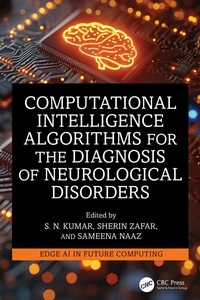
Computational Intelligence Algorithms for the Diagnosis of Neurological Disorders
Published on 6. August 2025
352 pages
978-1-040-39417-5 (ISBN)
Description

This book delves into the transformative potential of artificial intelligence (AI) and machine learning (ML) as game-changers in diagnosing and managing neurodisorder conditions. It covers a wide array of methodologies, algorithms, and applications in depth.
Computational Intelligence Algorithms for the Diagnosis of Neurological Disorders equips readers with a comprehensive understanding of how computational intelligence empowers healthcare professionals in the fight against neurodisorders. Through practical examples and clear explanations, it explores the diverse applications of these technologies, showcasing their ability to analyze complex medical data, identify subtle patterns, and contribute to the development of more accurate and efficient diagnostic tools. The authors delve into the exciting possibilities of AI-powered algorithms, exploring their ability to analyze various data sources like neuroimaging scans, genetic information, and cognitive assessments. They also examine the realm of ML for pattern recognition, enabling the identification of early disease markers and facilitating timely intervention. Finally, the authors also address the critical challenges of data privacy and security, emphasizing the need for robust ethical frameworks to safeguard sensitive patient information.
This book aims to spark a conversation and foster collaboration among researchers, clinicians, and technologists, and will assist radiologists and neurologists in making precise diagnoses with enhanced accuracy.
Computational Intelligence Algorithms for the Diagnosis of Neurological Disorders equips readers with a comprehensive understanding of how computational intelligence empowers healthcare professionals in the fight against neurodisorders. Through practical examples and clear explanations, it explores the diverse applications of these technologies, showcasing their ability to analyze complex medical data, identify subtle patterns, and contribute to the development of more accurate and efficient diagnostic tools. The authors delve into the exciting possibilities of AI-powered algorithms, exploring their ability to analyze various data sources like neuroimaging scans, genetic information, and cognitive assessments. They also examine the realm of ML for pattern recognition, enabling the identification of early disease markers and facilitating timely intervention. Finally, the authors also address the critical challenges of data privacy and security, emphasizing the need for robust ethical frameworks to safeguard sensitive patient information.
This book aims to spark a conversation and foster collaboration among researchers, clinicians, and technologists, and will assist radiologists and neurologists in making precise diagnoses with enhanced accuracy.
More details
Series
Language
English
Place of publication
London
United Kingdom
Publishing group
Taylor & Francis Ltd
Target group
College/higher education
Professional and scholarly
Illustrations
32 Tables, black and white; 105 Line drawings, black and white; 15 Halftones, black and white; 120 Illustrations, black and white
File size
15,30 MB
ISBN-13
978-1-040-39417-5 (9781040394175)
Copyright in bibliographic data and cover images is held by Nielsen Book Services Limited or by the publishers or by their respective licensors: all rights reserved.
Schweitzer Classification
Other editions
Additional editions
S. N. Kumar | Sherin Zafar | Sameena Naaz
Computational Intelligence Algorithms for the Diagnosis of Neurological Disorders
Book
08/2025
1st Edition
CRC Press
€177.80
Shipment within 10-20 days
Persons
S. N. Kumar received his B.E. degree from the Department of Electrical and Electronics Engineering, Sun College of Engineering and Technology, in 2007, his M.E. degree in applied electronics from the Anna University of Technology, Tirunelveli, and his Ph.D. degree from the Sathyabama Institute of Science and Technology in 2019. He is currently an Associate Professor with the Department of Electrical and Electronics Engineering, Amal Jyothi College of Engineering, Kanjirappally, and his research areas include medical image processing and embedded systems.
Sherin Zafar is an Assistant Professor of Computer Science and Engineering at the School of Engineering Sciences and Technology, Jamia Hamdard University, with a decade of successful experience in teaching and research management. She specializes in wireless networks, soft computing, and network security.
Sameena Naaz is a Senior Lecturer at the Department of Computer Science, School of Arts, Humanities and Social Sciences at the University of Roehampton, London, UK, with more than 22 years of experience. She received her M.Tech. degree in Electronics with Specialization in Communication and Information Systems from Aligarh Muslim University in 2000 and completed her Ph.D. from Jamia Hamdard in the field of distributed systems in 2014. Her research interests include distributed systems, cloud computing, big data, machine learning, data mining, and image processing.
Sherin Zafar is an Assistant Professor of Computer Science and Engineering at the School of Engineering Sciences and Technology, Jamia Hamdard University, with a decade of successful experience in teaching and research management. She specializes in wireless networks, soft computing, and network security.
Sameena Naaz is a Senior Lecturer at the Department of Computer Science, School of Arts, Humanities and Social Sciences at the University of Roehampton, London, UK, with more than 22 years of experience. She received her M.Tech. degree in Electronics with Specialization in Communication and Information Systems from Aligarh Muslim University in 2000 and completed her Ph.D. from Jamia Hamdard in the field of distributed systems in 2014. Her research interests include distributed systems, cloud computing, big data, machine learning, data mining, and image processing.
Content
PART A: Introduction and Challenges Chapter 1 Introduction to Neurological Disorders Chapter 2 Navigating the Complexities of the Brain Challenges and Opportunities in Computational Neurology Chapter 3 Challenges and Opportunities in Computational Neurology Chapter 4 Ethical Issues in Neurodisorder Diagnosis Chapter 5 Ethical Issues in Neurodisorder Diagnosis: Computational Intelligence towards Compassionate Psychiatric Treatment Part-B: Neuroimaging and Diagnostic Techniques Chapter 6 Improving Magnetic Resonance Imaging (MRI) for Better Understanding of Neurological Disorders Chapter 7 Advancements in Neuroimaging technique in Encephalopathy Chapter 8 Targeted Drug Delivery for Neurological Disorders Chapter 9 Intelligent Deep Learning Algorithms for Autism Spectrum Disorder Diagnosis Chapter 10 Advanced Neuroimaging with Generative Adversarial Networks Chapter 11 Machine Learning Strategy with Decision Trees for Parkinson's Detection by Analyzing the Energy of the Acoustic Data Chapter 12 Adaptive Convolution Neural Network-based Brain Tumor Detection from MR Images Chapter 13 STN-DRN: Integrating Spatial Transformer Network with Deep Residual Network for Multiclass Classification of Alzheimer's Disease Part C: Machine Learning & AI Applications in Neurological Disorders Chapter 14 Evaluation of Supervised Learning Algorithms in Detection of Neurodisorders: A Focus on Parkinson's Disease Chapter 15 Comparative Analysis of Supervised and Unsupervised Learning Algorithms in the Detection of Alzheimer's disease Chapter 16 Deep Learning Techniques in Neurological Disorder Detection Chapter 17 From Data to Diagnosis: Supervised Learning's Impact on Neuro-disorder detection, with a focus on Autism Spectrum Disorder Chapter 18 Parkinson's Disease Detection from Drawing Images using Deep Pretrained Models Chapter 19 Optimizing Digital Healthcare for Alzheimer's: A Deep Federated Learning Convolutional Neural Network Scheme (DFLCNNS) Chapter 20 Artificial Intelligence: A Game-Changer in Parkinson's Disease Neurorehabilitation Chapter 21 Targeting Upper Limb Sensory Gaps: New Rehab Insights for Chronic Neck Pain
