

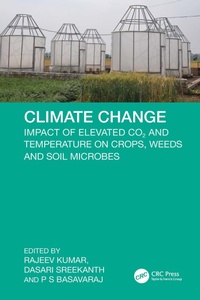
Climate Change
Impact of Elevated CO2 and Temperature on Crops, Weeds and Soil Microbes
1st Edition
Published on 30. September 2025
284 pages
978-1-040-42998-3 (ISBN)
Description

Climate Change: Impact of Elevated CO2 and Temperature on Crops, Weeds and Soil Microbes is a comprehensive and timely volume that explores the profound effects of climate change, specifically elevated CO2 and temperature on plant physiology, crop productivity, weed dynamics, and soil microbial interactions. The primary objective of this book is to provide a detailed and up-to-date overview of the physiological, biochemical, and molecular mechanisms governing crop responses to elevated CO2 and temperature. It also examines the impact on weeds and soil microbial communities, highlighting potential adaptation and mitigation strategies for sustainable agriculture. Readers will gain valuable insights into the latest methodologies and scientific advancements in this field.
This volume offers in-depth coverage of key topics, including:
Impact of elevated CO2 and temperature on the physiology, yield, and quality of major crops
Responses of cereals, pulses, oilseeds, and vegetables to elevated CO2 and temperature
Nutritional and quality changes in food crops under climate change scenarios
Growth dynamics and physiological responses of weeds under elevated CO2 and temperature
Role of soil microbes in plant health and ecosystem stability in changing climates
Influence of elevated CO2 and temperature on key metabolic pathways, including photosynthesis, transpiration, redox metabolism, carbon metabolism, and nitrogen metabolism
Adaptive mechanisms in crops, including osmo-protectant accumulation, phytohormonal regulation, and mitigation strategies for climate resilience
As a significant contribution to climate change and plant science research, this book serves as an essential resource for plant physiologists, agronomists, environmental scientists, soil microbiologists, geneticists, and students. It is a valuable reference for researchers and professionals working on climate adaptation strategies in agriculture and can also be used in coursework for graduate and postgraduate studies.
This volume offers in-depth coverage of key topics, including:
Impact of elevated CO2 and temperature on the physiology, yield, and quality of major crops
Responses of cereals, pulses, oilseeds, and vegetables to elevated CO2 and temperature
Nutritional and quality changes in food crops under climate change scenarios
Growth dynamics and physiological responses of weeds under elevated CO2 and temperature
Role of soil microbes in plant health and ecosystem stability in changing climates
Influence of elevated CO2 and temperature on key metabolic pathways, including photosynthesis, transpiration, redox metabolism, carbon metabolism, and nitrogen metabolism
Adaptive mechanisms in crops, including osmo-protectant accumulation, phytohormonal regulation, and mitigation strategies for climate resilience
As a significant contribution to climate change and plant science research, this book serves as an essential resource for plant physiologists, agronomists, environmental scientists, soil microbiologists, geneticists, and students. It is a valuable reference for researchers and professionals working on climate adaptation strategies in agriculture and can also be used in coursework for graduate and postgraduate studies.
More details
Language
English
Place of publication
London
United Kingdom
Publishing group
Taylor & Francis Ltd
Target group
College/higher education
Professional and scholarly
Illustrations
23 Tables, black and white; 15 Line drawings, black and white; 5 Halftones, black and white; 20 Illustrations, black and white
File size
14,24 MB
ISBN-13
978-1-040-42998-3 (9781040429983)
Copyright in bibliographic data and cover images is held by Nielsen Book Services Limited or by the publishers or by their respective licensors: all rights reserved.
Schweitzer Classification
Other editions
New editions
E-Book
11/2013
2nd Edition
Routledge
€52.49
Available for download
Additional editions
Rajeev Kumar | Dasari Sreekanth | P.S. Basavaraj
Climate Change
Impact of Elevated CO2 and Temperature on Crops, Weeds and Soil Microbes
Book
09/2025
1st Edition
CRC Press
€166.20
Shipment within 10-20 days
Persons
Rajeev Kumar is presently working as a Scientist at ICAR-Indian Institute of Vegetable Research, Varanasi, Uttar Pradesh, India. He completed his M.Sc. and Ph.D. in Plant Physiology in 2015 and 2021, respectively from ICAR-Indian Agricultural Research Institute, New Delhi. India. His research interests are phenotyping of vegetables (tomato, okra, Indian bean, cowpea, pea, French Bean and cucurbits etc.) for abiotic stresses like drought, high temperature and salinity. Moreover, he also has expertise in post-harvest physiology and image-based phenotyping. His findings have been published in various national and international peer-reviewed journals. He is the recipient of awards like young scientist award and best oral/poster awards of different scientific professional societies.
Dasari Sreekanth is working as a Scientist (Plant Physiology) at ICAR- Directorate of Weed Research, Jabalpur, Madhya Pradesh. He is an expert worker in the area of climate change such as the impact of elevated CO2, temperature and drought stress on crop-weed interaction and herbicide efficacy in various major crops like rice, wheat and green gram. Moreover, he is also working on the aspect of the effect of biotic stress such as weeds on crop physiological, biochemical and molecular responses. His findings have been published in various international peer-reviewed journals. He has published several research papers/reviews articles in national/international peer reviewed journals, books, and book chapters, technical bulletins, edited Institute publications like newsletters and annual reports. He is the recipient of Awards like best scientist award, best oral/poster awards of different scientific professional societies.
P.S. Basavaraj is working as a Scientist (Genetics and Plant Breeding) at ICAR- National Institute of Abiotic Stress Management, Baramati, Maharashtra. He has a specialization in physiological breeding for abiotic stress tolerance in field crops, particularly grain legumes for drought, high temperature, and water logging stresses. Currently, his research interests are in pre-breeding for genetic enhancement of abiotic stress tolerance in grain legumes and trait discovery to integrate into breeding programs for abiotic stress tolerance. His findings have been published in various national and international peer-reviewed journals. He is the recipient of awards including the young scientist award and best oral/poster awards from different scientific professional societies.
Dasari Sreekanth is working as a Scientist (Plant Physiology) at ICAR- Directorate of Weed Research, Jabalpur, Madhya Pradesh. He is an expert worker in the area of climate change such as the impact of elevated CO2, temperature and drought stress on crop-weed interaction and herbicide efficacy in various major crops like rice, wheat and green gram. Moreover, he is also working on the aspect of the effect of biotic stress such as weeds on crop physiological, biochemical and molecular responses. His findings have been published in various international peer-reviewed journals. He has published several research papers/reviews articles in national/international peer reviewed journals, books, and book chapters, technical bulletins, edited Institute publications like newsletters and annual reports. He is the recipient of Awards like best scientist award, best oral/poster awards of different scientific professional societies.
P.S. Basavaraj is working as a Scientist (Genetics and Plant Breeding) at ICAR- National Institute of Abiotic Stress Management, Baramati, Maharashtra. He has a specialization in physiological breeding for abiotic stress tolerance in field crops, particularly grain legumes for drought, high temperature, and water logging stresses. Currently, his research interests are in pre-breeding for genetic enhancement of abiotic stress tolerance in grain legumes and trait discovery to integrate into breeding programs for abiotic stress tolerance. His findings have been published in various national and international peer-reviewed journals. He is the recipient of awards including the young scientist award and best oral/poster awards from different scientific professional societies.
Content
1. Elevated CO2 and Temperature: As Agents of Climate Change and Their Impacts on Crop Production 2. Elevated Carbon Dioxide and Temperature Influence on Physiology and Yield of Cereal Crops 3. Responses of Pulse crops to Elevated CO2 and Temperature: Physiological, Biochemical, and Yield Impacts 4. Impact of Elevated CO2 and Temperature on Physiology and Yield of Vegetable Crops 5. The Nutrient Nexus: Impacts of Elevated CO2 and Temperature on the Nutritional and Quality Attributes of Cereals, Pulses, and Vegetables 6. Impact of Elevated CO2 and Temperature on Physiology and Yield of Oilseed Crops 7. Impacts of Elevated Carbon Dioxide and Temperature on Weed Growth and Physiological Responses 8. Role of Soil Microbes in Plant Health Management Under Elevated CO2 and Temperature 9. Impact of Elevated CO2 and Temperature on Photosynthesis and Allied Traits 10. Impact of Elevated CO2 and Temperature on Transpiration 11. Impact of Elevated CO2 and Temperature on Plant Redox Metabolism 12. Impact of Elevated CO2 and Temperature on Carbon Metabolism 13. Impact of Elevated CO2 and Temperature on Nitrogen Metabolism 14. Role of Osmoprotectants on Alleviation of Elevated CO2 and Temperature Stress 15. Role of Phytohormones in Crop Responses Under Elevated CO2 and Temperature 16. Adaptations and Mitigation Strategies to Combat the Impact of Elevated CO2 and Temperature on Major Field Crops
