

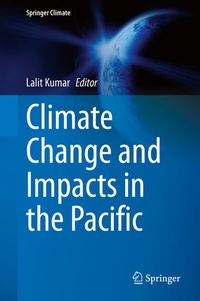
Climate Change and Impacts in the Pacific
Description

This edited volume addresses the impacts of climate change on Pacific islands, and presents databases and indexes for assessing and adapting to island vulnerabilities. By analyzing susceptibility variables, developing comprehensive vulnerability indexes, and applying GIS techniques, the book's authors demonstrate the particular issues presented by climate change in the islands of the Pacific region, and how these issues may be managed to preserve and improve biodiversity and human livelihoods.
The book first introduces the issues specific to island communities, such as high emissions impacts, and discusses the importance of the lithological traits of Pacific islands and how these physical factors relate to climate change impacts. From here, the book aims to analyze the various vulnerabilities of different island sectors, and to formulate a susceptibility index from these variables to be used by government and planning agencies for relief prioritization. Such variables include tropical cyclones, built infrastructures, proximity to coastal areas, agriculture, fisheries and marine resources, groundwater availability, biodiversity, and economic impacts on industries such as tourism. Through the categorization and indexing of these variables, human and physical adaptation measures are proposed, and support solutions are offered to aid the inhabitants of affected island countries. This book is intended for policy makers, academics, and climate change researchers, particularly those dealing with climate change impacts on small islands.More details
Other editions
Additional editions
Person
Dr. Lalit Kumar is a Professor in the School of Environmental and Rural Science at the University of New England, NSW, Australia. He received his PhD in GIS/remote sensing at the University of New South Wales in 1998, has authored or co-authored 20 books or book chapters, and has published over 220 scientific papers in reputable journals. Additionally, he is an editor on a number international journals, such as Remote Sensing; ISPRS Journal of Photogrammetry and Remote Sensing; Geomatics, Natural Hazards and Risk; PLoS ONE; Sustainability; and Remote Sensing Applications: Society and Environment. At UNE he teaches courses in GIS, remote sensing and image analysis, and spatial analysis and modeling. His research interests include the applications of spatial technologies, environmental modeling, ecological remote sensing, and climate change impacts on small island states in the Pacific and the Himalayas.
Content
Chapter1. Climate Change and the Pacific Islands.- Chapter2. Islands in the Pacific - settings, distribution, classification.- Chapter3 Climate Change Scenarios and Projections for the Pacific.-Chapter4. Comparison of the physical susceptibility of Pacific Islands to risks potentially associated with variability in weather and climate.- Chapter5 Downscaling from Whole Island to an island-coast assessment of coastal landform susceptibility to metocean change in the pacific.- Chapter6. A review of South Pacific tropical cyclones: Impacts of natural climate variability and climate change.- Chapter7. Impacts of Climate Change on Coastal Infrastructure in the Pacific.- Chapter 8 Population distribution in the Pacific islands, proximity to coastal areas, and risks.- Chapter9. Agriculture under a changing climate.- Chapter10. Impacts of climate change on marine resources in the Pacific Island region.- Chapter11. Freshwater availability under climate change.- Chapter12. Climate change and impacts on biodiversity on small islands.- Chapter13. Economic impacts and implications of climate change in the Pacific.- Chapter14. Adaptation to climate change: contemporary challenges and perspectives.
