

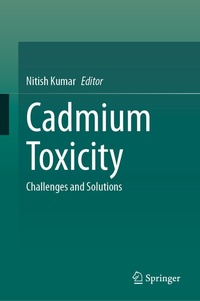
Cadmium Toxicity
Description

This book offers a comprehensive collection of review and case chapters that cover cadmium toxicity and remediation. It covers sources of cadmium contamination, its impact on human health, and prospective remediation strategies, taking a multi-disciplinary approach a focus on application of recent advanced biological technology. The chapters here bring together a diverse group of environmental science, sustainability and health researchers to address the challenges caused by cadmium contamination, explaining the routes of exposure to environmental cadmium, how cadmium is transported in ecosystems, and the health risks linked to cadmium exposure in food and the environment.
This book contains two sections. The first section describes the different sources and distribution of cadmium in soil and plant ecosystems. The second section addresses sustainable cadmium toxicity mitigation strategies and potential applications of recent biological technology. This book is a valuable resource to students, academics, researchers, and environmental professionals studying cadmium contamination throughout the world.
More details
Other editions
Additional editions
Person
Nitish Kumar is Senior Assistant Professor at the Department of Biotechnology, Central University of South Bihar, Gaya, Bihar, India. Dr. Kumar completed his doctoral research at the Council of Scientific & Industrial Research-Central Salt & Marine Chemicals Research Institute, Bhavnagar, Gujarat, India. He has more than 14 years of research and teaching experience in the field of plant and microbial biotechnology, and heavy metal bioremediation. He has published more than 70 research articles in leading international and national journals, more than 20 book chapters and 10 books. Dr. Kumar is a recipient of the Young Scientist Award from the Science and Engineering Research Board (SERB) in 2014. He has received many awards/fellowships/projects from various organizations, for example, the CSIR, DBT, ICAR and SERB-DST, BRNS-BARC, among others. He is an active reviewer for journals, including Biotechnology Reports, Aquatic Botany, Industrial Crops and Products, PLoS One, Plant Biochemistry and Biotechnology, and 3Biotech. He also serves as an associate editor of the journal Gene (Elsevier). He has H-Index 23 and i10-Index 38 as per Google scholar database 2024.
Content
1 Cadmium Toxicity in the Environment.- 2 Sources and Spatial Distribution of Cadmium in the Environment.- 3 Dynamics of Changes in Cadmium Levels in the Environment.- 4 Cadmium Contamination.- 5 Role of Biotechnology in Remediation of Cadmium from Contaminated Site.- 6 Nanocomposites.- 7 Discovering Sustainable Bio-sorbents for Efficient Cadmium Remediation.- 8 Phytoremediation of Cadmium Toxicity in Water and Soil.- 9 Microbial Interventions in Bioremediation of Cadmium from Contaminated Site.- 10 Biochar-based Adsorptive Materials for the Efficient Immobilisation of Cadmium in Contaminated Soils.- 11 Potential Biological Approaches of Cadmium Removal.- 12 Environmental Cadmium Toxicity and its Bioremediation.- 13 Microbial Transformations of Cadmium.- 14 Toxicity of Rhizospheric Cadmium Contaminated Soil and its Remediation.- 15 Genetic Engineering for Cadmium Removal from Wastewater.
