

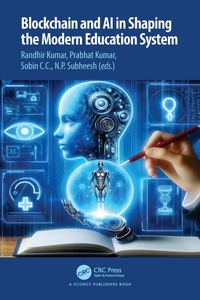
Blockchain and AI in Shaping the Modern Education System
Published on 21. May 2025
284 pages
978-1-040-40717-2 (ISBN)
Description

In today's rapidly evolving digital landscape, blockchain and artificial intelligence (AI) are at the forefront of transforming various industries, and education is no exception. The convergence of these two revolutionary technologies promises to reshape the modern education system by enhancing data security, promoting personalized learning, and creating decentralized frameworks for record-keeping and credentialing. This book delves into how blockchain and AI can drive a more inclusive, efficient, and secure educational ecosystem, where student-centered approaches and data integrity are paramount.
This book is organized into several sections, each exploring the distinct roles of blockchain and AI within education. It begins with an introduction to the fundamental principles of these technologies and an overview of their individual strengths. Following this, chapters examine blockchain's role in secure credential verification, decentralized learning platforms, and the protection of digital records. Next, the discussion shifts to AI applications, covering adaptive learning models, predictive analytics, and AI-driven administrative support. Finally, the book provides real-world case studies and future projections on how blockchain and AI together can tackle challenges in education, such as data privacy, resource distribution, and student engagement, ultimately creating an interconnected and resilient educational framework.
This book is designed for educators, administrators, policymakers, technology enthusiasts, and researchers who are interested in the transformative potential of emerging technologies in education. It serves as a comprehensive guide for those looking to understand the practical applications and implications of blockchain and AI in the modern education system.
This book is organized into several sections, each exploring the distinct roles of blockchain and AI within education. It begins with an introduction to the fundamental principles of these technologies and an overview of their individual strengths. Following this, chapters examine blockchain's role in secure credential verification, decentralized learning platforms, and the protection of digital records. Next, the discussion shifts to AI applications, covering adaptive learning models, predictive analytics, and AI-driven administrative support. Finally, the book provides real-world case studies and future projections on how blockchain and AI together can tackle challenges in education, such as data privacy, resource distribution, and student engagement, ultimately creating an interconnected and resilient educational framework.
This book is designed for educators, administrators, policymakers, technology enthusiasts, and researchers who are interested in the transformative potential of emerging technologies in education. It serves as a comprehensive guide for those looking to understand the practical applications and implications of blockchain and AI in the modern education system.
More details
Language
English
Place of publication
London
United Kingdom
Publishing group
Taylor & Francis Ltd
Target group
College/higher education
Professional and scholarly
Illustrations
10 Tables, black and white; 10 Line drawings, color; 37 Line drawings, black and white; 10 Illustrations, color; 37 Illustrations, black and white
File size
13,50 MB
ISBN-13
978-1-040-40717-2 (9781040407172)
Copyright in bibliographic data and cover images is held by Nielsen Book Services Limited or by the publishers or by their respective licensors: all rights reserved.
Schweitzer Classification
Other editions
Additional editions
Randhir Kumar | Prabhat Kumar | Sobin C.C.
Blockchain and AI in Shaping the Modern Education System
Book
05/2025
1st Edition
CRC Press
€229.10
Shipment within 10-20 days
Persons
Randhir Kumar has a Ph.D. from the Department of Information Technology, NIT Raipur, India. He completed his Postdoctoral from Department of Electrical Engineering, IIT Hyderabad, and is now an Assistant Professor, Department of Computer Science and Engineering, SRM University, AP, India. He has 7 years of teaching and 4 years of research experience. He has published his research articles in leading journal and conferences. His paper has been published in some of the high impact factor journals such as - IEEE Internet of Things, IEEE Transactions on Intelligent Transportation Systems, IEEE Transactions on Network Science and Engineering, IEEE Transactions on Green Communications and Networking, IEEE Transactions on Industrial Informatics, IEEE Intelligent Systems, IEEE Consumer Electronics Magazine, IEEE COMSNETs, IEEE ICC, MobiCom, GlobeCom, Computer Networks, JPDC, and Transactions on Emerging Telecommunications Technologies. His paper was recognized as most cited paper of year 2020-2021 in Transactions on Emerging Telecommunications Technologies. He received best paper presentation award in one of the reputed conferences i.e., GLOBECOM in the year 2022. He has qualified UGC-NET in the year of 2018. He has been awarded as Best Engineer Trainee by Honeywell Technology, India in the year 2009. He is an active reviewer of many of the reputed journals like IEEE TDSC, IEEE TGCN, IEEE TNSM, IEEE TII, IEEE Access, Journal of Super Computing, Journal of Ambient Intelligent and Humanized Computing, and International Journal of Information Security and Privacy, IGI global. His research interest includes Cryptographic Techniques, Information Security, Blockchain Technology, Digital Twin and Services, Machine Learning, and Web Mining. He is also a member of IEEE, IAENG.
Prabhat Kumar has a Ph.D. in Information Technology, NIT, Raipur, India, under the prestigious fellowship of Ministry of Human Resource and Development (MHRD) funded by the Government of India in 2022. Thereafter, he worked with Indian Institute of Technology Hyderabad, India, as a Postdoctoral Researcher under project "Development of Indian Telecommunication Security Assurance Requirements for IoT devices". He is currently working as Postdoctoral Researcher with the Department of Software Engineering, LUT School of Engineering Science, LUT University, Lappeenranta, Finland. He has several contributions in the area of Machine Learning, Deep Learning, Federated Learning, Big Data Analytics, Cybersecurity, Blockchain, Cloud Computing, Internet of Things, Digital Twin and Software Defined Networking. He has authored or co-authored over 28+ top-tier journal/conference articles, including 13+ IEEE TRANSACTIONS/Magazine papers. One of his Ph.D. publications was recognized as a top cited article by WILEY in 2020-21. Some of his research findings are published in top cited journals and conferences, such as IEEE TII, IEEE TITS, IEEE TNSE, IEEE TGCN, IEEE IoT-J, IEEE Intelligent Systems, IEEE Consumer Electronics Magazine, IEEE MICRO, JSA (Elsevier), ComCom (Elsevier), Comnet (Elsevier), JPDC (Elsevier), ICDCN, IEEE ICC, ACM MobiCom and IEEE GLOBECOM. He is an Expert Evaluator of top scientific journals and conferences, including IEEE TII, IEEE TITS, IEEE TNSE, IEEE TGCN, IEEE JBHI, IEEE IoTJ, IEEE Network Magazine, IEEE IoT Magazine, IEEE Access, ACM TALLIP, ComCom and IEEE ICC. He is also an IEEE Member.
Sobin C.C. has vast expertise in studies of "Delay Tolerant Networks (DTNs)", "Wireless Networks", and "Internet of Things (IoT)". Dr Sobin's M. Tech and PhD research from premier institutes in India, such as IIT Madras and IIT Roorkee enabled him to acquire in-depth knowledge in developing routing protocols for DTNs and designing IoT-based applications. Also, well-versed in building IoT applications over DTN in case of limited Internet connectivity. PI published articles relevant to his area of expertise in leading reputed journals in the specified field (Journal of Network and Computer Applications, Wireless Personal Communications, International Journal of Communication Systems, etc.).
N. P. Subheesh is the Chairperson, Educational Activities of IEEE Education Society, Kerala, India. He received his bachelor's degree in applied electronics and instrumentation engineering from the University of Calicut, India, in 2004, and master's degree in media and sound engineering from Indian Institute of Technology Kharagpur, in 2013. He is currently completing his PhD degree in Engineering Education at the Indian Institute of Technology Madras, Chennai. He has authored or co-authored more than ten articles in peer-reviewed journals and international conferences. His research interests focus on Information and Communication Technology (ICT) in education, Technology-Enhanced Learning (TEL), Artificial Intelligence and Machine Learning (AI & ML) techniques in education, Engineering Education Research (EER), and assessment and evaluation in higher education. He is a member of the IEEE, IEEE Education Society, and the Portuguese Society for Engineering Education (SPEE).
Prabhat Kumar has a Ph.D. in Information Technology, NIT, Raipur, India, under the prestigious fellowship of Ministry of Human Resource and Development (MHRD) funded by the Government of India in 2022. Thereafter, he worked with Indian Institute of Technology Hyderabad, India, as a Postdoctoral Researcher under project "Development of Indian Telecommunication Security Assurance Requirements for IoT devices". He is currently working as Postdoctoral Researcher with the Department of Software Engineering, LUT School of Engineering Science, LUT University, Lappeenranta, Finland. He has several contributions in the area of Machine Learning, Deep Learning, Federated Learning, Big Data Analytics, Cybersecurity, Blockchain, Cloud Computing, Internet of Things, Digital Twin and Software Defined Networking. He has authored or co-authored over 28+ top-tier journal/conference articles, including 13+ IEEE TRANSACTIONS/Magazine papers. One of his Ph.D. publications was recognized as a top cited article by WILEY in 2020-21. Some of his research findings are published in top cited journals and conferences, such as IEEE TII, IEEE TITS, IEEE TNSE, IEEE TGCN, IEEE IoT-J, IEEE Intelligent Systems, IEEE Consumer Electronics Magazine, IEEE MICRO, JSA (Elsevier), ComCom (Elsevier), Comnet (Elsevier), JPDC (Elsevier), ICDCN, IEEE ICC, ACM MobiCom and IEEE GLOBECOM. He is an Expert Evaluator of top scientific journals and conferences, including IEEE TII, IEEE TITS, IEEE TNSE, IEEE TGCN, IEEE JBHI, IEEE IoTJ, IEEE Network Magazine, IEEE IoT Magazine, IEEE Access, ACM TALLIP, ComCom and IEEE ICC. He is also an IEEE Member.
Sobin C.C. has vast expertise in studies of "Delay Tolerant Networks (DTNs)", "Wireless Networks", and "Internet of Things (IoT)". Dr Sobin's M. Tech and PhD research from premier institutes in India, such as IIT Madras and IIT Roorkee enabled him to acquire in-depth knowledge in developing routing protocols for DTNs and designing IoT-based applications. Also, well-versed in building IoT applications over DTN in case of limited Internet connectivity. PI published articles relevant to his area of expertise in leading reputed journals in the specified field (Journal of Network and Computer Applications, Wireless Personal Communications, International Journal of Communication Systems, etc.).
N. P. Subheesh is the Chairperson, Educational Activities of IEEE Education Society, Kerala, India. He received his bachelor's degree in applied electronics and instrumentation engineering from the University of Calicut, India, in 2004, and master's degree in media and sound engineering from Indian Institute of Technology Kharagpur, in 2013. He is currently completing his PhD degree in Engineering Education at the Indian Institute of Technology Madras, Chennai. He has authored or co-authored more than ten articles in peer-reviewed journals and international conferences. His research interests focus on Information and Communication Technology (ICT) in education, Technology-Enhanced Learning (TEL), Artificial Intelligence and Machine Learning (AI & ML) techniques in education, Engineering Education Research (EER), and assessment and evaluation in higher education. He is a member of the IEEE, IEEE Education Society, and the Portuguese Society for Engineering Education (SPEE).
Content
Preface. Blockchain and AI in Shaping the Modern Education System. Blockchain and AI for Educational Data Analytics in the Modern Education System. Adaptive Learning in Modern Education Systems Leveraged by AI and Blockchain. Artificial Intelligence in Modern Education: Empowering Educators and Learners Beyond Automation. Need of AI in Modern Education: In the Eyes of Explainable AI (xAI). Deep Learning Approaches for Intelligent Cyber Threat Detection in Modern Education Systems. Federated Learning-Based Security Analytics Education System. Strengthening the Digital Skills of Finnish and Polish Students by Learning Low-code Tools for Intelligent Automation. Transformative Fusion: Leveraging Blockchain and AI for Educational Data Analytics in Modern Education Systems. Exploring the Awareness of Artificial Intelligence in Sustainable Higher Education. Artificial Intelligence Based Personalised Learning for Chemical Engineering Education. Modern Higher Education System with Blockchain-based Infrastructure Focusing on Improving the Efficacy of Financial Operations. Index
