

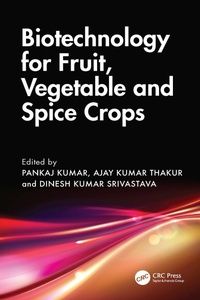
Biotechnology for Fruit, Vegetable and Spice Crops
1st Edition
Published on 21. August 2025
294 pages
978-1-040-41464-4 (ISBN)
Description

Biotechnology has revolutionized horticulture by enhancing the productivity, resilience and nutritional quality of fruit, vegetable and spice crops. This comprehensive volume provides an in-depth exploration of cutting-edge biotechnological advancements that are reshaping horticultural science. From genomics-driven crop improvement to the development of functional foods, this book presents a meticulously curated compilation of research and methodologies addressing key challenges and opportunities in modern horticulture. By integrating molecular techniques, plant-microbe interactions and bioprocess innovations, this book provides a unique perspective on sustainable and precision-driven horticultural practices.
Key Features
Insights into genomic approaches for understanding abiotic stress tolerance and developing climate-resilient varieties.
Advances in tissue culture, marker-assisted selection and genome editing for apple, grapevine and potato breeding.
Molecular and biocontrol strategies for tackling major threats, such as root rot disease in apples.
Applications of soilless cultivation techniques and plant growth-promoting rhizobacteria (PGPR) to optimize crop yield and quality.
Biotechnological tools for developing probiotic-enriched fruits and vegetables and the valorization of non-grape fruit wines.
With contributions from leading researchers, this book serves as an essential reference for graduate students, academics and professionals in plant biotechnology, horticulture and food science. It provides a valuable resource for those seeking to harness the power of biotechnology to drive sustainable innovation in horticultural crop production.
Key Features
Insights into genomic approaches for understanding abiotic stress tolerance and developing climate-resilient varieties.
Advances in tissue culture, marker-assisted selection and genome editing for apple, grapevine and potato breeding.
Molecular and biocontrol strategies for tackling major threats, such as root rot disease in apples.
Applications of soilless cultivation techniques and plant growth-promoting rhizobacteria (PGPR) to optimize crop yield and quality.
Biotechnological tools for developing probiotic-enriched fruits and vegetables and the valorization of non-grape fruit wines.
With contributions from leading researchers, this book serves as an essential reference for graduate students, academics and professionals in plant biotechnology, horticulture and food science. It provides a valuable resource for those seeking to harness the power of biotechnology to drive sustainable innovation in horticultural crop production.
More details
Edition
1. Auflage
Language
English
Place of publication
London
United Kingdom
Publishing group
Taylor & Francis Ltd
Target group
College/higher education
Professional and scholarly
Illustrations
18 Tables, black and white; 9 Halftones, black and white; 9 Illustrations, black and white
File size
2,17 MB
ISBN-13
978-1-040-41464-4 (9781040414644)
Copyright in bibliographic data and cover images is held by Nielsen Book Services Limited or by the publishers or by their respective licensors: all rights reserved.
Schweitzer Classification
Other editions
Additional editions
Pankaj Kumar | Ajay Kumar Thakur | Dinesh Kumar Srivastava
Biotechnology for Fruit, Vegetable and Spice Crops
Book
08/2025
1st Edition
CRC Press
€167.20
Shipment within 15-20 days
Persons
Pankaj Kumar currently serves as an Assistant Professor in Biotechnology at the Department of Biotechnology, Dr. Yashwant Singh Parmar University of Horticulture and Forestry in Solan, Himachal Pradesh, India. His academic journey includes post-doctoral studies at the National Institute of Plant Genome Research in New Delhi and the Council of Scientific & Industrial Research - Institute of Himalayan Bioresource Technology in Palampur, Himachal Pradesh. Dr. Kumar boasts 12 years of expertise in horticulture biotechnology, focusing on plant secondary metabolite enhancement through cell and tissue engineering approaches. His research encompasses the identification of molecular cues associated with enhanced metabolites using a comparative transcriptomics approach. Additionally, he possesses experience in hydro-aero cultivation of medicinal plants for industrial significance. His accolades include the DST INSPIRE JRF/SRF Fellowship, ICAR AICE-SRF (PGS) and ICAR ASRB National Eligibility Test (NET). Dr. Kumar has an extensive publication record with more than 100 research/review papers, book chapters and six books. He has also filed and published four Indian patents and registered four apple mutants with unique, early color and early maturity characteristics in the Indian National Germplasm Repository (INGR 20103, INGR 20104, INGR 20105 and INGR 20106). Recognized for his scientific contributions, Dr. Kumar has received numerous awards, including the Young Scientists Fellowship Award-2021 (ICMR, New Delhi), Scientist's Pool Scheme Award-2020 (CSIR, New Delhi) and the SERB-ACS-NPDF Best Poster Award-2022, etc.
Ajay Kumar Thakur is currently working as a Principal Scietist (Agri. Biotechnology) at ICAR-Central Potato Research Institute, Shimla, H.P. Presently, he is working on biotechnological interventions for potato improvement. He has obtained his graduation, PG and Doctoral degrees from Dr. Y.S. Parmar University of Horticulture and Forestry, Solan, H.P. He got induced into Agricultural Research Services (ARS) in 2008. He has published 72 research/review papers in various journals of international and national repute, authored one book "Agricultural Biotechnology at a Glance", edited three books and contributed eight book chapters and 23 popular articles. He has developed high-efficiency plant regeneration and genetic transformation protocols in a number of crops including Populus ciliata, P. deltoides, Punica granatum, Capsicum annum and Cucumis sativus. Dr. Thakur is associated with Brassica juncea improvement program using biotechnological interventions from last 14 years. He has developed a core set of SSR markers for B. juncea genomics and has worked on germplasm characterization and association mapping of various agronomically important traits in this oilseed crop. He has also been granted one patent from Indian Patent Office, New Delhi and associated in the development of two high yielding Indian mustard varieties Giriraj and Brajraj, one gobhi sarson variety, AKMS-8141 and five disease-resistant Indian mustard genetic stocks. Dr. Thakur has received many awards from various societies and scientific organizations for his scientific contribution. He is also an elected Member of the Plant Tissue Culture Association of India (PTCAI) and selected Member of the National Academy of Sciences-India (NASI), Allahabad.
Dinesh Kumar Srivastava has retired as Director Extension Education, prior to this he worked as Professor and Head in the Department of Biotechnology, Dr. Yashwant Singh Parmar University of Horticulture and Forestry, Solan, Himachal Pradesh, India. He did his post-doctoral studies in the field of Plant Molecular Biology at the Institute of Molecular Genetics, USSR Academy of Sciences, Moscow, USSR and at Washington University, St. Louis, USA. He has 32 years of research experience and 29 years of teaching experience in the field of Plant Biotechnology and Molecular Biology. He had guided 32 M/Sc. students and 9 Ph.D. students for their research work. He has published 110 research papers in journals of national and international repute and 38 research articles, contributed 12 chapters in edited books, and also authored a book on biotechnology. He has delivered 45 invited lectures and attended 47 national and international conferences. His main area of research includes plant tissue culture, genetic transformation and molecular characterization of plants. He is a life member of various national and international academic bodies/societies. He has received many awards for his scientific contributions, including the 'MS Swaminathan Award' from the Society of Plant Research, Meerut, India.
Ajay Kumar Thakur is currently working as a Principal Scietist (Agri. Biotechnology) at ICAR-Central Potato Research Institute, Shimla, H.P. Presently, he is working on biotechnological interventions for potato improvement. He has obtained his graduation, PG and Doctoral degrees from Dr. Y.S. Parmar University of Horticulture and Forestry, Solan, H.P. He got induced into Agricultural Research Services (ARS) in 2008. He has published 72 research/review papers in various journals of international and national repute, authored one book "Agricultural Biotechnology at a Glance", edited three books and contributed eight book chapters and 23 popular articles. He has developed high-efficiency plant regeneration and genetic transformation protocols in a number of crops including Populus ciliata, P. deltoides, Punica granatum, Capsicum annum and Cucumis sativus. Dr. Thakur is associated with Brassica juncea improvement program using biotechnological interventions from last 14 years. He has developed a core set of SSR markers for B. juncea genomics and has worked on germplasm characterization and association mapping of various agronomically important traits in this oilseed crop. He has also been granted one patent from Indian Patent Office, New Delhi and associated in the development of two high yielding Indian mustard varieties Giriraj and Brajraj, one gobhi sarson variety, AKMS-8141 and five disease-resistant Indian mustard genetic stocks. Dr. Thakur has received many awards from various societies and scientific organizations for his scientific contribution. He is also an elected Member of the Plant Tissue Culture Association of India (PTCAI) and selected Member of the National Academy of Sciences-India (NASI), Allahabad.
Dinesh Kumar Srivastava has retired as Director Extension Education, prior to this he worked as Professor and Head in the Department of Biotechnology, Dr. Yashwant Singh Parmar University of Horticulture and Forestry, Solan, Himachal Pradesh, India. He did his post-doctoral studies in the field of Plant Molecular Biology at the Institute of Molecular Genetics, USSR Academy of Sciences, Moscow, USSR and at Washington University, St. Louis, USA. He has 32 years of research experience and 29 years of teaching experience in the field of Plant Biotechnology and Molecular Biology. He had guided 32 M/Sc. students and 9 Ph.D. students for their research work. He has published 110 research papers in journals of national and international repute and 38 research articles, contributed 12 chapters in edited books, and also authored a book on biotechnology. He has delivered 45 invited lectures and attended 47 national and international conferences. His main area of research includes plant tissue culture, genetic transformation and molecular characterization of plants. He is a life member of various national and international academic bodies/societies. He has received many awards for his scientific contributions, including the 'MS Swaminathan Award' from the Society of Plant Research, Meerut, India.
Content
1 Genomic approaches in horticultural crop improvement 2 Apple breeding through biotechnological interventions 3 Comprehensive insight on root rot disease of apple 4 Biotechnology for grape improvement 5 Genetic diversity studies in potato (Solanum tuberosum L.) using various molecular markers 6 Soilless cultivation for the production of spice and essential oil-bearing plants 7 PGPR- Biotechnological interventions for improvement of crop plants 8 Plant growth promoting rhizobacteria for nutrient mobilization and enhancing yield and quality of vegetable crops 9 Probiotic Fruit and Vegetable Products: Biotechnological Tools for Functional Enrichment 10 Fruit wine from non-grape fruit
