

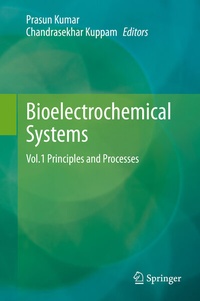
Bioelectrochemical Systems
Description

This book is the first in a two-volume set devoted to bioelectrochemical systems (BESs) and the opportunities that they may offer in providing a green solution to growing energy demands worldwide. In this first volume, established research professionals explain the underlying principles and processes of BESs, providing a thorough introduction to these systems before proceeding to address the roles of cathode catalysts and biocatalysts, biofilms, heterotrophic denitrification, and nanotechnology approaches. This volume forms a sound foundation for understanding the potential industrial applications of this technology, which include in particular the generation of high-value chemicals and energy using organic wastes. These applications are the focus of the second volume, where readers will find up-to-date information on microbial fuel cells and the use of microbial biofilm- and algae-based bioelectrochemical systems for bioremediation and co-generation of valuable chemicals. The bookis designed for a broad audience, including undergraduates, postgraduates, energy researchers/scientists, policymakers, and anyone else interested in the latest developments in this field.
More details
Other editions
Additional editions
Persons
Dr. K. Chandrasekhar
Dr. K. Chandrasekhar is a Ph.D. in Biological Science from the Academy of Scientific and Innovative Research (AcSIR), Indian Institute of Chemical Technology (CSIR-IICT), Hyderabad, Telangana, India. He has worked as a senior research fellow at CSIR-IICT. His main areas of research are bioenergy from waste biomass, microbial fuel cells, biohydrogen, and waste remediation technologies. He has published 23 papers in scientific journals such as (1) Bioresource Technology, (2) International Journal of Hydrogen Energy, (3) Renewable and Sustainable Energy Reviews, (4) Waste management, (5) Journal of Biotechnology, (6) International Journal of Molecular Sciences, (7) Journal of Hazardous Materials, (8) Energies, (9) Chemosphere, and (10) Critical Reviews in Biotechnology. He has authored 10 book chapters. His work has been cited 1140 times with an h index of 18 and an i10 index of 20. He is a life member of the following scientific societies (1) Life member - The Biotech Research Society of India (BRSI), (2) Senior membership in Asia- Pacific Chemical, Biological & Environmental Engineering Society (APCBEES), (3) Senior member in Institute of Research Engineers and Doctors, (4) Frontiers member. He is serving as a Review Editor in Bioenergy and Biofuels. Then as a guest faculty, Department of Engineering - University of Naples "Parthenope", Naples, Italy. He has also presented his work at several national and international conferences.Content
Part 1. The Principle of Bio-electrochemical Systems+61. Bio-electrochemical systems: Principles and Application.- 2. Bioelectrochemically assisted anaerobic digestion: Principles and Perspectives.- 3. An insight into Biological Photovoltaic Cell based Electrochemical System.- 4. Electro-fermentation technology: Emerging platform.- 5. Electrochemical losses and their role in power generation.- 6. Electricity-driven microbial factory for value-added resources recovery from waste streams.- Part 2. Catalysts controlling BES implementation.- 7. Effective cathode catalysts for O2 reduction.- 8. Role of Biocatalysts in Microbial Electrosynthesis for value-added product via CO2 sequestration.- 9. Biocatalysts in electro-fermentation systems: Mixed culture and pure cultures.- 10. Bacterial metabolism coupled energetic.- 11. Electrotrophs and Electricigens; Key players in Microbial Electrophysiology.- 12. Biofilms: Engineering approaches to enhance process efficiency.- 13. The enhanced mechanism of heterotrophic denitrification in bioelectrochemical system.- 14. Nanotechnology approaches: Tunable electrode surfaces for bioelectrocatalytic conversion of greenhouse gases into valuable products.
