

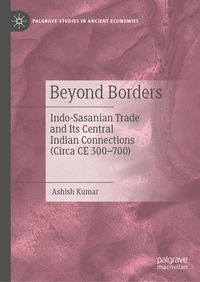
Beyond Borders
Description

This book examines the economic history of ancient South Asia by situating the Malwa region of Central India within Afro-Eurasian trade networks to illuminate the role of traders in the political, religious and economic processes connected with the Indo-Sasanian trade in the period of five centuries, circa CE 300-700.
The book challenges the long-held centrality of the Roman factor in the South Asian economy by locating the Indo-Sasanian interactions in long distance economic networks with trade as a central feature. It considers the role and influence of traders as an understudied group affecting the contribution of the Indian economy to the world system. Amidst rapidly changing political landscapes, traders of Indian and Sasanian origins are studied as conscious political beings, who formed ties with varieties of polities and religious communities to secure their commercial interests. In addition, their commercial interactions with their Sogdian (Central Asia) and Aksumite (East Africa) counterparts are analyzed. The book also considers the nature of trade routes and the specific connections between mercantile and religious networks, including patterns of construction of religious shrines and temples along trade routes. Integrating epigraphic, numismatic, literary and archaeological evidence, this book moves away from a marginal treatment of the Indo-Sasanian trade in Indian history, and demonstrates how regional economic history must address a plurality of causes, actors, and processes in its assessment of the regional economy. The book will be of interest to students and academics of Indian economic history, as well as the ancient economies of South Asia more broadly.
More details
Other editions
Additional editions
Person
Ashish Kumar is Assistant Professor in the Department of History, Panjab University, Chandigarh (India). His area of specialization is ancient and early medieval history of India with a special interest in the history of political processes and connected economic and religious developments.
Content
Chapter 1. Introduction: A step away from the long shadow of colonial Europe .- Chapter 2.The Wider World of Indo-Sasanian Interactions.- Chapter 3. Trade Networks, Metallic Currency, and the Huns in Early India.- Chapter 4. The Commodities, the Producers and the Consumers: Defining Markets.- Chapter 5. Christian and Sogdian Traders, and the Indo-Sasanian Trade.- Chapter 6. Trade Routes, Traders and the Making of the Sacred Landscapes.- Chapter 7. India's Ancient Economy: How does this book differ from available writings? .- Chapter 8. Conclusion: Theorizing the Indo-Sasanian Trade.
