

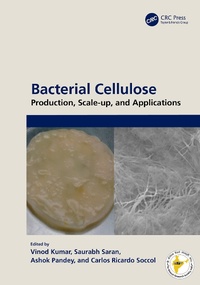
Bacterial Cellulose
Production, Scale-up, and Applications
1st Edition
Published on 27. December 2023
185 pages
978-1-003-81407-8 (ISBN)
Description

This reference book provides updated information on the production and industrial significance of bacterial cellulose. Bacterial cellulose is a natural fiber produced by certain microbes, mainly bacteria which belong to the Acetobacter genera. The book discusses its applications in different industrial sectors, such as food, pharmaceutical, energy, and wastewater treatment. It covers the production of cellulose from conventional and renewable feedstock and includes topics such as downstream processing, characterization, and chemical modification of bacterial cellulose.
FEATURES:
Addresses the challenges of the production technologies of bacterial cellulose up to pilot scale
Discusses cost-effective green processes using agri-processing residues and medium formulation
Includes efficient preparation of nanocomposites using in vitro and in vivo methods
Provides the latest applications of bacterial cellulose in the food and pharmaceuticals fields
Reviews the production of bacterial cellulose from conventional feedstock such as sugars and starches
This book is designed for industry experts and researchers of applied microbiology, bioprocesses, and industrial microbiology.
FEATURES:
Addresses the challenges of the production technologies of bacterial cellulose up to pilot scale
Discusses cost-effective green processes using agri-processing residues and medium formulation
Includes efficient preparation of nanocomposites using in vitro and in vivo methods
Provides the latest applications of bacterial cellulose in the food and pharmaceuticals fields
Reviews the production of bacterial cellulose from conventional feedstock such as sugars and starches
This book is designed for industry experts and researchers of applied microbiology, bioprocesses, and industrial microbiology.
More details
Series
Edition
1. Auflage
Language
English
Place of publication
London
United Kingdom
Publishing group
Taylor & Francis Ebooks
Target group
College/higher education
Professional and scholarly
Illustrations
19 Tables, black and white; 15 Line drawings, black and white; 7 Halftones, black and white; 22 Illustrations, black and white
ISBN-13
978-1-003-81407-8 (9781003814078)
Copyright in bibliographic data and cover images is held by Nielsen Book Services Limited or by the publishers or by their respective licensors: all rights reserved.
Schweitzer Classification
Other editions
Additional editions
Vinod Kumar | Saurabh Saran | Ashok Pandey
Bacterial Cellulose
Production, Scale-up, and Applications
Book
12/2023
1st Edition
CRC Press
€230.20
Shipment within 10-20 days
Persons
Vinod Kumar, PhD, is a Scientist at the Fermentation and Microbial Biotechnology Division, CSIR-Indian Institute of Integrative Medicine, Jammu, India. He earned a PhD at the University of Delhi. Dr. Kumar was awarded the EPFL Visiting Fellowship in 2016.
Saurabh Saran, PhD, is a Principal Scientist at the CSIR-Indian Institute of Integrative Medicine, Jammu, India. He earned a PhD at Delhi University, India. He works on strain engineering, strain development, biotransformation using CYP 450, upstream and downstream processing of different fermentation processes, and applications of these molecules in various industries.
Ashok Pandey, PhD, is currently a Distinguished Scientist at the Centre for Innovation and Translational Research, CSIR-Indian Institute of Toxicology Research, Lucknow, India, and Executive Director (Honorary) at the Centre for Energy and Environmental Sustainability, India. His major research and technological development interests include industrial and environmental biotechnology, energy biosciences, focusing on biomass to biofuels and chemicals, waste to wealth and energy, and industrial enzymes.
Carlos Ricardo Soccol, PhD, is the Research Group Leader of the Department of Bioprocesses Engineering and Biotechnology (DEBB) at the Federal University of Parana, Curitiba, Brazil. Professor Soccol is an expert in bioprocesses, biological engineering, industrial biotechnology, green fuels technology, applied microbiology, and fermentation technology.
Saurabh Saran, PhD, is a Principal Scientist at the CSIR-Indian Institute of Integrative Medicine, Jammu, India. He earned a PhD at Delhi University, India. He works on strain engineering, strain development, biotransformation using CYP 450, upstream and downstream processing of different fermentation processes, and applications of these molecules in various industries.
Ashok Pandey, PhD, is currently a Distinguished Scientist at the Centre for Innovation and Translational Research, CSIR-Indian Institute of Toxicology Research, Lucknow, India, and Executive Director (Honorary) at the Centre for Energy and Environmental Sustainability, India. His major research and technological development interests include industrial and environmental biotechnology, energy biosciences, focusing on biomass to biofuels and chemicals, waste to wealth and energy, and industrial enzymes.
Carlos Ricardo Soccol, PhD, is the Research Group Leader of the Department of Bioprocesses Engineering and Biotechnology (DEBB) at the Federal University of Parana, Curitiba, Brazil. Professor Soccol is an expert in bioprocesses, biological engineering, industrial biotechnology, green fuels technology, applied microbiology, and fermentation technology.
Content
1. Bacterial Cellulose-Introduction. 2. Production of Bacterial Cellulose from Conventional Feedstock. 3. Bacterial Cellulose Production from Renewable Feedstock. 4. Strategies for Scale-up of Bacterial Cellulose Production. 5. Downstream Process for Bacterial Cellulose Production. 6. Characterization and Storage of Bacterial Cellulose. 7. Chemical Modification of Bacterial Cellulose for Industrial Applications. 8. Preparation of Bacterial Cellulose Composite in Situ Processes. 9. Application of Bacterial Cellulose as Polymer Matrices. 10. Application of Bacterial Cellulose in the Food Industry. 11. Application of Bacterial Cellulose in the Pharmaceuticals Industry. 12. Applications of Bacterial Cellulose in Biomedical Sector.
