

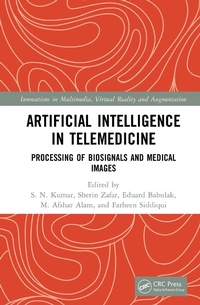
Artificial Intelligence in Telemedicine
Processing of Biosignals and Medical images
1st Edition
Published on 1. August 2023
282 pages
978-1-000-91624-9 (ISBN)
Description

This book explores the role of artificial Intelligence in Telemedicine. It explains the concepts through the detailed study and processing of biosignals, physiological parameters, and medical images. The book focuses on computational algorithms in telemedicine for the processing of biosignals, physiological parameters, and medical Images. The book is presented in two section.
The first section presents the role of computational algorithms in the processing of biosignal and medical images for disease diagnosis and treatment planning. Noise removal in ECG signal using an improved adaptive learning approach, classification of ECG signals using CNN for cardiac arrhythmia detection, EEG signal analysis for stroke detection, and EMG signal analysis for gesture classification were discussed in this section. Application of CNN in pertussis Diagnosis by temperature monitoring, physician handwriting recognition using deep learning model, melanoma detection using ABCD parameters, and transfer learning enabled heuristic approach for pneumonia detection was also discussed in this section
The second section focus on the role of IoT and artificial intelligence in the healthcare sector. IoT in smart health care and applications of artificial intelligence in disease diagnosis and prediction was discussed in this section. The importance of 5G/6G in the pandemic scenario for telemedicine applications, wireless capsule endoscopy image compression, leukemia detection from the microscopic cell images, and genomic signal processing using numerical mapping techniques was also discussed in this section.
This book can be used by a wide range of users including students, research scholars, faculty, and practitioners in the field of engineering for applications in biomedical signal, image analysis, and diagnosis.
The first section presents the role of computational algorithms in the processing of biosignal and medical images for disease diagnosis and treatment planning. Noise removal in ECG signal using an improved adaptive learning approach, classification of ECG signals using CNN for cardiac arrhythmia detection, EEG signal analysis for stroke detection, and EMG signal analysis for gesture classification were discussed in this section. Application of CNN in pertussis Diagnosis by temperature monitoring, physician handwriting recognition using deep learning model, melanoma detection using ABCD parameters, and transfer learning enabled heuristic approach for pneumonia detection was also discussed in this section
The second section focus on the role of IoT and artificial intelligence in the healthcare sector. IoT in smart health care and applications of artificial intelligence in disease diagnosis and prediction was discussed in this section. The importance of 5G/6G in the pandemic scenario for telemedicine applications, wireless capsule endoscopy image compression, leukemia detection from the microscopic cell images, and genomic signal processing using numerical mapping techniques was also discussed in this section.
This book can be used by a wide range of users including students, research scholars, faculty, and practitioners in the field of engineering for applications in biomedical signal, image analysis, and diagnosis.
More details
Series
Edition
1. Auflage
Language
English
Place of publication
London
United Kingdom
Publishing group
Taylor & Francis Ltd
Target group
Professional and scholarly
Illustrations
35 Tables, black and white; 22 Line drawings, color; 7 Line drawings, black and white; 105 Halftones, color; 2 Halftones, black and white; 128 Illustrations, color; 8 Illustrations, black and white
ISBN-13
978-1-000-91624-9 (9781000916249)
Copyright in bibliographic data and cover images is held by Nielsen Book Services Limited or by the publishers or by their respective licensors: all rights reserved.
Schweitzer Classification
Other editions
Additional editions
S. N. Kumar | Sherin Zafar | Eduard Babulak
Artificial Intelligence in Telemedicine
Processing of Biosignals and Medical images
Book
06/2025
1st Edition
CRC Press
€76.70
Shipment within 10-20 days
S. N. Kumar | Sherin Zafar | Eduard Babulak
Artificial Intelligence in Telemedicine
Processing of Biosignals and Medical images
Book
08/2023
1st Edition
CRC Press
€185.70
Shipment within 10-20 days
Persons
Dr.S. N Kumar is currently an Associate. Professor, Dept. of Electrical and Electronics Engineering., Amal Jyothi College of Engineering, Kanjirappally, Kerala. He was awarded PhD in Electronics and Communication Engineering from Sathyabama Institute of Science and Technology, Chennai. He has 15 years of teaching experience, and his areas of interest include Medical Image Processing and Embedded System Applications in Telemedicine. He was the Co-Principal Investigator of the DST IDP-funded project and research fellow of the RCA scheme, NTU Singapore.
Dr. Sherin Zafar is an Assistant Professor, Computer Science and Engineering at the School of Engineering Sciences & Technology, Jamia Hamdard with a decade of successful experience in teaching and research management. She specializes in Wireless Networks, Soft Computing, and Network Security and has great profile in Scopus, Mendeley, Google Scholar, Research Gate and Publons. With about half-century of papers published in Scopus, SCI and peer reviewed journals double century of papers reviewed and also Editorial Board and Editor in Chief of many reputed and Scopus indexed journals. Has published 3 patents on Block Chain technology, Co-PI for FIST project of DST and Pi for 2 Unnat Bharat projects. A strong believer in the power of positive thinking in the workplace, Dr. Sherin regularly develops internship and career campaigns for students through Internshala and Epoch (Literary and Cultural Society) Groups and guided huge number of graduate, post graduate and also PhD students. Dr Sherin has been session chairs for 7+ international conferences, keynote speaker, resource person for 100+ webinars and FDP's for renowned institutions, AICTE STTP and for AICTE ATAL FDP. Sherin enjoys a good Netflix and Cricket binge but can also be found on long drives rides on country roads."
Dr Eduard Babulak is an accomplished international scholar, researcher, consultant, educator, professional engineer, and polyglot with more than thirty years of teaching experience and industrial experience as a professional engineer and consultant.
Dr Mohammad Afshar Alam is currently working as Vice-Chancellor and Professor, Dean of School of Engineering Sciences and Technology at Jamia Hamdard, New Delhi. His research areas include Software Re-engineering, Data Mining, Bio-Informatics, Fuzzy databases, and Sustainable Development.
Dr Farheen has a professional experience spanning over more than 20 years of teaching, research and project supervision. She has supervised more than 100 students for interdisciplinary research and project supervision. She has many research papers published in renowned national and international journals and conference proceedings. Apart from this she is also a member of editorial board of many journals. Her primary area of research is Data analytics, Cloud computing and Semantic Web.
Dr. Sherin Zafar is an Assistant Professor, Computer Science and Engineering at the School of Engineering Sciences & Technology, Jamia Hamdard with a decade of successful experience in teaching and research management. She specializes in Wireless Networks, Soft Computing, and Network Security and has great profile in Scopus, Mendeley, Google Scholar, Research Gate and Publons. With about half-century of papers published in Scopus, SCI and peer reviewed journals double century of papers reviewed and also Editorial Board and Editor in Chief of many reputed and Scopus indexed journals. Has published 3 patents on Block Chain technology, Co-PI for FIST project of DST and Pi for 2 Unnat Bharat projects. A strong believer in the power of positive thinking in the workplace, Dr. Sherin regularly develops internship and career campaigns for students through Internshala and Epoch (Literary and Cultural Society) Groups and guided huge number of graduate, post graduate and also PhD students. Dr Sherin has been session chairs for 7+ international conferences, keynote speaker, resource person for 100+ webinars and FDP's for renowned institutions, AICTE STTP and for AICTE ATAL FDP. Sherin enjoys a good Netflix and Cricket binge but can also be found on long drives rides on country roads."
Dr Eduard Babulak is an accomplished international scholar, researcher, consultant, educator, professional engineer, and polyglot with more than thirty years of teaching experience and industrial experience as a professional engineer and consultant.
Dr Mohammad Afshar Alam is currently working as Vice-Chancellor and Professor, Dean of School of Engineering Sciences and Technology at Jamia Hamdard, New Delhi. His research areas include Software Re-engineering, Data Mining, Bio-Informatics, Fuzzy databases, and Sustainable Development.
Dr Farheen has a professional experience spanning over more than 20 years of teaching, research and project supervision. She has supervised more than 100 students for interdisciplinary research and project supervision. She has many research papers published in renowned national and international journals and conference proceedings. Apart from this she is also a member of editorial board of many journals. Her primary area of research is Data analytics, Cloud computing and Semantic Web.
Content
PART 1 Biosignal and Medical Image Processing for Disease Diagnosis
Chapter 1 Lightweight One-Dimensional CNN for Cardiac Arrhythmia Classification
Chapter 2 An Automatic System for Pertussis Diagnosis with Temperature Monitoring Using CNN
Chapter 3 DocPresRec: Doctor's Handwritten Prescription Recognition Using Deep Learning Algorithm
Chapter 4 An Efficient Deep Learning Approach for Brain Stroke Detection: Application of Telemedicine
Chapter 5 An Automated Detection of Notable ABCD Diagnostics of Melanoma in Dermoscopic Images
Chapter 6 Comparative Study of CNN and LSTM-Based Hand Gesture Classification Using EMG Signals
Chapter 7 Improved Transfer Learning-Enabled Heuristic Technique for Pneumonia Detection on Graphical Processing Unit Platform
Chapter 8 Improved Adaptive Learning Framework for an Effective Removal of Noise in ECG Signal for Telemedicine System
PART 2 Role of Artificial Intelligence and IoT in Health Care
Chapter 9 Human Disease Prediction System - Application of AI Techniques in Chronic Diseases
Chapter 10 Internet of Things in Mental Healthcare Worldwide - A Study
Chapter 11 Internet of Things: A Promise to Smart Healthcare
Chapter 12 A Brief Review on Wireless Capsule Endoscopy Image Compression
Chapter 13 A Comprehensive Review on Leukemia Diseases Based on Microscopic Blood Cell Images
Chapter 14 Effects of Numerical Mapping Techniques on Performance in Genomic Signal Processing
Chapter 15 Importance of 5G/6G in Telemedicine System during the Pandemic Situation
Chapter 16 Applications of Artificial Intelligence Techniques in Healthcare
Industry
Chapter 1 Lightweight One-Dimensional CNN for Cardiac Arrhythmia Classification
Chapter 2 An Automatic System for Pertussis Diagnosis with Temperature Monitoring Using CNN
Chapter 3 DocPresRec: Doctor's Handwritten Prescription Recognition Using Deep Learning Algorithm
Chapter 4 An Efficient Deep Learning Approach for Brain Stroke Detection: Application of Telemedicine
Chapter 5 An Automated Detection of Notable ABCD Diagnostics of Melanoma in Dermoscopic Images
Chapter 6 Comparative Study of CNN and LSTM-Based Hand Gesture Classification Using EMG Signals
Chapter 7 Improved Transfer Learning-Enabled Heuristic Technique for Pneumonia Detection on Graphical Processing Unit Platform
Chapter 8 Improved Adaptive Learning Framework for an Effective Removal of Noise in ECG Signal for Telemedicine System
PART 2 Role of Artificial Intelligence and IoT in Health Care
Chapter 9 Human Disease Prediction System - Application of AI Techniques in Chronic Diseases
Chapter 10 Internet of Things in Mental Healthcare Worldwide - A Study
Chapter 11 Internet of Things: A Promise to Smart Healthcare
Chapter 12 A Brief Review on Wireless Capsule Endoscopy Image Compression
Chapter 13 A Comprehensive Review on Leukemia Diseases Based on Microscopic Blood Cell Images
Chapter 14 Effects of Numerical Mapping Techniques on Performance in Genomic Signal Processing
Chapter 15 Importance of 5G/6G in Telemedicine System during the Pandemic Situation
Chapter 16 Applications of Artificial Intelligence Techniques in Healthcare
Industry
