

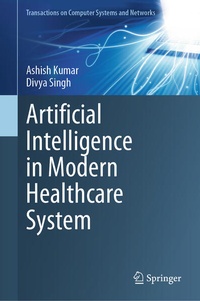
Artificial Intelligence in Modern Healthcare System
Description

The book explores advancements in medical system design through the use of recent technologies, particularly artificial intelligence. It analyzes the accuracy of predictions suitable for real-time deployment of these methodologies. The text covers a wide range of prediction and segmentation algorithms based on machine learning and deep learning techniques. These approaches are applied in the analysis of critical diseases, such as mental disorders, diabetic retinopathy, cardiovascular disorders, breast cancer, and many others.
More details
Other editions
Additional editions
Persons
Ashish Kumar is an Associate Professor at Bennett University, India, where he has been since 2022. Prior to joining Bennett University, he worked with Bharati Vidyapeeth's College of Engineering. He completed his Ph.D. in Computer Science and Engineering from Delhi Technological University (formerly known as DCE), New Delhi, in 2020. For his contributions to the computer vision domain, he received the Best Researcher Award from Delhi Technological University. Dr. Kumar holds an M.Tech degree with distinction in Computer Science and Engineering from GGS Indraprastha University, New Delhi. He has published over 25 research papers in various esteemed national and international journals and conferences, as well as more than 15 book chapters in Scopus-indexed books. Additionally, he has authored and edited several books in the fields of artificial intelligence, computer vision, and healthcare. As an active member of various international societies and clubs, Dr. Kumar serves as a reviewer for many respected journals and participates in the technical program committees of various national and international conferences. He has also chaired sessions at multiple conferences. His current research interests include object tracking, image processing, artificial intelligence, and medical imaging analysis.
Divya Singh is an Assistant Professor in the School of Computer Science and Engineering at Bennett University, India. She holds a B.Tech degree in Information Technology and an M.Tech degree, as well as a Ph.D. in Computer Science Engineering and Technology from IIT BHU, Varanasi. Dr. Singh has two years of teaching experience and has published several research papers in reputable international journals and conferences. Her research interests encompass image and video processing, computer vision, artificial intelligence, machine learning, and deep learning.Content
Introduction to AI in Medical Systems.- Background and research orientation of AI techniques in Medical Imaging.- Benchmark datasets for analysis in Medical System.- AI for diagnosis of mental illness and neurological disorders.
