

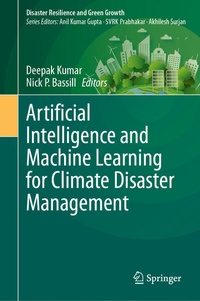
Artificial Intelligence and Machine Learning for Climate Disaster Management
Description

This edited volume highlights the importance of Artificial Intelligence (AI) and Machine Learning (ML) being utilised in climate disaster management to enhance preparedness, response, recovery, and mitigation efforts. The integration of AI and ML technologies with climate disaster management greatly improves decision-making, resource allocation, and overall effectiveness in addressing the impacts of climate-related disasters. It serves as a comprehensive guide to harnessing the power of geospatial information and services for climate-resilient disaster management.
This book is a timely exploration of how cutting-edge technology can shape our response to climate-related disasters. The book embarks on a journey through the intricate web of geospatial data, uncovering its indispensable role in disaster preparedness, response, and recovery. Several ways in which AI and ML are being applied comprise Early Warning Systems, Disaster Response Planning, Damage Assessment, Risk Assessment and Vulnerability Mapping, Climate Modeling and Simulation, Resilience and Adaptation Strategies, Satellite Imagery for Disaster Response, Vulnerability Mapping and Resilience Planning, Data Integration in Emergency Response, Climate Adaptation Policies, among many others. Real-world case studies and practical insights illustrate how geospatial technology empowers early warning systems, enhances risk assessment, and streamlines resource allocation. It delves into the nuances of climate adaptation planning, shedding light on innovative strategies for building resilient communities and infrastructure.
This book will serve as an invaluable resource for policymakers, disaster managers, researchers, and anyone concerned with safeguarding communities against climate-related disasters.
More details
Other editions
Additional editions
Persons
Dr Deepak Kumar is an academic researcher with a multidisciplinary background in Geospatial Sciences, Computational Sciences, Climate Change, and Sustainability for policy making with humanities, social science, and technology perspectives.
Dr. Nick P. Bassill has over a decade of experience in weather and climate research, with a focus on impact assessment and applied meteorology.
Content
Chapter 1. Artificial Intelligence and Machine Learning for Climate Disaster Management.- Chapter 2. The Climate Science, designing, and implementation of Climate Policy.- Chapter 3. Strategic Integration of Green Innovation and Information Systems for Sustainable Development.- Chapter 4. Artificial Intelligence and Machine Learning to Assess the Effects of COVID-19 on Land Surface Temperature (LST) and Air Quality Index.- Chapter 5. Trend analysis of long-term temperature data for prediction of heat waves through statistical analysis using extreme value theory for climate disaster management.- Chapter 6. Risk Assessment and Vulnerability Mapping of Soil Erosion for Climate Resilient Disaster Management with Geospatial Techniques.- Chapter 7. A Geospatial approach for DEM-Based Surface Hydrological Modelling of Sub-Watersheds towards Climate Disaster Management.- Chapter 8. Urban Heat Island Mitigation through Green Infrastructure for Sustainable Development.- Chapter 9. Identification of soil erosion susceptible areas with analytical hierarchy process (AHP) modelling for climate disaster management.- Chapter 10. Role of Artificial Intelligence and Machine Learning for Climate Disaster Management and Earth Resource Management.- Chapter 11. From Data to Planning: Innovations through LiDAR technology and data science in Sustainable Urban Resource Management.- Chapter 12. Beyond the Office Walls: Exploring Nature Connectedness for Climate Stress and Disaster Management.- Chapter 13. Challenges and Future Trends in Climate Disaster Management.
