

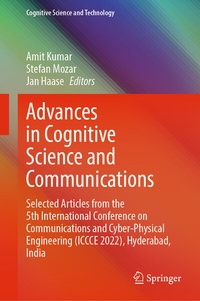
Advances in Cognitive Science and Communications
Description

More details
Other editions
Additional editions
Persons
Dr. Amit Kumar is DNA Forensics Professional, Entrepreneur, Engineer, Bioinformatician, and IEEE Volunteer. In 2005, he founded the first Private DNA Testing Company BioAxis DNA Research Centre (P) Ltd in Hyderabad, India, with an US Collaborator. He has vast experience of training 1000+ crime investigation officers and helped 750+ criminal and non-criminal cases to reach justice by offering analytical services in his laboratory. His group also works extensively on genetic predisposition risk studies of cancers and has been helping many cancer patients from 2012 to fight and win the battle against cancer. He was a Member of IEEE Strategy Development and Environmental Assessment (SDEA) Committee of IEEE MGA. He is Senior Member of IEEE and has been a very active IEEE Volunteer at Section, Council, Region, Technical Societies of Computational Intelligence and Engineering in Medicine and Biology and at IEEE MGA levels in several capacities. He has driven a number of IEEE conferences, conference leadership programs, entrepreneurship development workshops, innovation, and internship-related events. Currently, he is Managing Director of BioAxis DNA Research Centre (P) Ltd and Chair of IEEE Region 10 Section chapter committee.
Dr. Stefan Mozar
obtained his engineering degrees from the University of New South Wales in Sydney, Australia, and his M.B.A. from the University of Technology Sydney. He is Fellow of the IEEE and of the Institution of Engineers, Australia. He is Chartered Professional Engineer and has extensive experience in industry and academia. He has held senior leadership roles in various technology companies and has taught at a number of Australian, Asian, and British universities. His work has resulted in inventions, patents, and publications. He has lived and worked in Australia, China, Hong Kong, and Singapore, has worked on projects in India, Indonesia, Malaysia, Thailand, and Vietnam, and has made contributions to the advancement of the IEEE in R-10 and globally. He is Editor of the 6th edition of the McGraw Hill Electronics Engineering Handbook, released in 2017.
Dr. Jan Haase
received his Bachelor's, Master's, and Ph.D. in computer science at the University of Frankfurt/Main, Germany. He was then project leader at the University of Technology in Vienna, Austria, at the Institute of Computer Science and a lecturer at Helmut Schmidt University, Hamburg, where he received his Habilitation. From 2016-2020 he held a temporal professorship for Organic Computing at University of Luebeck, Germany and is currently a full professor at Nordakademie near Hamburg, Germany.
His main interests are in the areas of Building Automation, System Specification and Modeling, Simulation, Low-Power Design Methodologies, Wireless Sensor Networks, Automatic Parallelization and modern Computer Architectures.
