

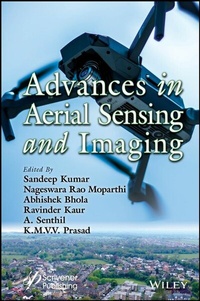
Advances in Aerial Sensing and Imaging
Description

This groundbreaking book is a comprehensive guide to the technology found in the complex field of aerial sensing and imaging, and the real-world challenges that stem from its growing significance and demand.
The advent of unmanned aerial vehicles (UAVs), or drones, along with advancements in sensor technology and image processing techniques, has further enhanced the capabilities and applications of aerial sensing and imaging. These developments have opened up new research, innovation, and exploration avenues.
Aerial sensing and imaging have rapidly evolved over the past few decades and have revolutionized several fields, including land cover and usage prediction, crop and livestock management, road accident monitoring, poverty estimation, defense, agriculture, forest fire detection, UAV security issues, and open parking management. This book provides a comprehensive understanding and knowledge of the underlying technology and its practical applications in different domains.
Audience
Computer science and artificial intelligence researchers working in the fields of aerial sensing and imaging, as well as professionals working in industries such as agriculture, geology, surveying, urban planning, disaster response, etc; this book provides them with practical guidance and instruction on how to apply aerial sensing and imaging for various purposes and stay up-to-date with the latest developments in the domain.
More details
Other editions
Additional editions

Persons
Sandeep Kumar, PhD, is a professor in the Department of Computer Science and Engineering, K L Deemed to be University, Vijayawada, Andhra Pradesh, India. He has been granted six patents and successfully filed another ten. He has published more than 100 research papers in various national and international journals and proceedings of reputed national and international conferences.
Nageswara Rao Moparthi, PhD, is a professor at KL University in the Department of Computer and Engineering. He has 13 years of IT industry exposure with major MNC's and seven years of teaching research experience. He has published 25 articles in reputed Scopus and SCIE/ESCI international journals.
Abhishek Bhola, PhD, is an associate professor in the Department of Computer Science and Engineering at K L Deemed to be University, Vijayawada, Andhra Pradesh, India. He has more than seven years of experience in academics and research. Additionally, he has published several research papers in various international journals and conferences.
Ravinder Kaur, PhD, is an assistant professor in the Department of Computer Science and Engineering (CSE) at the University Institute of Engineering, Chandigarh University, Punjab, India. She has published research papers in various renowned international conferences and SCI-indexed journals.
A. Senthil, PhD, is a professor in the Department of Computer Science and Engineering, KLEF Deemed to be University, A.P., India. He has been in teaching and research for the past 21 years, working as a Professor, Head of Department, and Associate Dean in leading institutions. He has also served as an ABET-USA program evaluator for the Computing Accreditation Commission (CAC) for the last four years.
K.M.V.V. Prasad, PhD, is an associate professor in the Department of Electronics and Telecommunications, Symbiosis International (Deemed University), Pune, India, with eight years of teaching experience. He has authored and co-authored many papers in international journals and both national and international conferences.
Content
Preface xv
1 A Systematic Study on Aerial Images of Various Domains: Competences, Applications, and Futuristic Scope 1
Abhishek Bhola, Bikash Debnath and Ankita Tiwari
1.1 Introduction 2
1.2 Literature Work 5
1.3 Challenges of Object Detection and Classification in Aerial Images 17
1.4 Applications of Aerial Imaging in Various Domains 21
1.5 Conclusions and Future Scope 26
2 Oriental Method to Predict Land Cover and Land Usage Using Keras with VGG16 for Image Recognition 33
Monali Gulhane and Sandeep Kumar
2.1 Introduction 34
2.2 Literature Review 35
2.3 Materials and Methods 37
2.4 Discussion 40
2.5 Result Analysis 41
2.6 Conclusion 43
3 Aerial Imaging Rescue and Integrated System for Road Monitoring Based on AI/ML 47
Munish Kumar, Poonam Jaglan and Yogesh Kakde
3.1 Introduction 48
3.2 Related Work 49
3.3 Number of Accidents, Fatalities, and Injuries: 2016-2022 52
3.4 Proposed Methodology 53
3.5 Result Analysis 61
3.6 Conclusion 63
4 A Machine Learning Approach for Poverty Estimation Using Aerial Images 69
Nandan Banerji, Sreenivasulu Ballem, Siva Mala Munnangi and Sandeep Mittal
4.1 Introduction 70
4.2 Background and Literature Review 73
4.3 Proposed Methodology 76
4.4 Result and Discussion 82
4.5 Conclusion and Future Scope 83
5 Agriculture and the Use of Unmanned Aerial Vehicles (UAVs): Current Practices and Prospects 87
Ajay Kumar Singh and Suneet Gupta
5.1 Introduction 88
5.2 UAVs Classification 90
5.3 Agricultural Use of UAVs 96
5.4 UAVs in Livestock Farming 101
5.5 Challenges 104
5.6 Conclusion 105
6 An Introduction to Deep Learning-Based Object Recognition and Tracking for Enabling Defense Applications 109
Nitish Mahajan, Aditi Chauhan and Monika Kajal
6.1 Introduction 110
6.2 Related Work 111
6.3 Experimental Methods 121
6.4 Results and Outcomes 122
6.5 Conclusion 123
6.6 Future Scope 125
7 A Robust Machine Learning Model for Forest Fire Detection Using Drone Images 129
Chahil Choudhary, Anurag and Pranjal Shukla
7.1 Introduction 130
7.2 Literature Review 131
7.3 Proposed Methodology 133
7.4 Result and Discussion 135
7.5 Conclusion and Future Scope 142
8 Semantic Segmentation of Aerial Images Using Pixel Wise Segmentation 145
Swathi Gowroju, Shilpa Choudhary, Sandhya Raajaani and Regula Srilakshmi
8.1 Introduction 146
8.2 Related Work 147
8.3 Proposed Method 149
8.4 Datasets 153
8.5 Results and Discussion 154
8.6 Conclusion 161
9 Implementation Analysis of Ransomware and Unmanned Aerial Vehicle Attacks: Mitigation Methods and UAV Security Recommendations 165
Sidhant Sharma, Pradeepta Kumar Sarangi, Bhisham Sharma and Girija Bhusan Subudhi
9.1 Introduction 166
9.2 Types of Ransomwares 167
9.3 History of Ransomware 168
9.4 Notable Ransomware Strains and Their Impact 171
9.5 Mitigation Methods for Ransomware Attacks 184
9.6 Cybersecurity in UAVs (Unmanned Aerial Vehicles) 185
9.7 Experimental analysis of Wi-Fi Attack on Ryze Tello UAVs 194
9.8 Results and Discussion 198
9.9 Conclusion and Future Scope 206
10 A Framework for Detection of Overall Emotional Score of an Event from the Images Captured by a Drone 213
P.V.V.S. Srinivas, Dhiren Dommeti, Pragnyaban Mishra and T.K. Rama Krishna Rao
10.1 Introduction 214
10.2 Literature Review 216
10.3 Proposed Work 220
10.4 Experimentation and Results 223
10.5 Future Work and Conclusion 230
11 Drone-Assisted Image Forgery Detection Using Generative Adversarial Net-Based Module 245
Swathi Gowroju, Shilpa Choudhary, Medipally Rishitha, Singanaboina Tejaswi, Lankala Shashank Reddy and Mallepally Sujith Reddy
11.1 Introduction 246
11.2 Literature Survey 247
11.3 Proposed System 250
11.4 Results 256
11.5 Conclusion 264
12 Optimizing the Identification and Utilization of Open Parking Spaces Through Advanced Machine Learning 267
Harish Padmanaban P. C. and Yogesh Kumar Sharma
12.1 Introduction 267
12.2 Proposed Framework Optimized Parking Space Identifier (OPSI) 270
12.3 Potential Impact 281
12.4 Application and Results 284
12.5 Discussion and Limitations 289
12.6 Future Work 290
12.7 Conclusion 290
13 Graphical Password Authentication Using Python for Aerial Devices/Drones 295
Sushma Singh and Dolly Sharma
13.1 Introduction 296
13.2 Literature Review 297
13.3 Methodology 298
13.4 A Brief Overview of a Drone and Authentication 299
13.5 Password Cracking 305
13.6 Data Analysis 307
13.7 Discussion 309
13.8 Conclusion and Future Scope 309
14 A Study Centering on the Data and Processing for Remote Sensing Utilizing from Annoyed Aerial Vehicles 313
Vandna Bansla, Sandeep Kumar, Vibhoo Sharma, Girish Singh Bisht and Akanksha Srivastav
14.1 Introduction 314
14.2 An Acquisition Method for 3D Data Utilising Annoyed Aerial Vehicles 315
14.3 Background and Literature of Review 317
14.4 Research Gap 319
14.5 Methodology 319
14.6 Discussion 321
14.7 Conclusion 327
15 Satellite Image Classification Using Convolutional Neural Network 333
Pradeepta Kumar Sarangi, Bhisham Sharma, Lekha Rani and Monica Dutta
15.1 Introduction 334
15.2 Literature Review 335
15.3 Objectives of this Research Work 336
15.4 Description of the Dataset 337
15.5 Theoretical Framework 337
15.6 Implementation and Results 339
15.7 Conclusion and Future Scope 350
16 Edge Computing in Aerial Imaging - A Research Perspective 355
Divya Vetriveeran, Rakoth Kandan Sambandam, Jenefa J. and Leena Sri R.
16.1 Introduction 355
16.2 Research Applications of Aerial Imaging 357
16.3 Edge Computing and Aerial Imaging 366
16.4 Comparative Analysis of the Aerial Imaging Algorithms and Architectures 376
16.5 Discussion 379
16.6 Conclusion 380
17 Aerial Sensing and Imaging Analysis for Agriculture 383
Monika Kajal and Aditi Chauhan
17.1 Introduction 384
17.2 Experimental Methods and Techniques 388
17.3 Aerial Imaging and Sensing Applications in Agriculture 390
17.4 Aerial Imaging and Sensing Applications in Livestock Farming 398
17.5 Challenges in Aerial Sensing and Imaging in Agriculture and Livestock Farming 404
17.6 Conclusion 406
References 406
Index 411
1
A Systematic Study on Aerial Images of Various Domains: Competences, Applications, and Futuristic Scope
Abhishek Bhola1*, Bikash Debnath2 and Ankita Tiwari3
1Chaudhary Charan Singh Haryana Agricultural University College of Agriculture, Bawal, Haryana, Rewari, India
2Department of Information Technology, Amity University, Kolkata, West Bengal, India
3Department of Mathematics, Koneru Lakshmaiah Education Foundation, Vijayawada, India
Abstract
Aerial images captured by drones or aircraft provide a unique perspective and valuable data in various fields, including agriculture, urban planning, construction, and environmental research. They offer high-resolution images that can be used to create detailed maps, monitor changes over time, and provide clear information not visible from ground level. Despite their many benefits, there are also challenges associated with aerial imaging. These challenges include the cost and availability of equipment, weather conditions and terrain, data management and analysis, privacy concerns, and regulatory issues. Overcoming these challenges requires specialized skills and expertise and careful consideration of ethical and environmental concerns. However, as technology advances, aerial images' benefits are expanding, enabling new applications, and more detailed analysis. For example, infrared imaging allows for monitoring plant health and identifying areas of water stress, which is particularly useful in agriculture and environmental research. In addition, the ability to cover large areas quickly and efficiently provides a comprehensive view that is impossible with ground-based surveys, making it valuable for infrastructure inspection and urban planning. Despite the challenges, the scope for aerial imaging is expanding rapidly, with advancements in technology enabling new applications and more detailed analysis. As the technology continues to evolve, the benefits of aerial images will only continue to grow, making it an increasingly valuable tool for decision-making and problem-solving in various industries.
Keywords: Aerial images, scale, sensor, camera, machine learning
1.1 Introduction
Aerial sensing and imaging have revolutionized how we observe, measure, and understand the world. This technology captures images, videos, and other data from an elevated platform like an aircraft or drone to understand a particular area or object better [1-3]. With technological advancements, aerial sensing and imaging have become more accessible and cost-effective, making them essential tools for various industries, including agriculture, forestry, urban planning, environmental monitoring, and infrastructure management [4-6]. Aerial sensing and imaging are also used to provide real-time data and insights in emergency response situations, such as natural disasters and search and rescue missions. This paper will explore the various applications and benefits of aerial sensing and imaging and discuss the latest technological advancements [7-9].
The history of aerial sensing and imaging dates back to the 19th century, when French photographer and balloonist Gaspar Félix Tournachon, known as Nadar, captured the first aerial photograph over Paris in 1858. The picture was taken from a hot air balloon at an altitude of 80 meters and provided a bird's eye view of the city [10-12]. In the early 20th century, advancements in aircraft technology led to the development of aerial photography, which became an essential tool for military surveillance during World War-I [13-16]. During the 1920s and 1930s, aerial photography was used for mapping, surveying, and topographic studies, as well as for scientific research and exploration. In the 1950s and 1960s, aerial sensing and imaging technology evolved with the development of airborne remote sensing systems, which used cameras and sensors mounted on aircraft to capture images and data [17-19]. This technology was used for various applications, including mapping, agriculture, forestry, and geological exploration. In the 1970s and 1980s, satellite remote sensing technology emerged as a new and powerful tool for remote sensing and imaging. Satellites offered a global view of the Earth and provided data on various environmental factors, including climate, vegetation, and oceanography [20-24]. In the 1990s and 2000s, advancements in unmanned aerial vehicle (UAV) technology led to the development of aerial sensing and imaging systems that were more cost-effective, flexible, and accessible than traditional airborne or satellite-based systems. UAVs were used for various applications, including agriculture, environmental monitoring, search and rescue, and infrastructure inspection [25-28]. The global market for unmanned aerial vehicle (UAV) drones is projected to reach 102.38 billion US dollars by 2032, expanding at a compound annual growth rate (CAGR) of 18.2% from 2018 to 2032 as shown in Figure 1.1 [29-31].
Today, aerial sensing and imaging technology continue to evolve, with new and innovative applications and advancements in sensor technology, data analysis, and artificial intelligence. Aerial sensing and imaging technology is being used to monitor and mitigate climate change's impact, support disaster response and recovery efforts, and improve the efficiency and sustainability of various industries [32-35]. Aerial sensing and imaging technology has a rich and diverse history, spanning over a century of technological advancements and innovation. Today, it continues to be a critical tool for understanding and managing our planet and is poised to play an increasingly important role in the future. Aerial sensing and imaging is a rapidly growing field involving advanced technologies to capture images and data from the air [36-38]. This field has numerous applications in environmental monitoring, disaster response, agriculture, and urban planning. Using unmanned aerial vehicles (UAVs) has revolutionized aerial sensing and imaging, enabling researchers and professionals to collect highresolution data quickly and accurately [39, 40]. If you are considering studying aerial sensing and imaging, there are many compelling reasons to do so. First and foremost, this field is at the forefront of technological innovation, and studying it will expose you to the latest advances in remote sensing and data collection. This is an exciting time to be involved in aerial sensing and imaging, as new technologies such as LiDAR, hyperspectral imaging, and drones are rapidly advancing the field. In addition to technological innovation, there is a growing need for professionals with aerial sensing and imaging expertise [41-43]. As the demand for more accurate and detailed data grows in areas such as environmental monitoring and agriculture, there is a need for skilled professionals who can use aerial sensing and imaging technologies to collect and analyze this data [44, 45]. This presents an excellent opportunity for those with a background in this field to pursue rewarding careers in agriculture, forestry, and environmental science. Studying aerial sensing and imaging also opens up opportunities for research and development. This field has many unanswered questions and options for exploration, and those with the skills and knowledge to tackle these challenges can significantly contribute to the field. Research in this area can lead to new insights into environmental processes, improved mapping, and monitoring techniques, and data analysis and interpretation advancements [46-48]. Finally, studying aerial sensing and imaging can be personally rewarding. It provides an opportunity to work on cutting-edge technology and make a meaningful impact in environmental conservation and disaster response fields. Suppose you are passionate about using technology to solve real-world problems and positively impact society. In that case, studying aerial sensing and imaging may be the perfect fit for you [49, 50].
Figure 1.1 Aerial imaging growth market (2023-2032).
The study of aerial sensing and imaging involves using advanced technologies to capture images and data from the air [51-53]. The following are some of the critical objectives of studying aerial sensing and imaging:
- To gain knowledge and understanding of the underlying principles and concepts of remote sensing and imaging techniques. Aerial sensing and imaging rely on various technologies, including LiDAR, radar, multispectral and hyperspectral imaging, and drones [54-56]. Studying these technologies will enable you to understand how they work, their limitations, and how they can be applied to various applications.
- To develop technical skills in using remote sensing and imaging equipment and software. Aerial sensing and imaging involve complex technologies and software for data capture, processing, and analysis. Studying this field will enable you to develop technical skills using remote sensing and imaging equipment, including drones, cameras, and other sensors [57-59]. You will also learn to process and analyze data using specialized software such as Geographic Information Systems (GIS).
- To understand the applications and limitations of aerial sensing and imaging in various fields. Aerial sensing and...
