

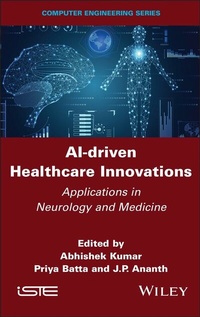
AI-driven Healthcare Innovations
Description

The book systematically examines core AI techniques, including machine learning (ML), deep learning (DL) and intelligent optimization, and demonstrates their practical deployment across neurological disorders, medical imaging, predictive analytics and personalized care. Emphasis is placed on real-world clinical workflows, data acquisition and preprocessing, model interpretability and performance evaluation. In addition, we also address ethical considerations, regulatory challenges and data security issues critical to healthcare adoption. By combining theoretical foundations with applied case studies and future research directions, this book serves as a valuable resource for researchers, clinicians, graduate students and industry professionals seeking to leverage AI-driven innovations to improve patient outcomes and advance next-generation healthcare systems.
More details
Other editions
Additional editions
Persons
Priya Batta is Associate Professor at Amity School of Engineering and Technology, Amity University Punjab, Mohali, India. She has over 12 years of academic experience and has edited several books. She actively contributes her research to reputed journals and conferences. Her expertise includes AI, blockchain and IoT.
J.P. Ananth is Professor of CSE and Director of IQAC at Dayananda Sagar University, Bengaluru, India. With 23 years of experience, he is also a senior IEEE member and a key contributor to academic quality assurance and examination systems.
Content
Preface xxiii
Abhishek KUMAR, Priya BATTA and J.P. ANANTH
Chapter 1. Artificial Intelligence in Healthcare: Principles, Paradigms and Emerging Trends 1
Shilpa C. PATIL and Salim Allauddin CHAVAN
1.1. Introduction 2
1.2. Principles of AI in healthcare 3
1.3. Paradigms of AI in healthcare 5
1.4. Emerging trends in AI-driven healthcare 7
1.5. Challenges and limitations 10
1.6. Future directions 12
1.7. Conclusion 12
1.8. References 13
Chapter 2. Machine Learning Models for Diagnostic Decision-Making in Neurology 17
Sunil Ramrao YADAV and Kalpana MALPE
2.1. Introduction 17
2.2. Overview of ML in healthcare 19
2.3. Supervised learning models in neurological diagnosis 20
2.4. Unsupervised and semi-supervised approaches 21
2.5. DL for neuroimaging and signal analysis 24
2.6. Multimodal and integrative diagnostic models 27
2.7. XAI and clinical interpretability 28
2.8. Future directions in ML for neurological diagnostics 30
2.9. Conclusion 31
2.10. References 31
Chapter 3. Deep Learning Approaches to Neuroimaging and Brain Mapping 35
G.V. RAMDAS and G.M. VAIDYA
3.1. Introduction 35
3.2. Deep learning fundamentals for neuroimaging 37
3.3. Applications in structural neuroimaging (MRI, CT) 41
3.4. Applications in functional neuroimaging (fMRI, PET, EEG/MEG) 43
3.5. Brain mapping and connectomics with deep learning 45
3.6. Clinical applications and translational potential 46
3.7. Challenges, limitations and future directions 48
3.8. Conclusion 50
3.9. References 50
Chapter 4. Predictive Analytics for Early Detection of Neurodegenerative Disorders 53
Debabrata SAHANA and K. GAVHALE
4.1. Introduction 53
4.2. Predictive analytics framework for neurodegenerative disorders 55
4.3. Applications of predictive analytics in specific neurodegenerative disorders 59
4.4. Emerging trends and methodological advances 62
4.5. Challenges, ethical considerations and future directions 64
4.6. Conclusion 67
4.7. References 67
Chapter 5. AI-Enhanced Stroke Diagnosis, Prognosis and Rehabilitation Pathways 71
Rahul PATIL and Fazil SHEIKH
5.1. Introduction 71
5.2. AI in stroke diagnosis 73
5.3. AI in stroke prognosis 75
5.4. AI in stroke rehabilitation pathways 77
5.5. Integration into clinical workflows 79
5.6. Future directions 81
5.7. Conclusion 83
5.8. References 84
Chapter 6. Computational Biomarker Discovery for Neurological and Psychiatric Disorders 87
Chaitnya GODBOLE and Shamla MANTRI
6.1. Introduction 87
6.2. Computational approaches for biomarker discovery 89
6.3. Machine learning and AI in biomarker identification 92
6.4. Biomarkers in neurological disorders 96
6.5. Biomarkers in psychiatric disorders 98
6.6. Challenges and future directions 100
6.7. Conclusion 102
6.8. References 103
Chapter 7. Natural Language Processing for Clinical Narratives and Neurological Case Records 107
Shrikrishna N. BAMNE and Swapna KAMBLE
7.1. Introduction 108
7.2. NLP fundamentals in clinical narratives 109
7.3. Applications in neurology and case records 111
7.4. Advances in model architectures 113
7.5. Clinical Utility: diagnosis, prognosis and treatment support 115
7.6. Integration with EHR and clinical workflows 117
7.7. Challenges: bias, privacy, data scarcity and interpretability 118
7.8. Future perspectives 120
7.9. Conclusion 121
7.10. References 122
Chapter 8. AI-Integrated Wearable Technologies for Continuous Neurological Monitoring 125
Swati JAGTAP and Ashish N. PATIL
8.1. Introduction 125
8.2. AI in wearable neurological monitoring 127
8.3. Clinical applications 129
8.4. System architecture and data integration 133
8.5. Challenges and limitations 136
8.6. Future directions 138
8.7. Conclusion 139
8.8. References 140
Chapter 9. Epilepsy Forecasting and Seizure Prediction Through AI Algorithms 143
Ashwini R. GARGATE and Komal M. JUJAR
9.1. Introduction 144
9.2. Pathophysiology and challenges of seizure prediction 145
9.3. AI in epilepsy forecasting: an overview 146
9.4. Machine learning approaches for seizure prediction 148
9.5. Deep learning and neural network models 150
9.6. Multimodal data integration for seizure forecasting 152
9.7. Wearable devices and real-time forecasting 154
9.8. Privacy, ethics and data challenges 155
9.9. Future directions in AI-driven seizure forecasting 156
9.10. Conclusion 157
9.11. References 158
Chapter 10. Intelligent Robotic Systems for Neurorehabilitation and Assistive Care 161
Debabrata SAHANA and Atul Namdev PAWAR
10.1. Introduction 162
10.2. Principles of intelligent robotic systems 162
10.3. Robotics in neurorehabilitation 164
10.4. Assistive robotics for daily living 166
10.5. Technological paradigms and enablers 167
10.6. Clinical evidence and applications 168
10.7. Challenges and limitations 171
10.8. Emerging trends and future directions 173
10.9. Conclusion 174
10.10. References 175
Chapter 11. Personalized Medicine in Multiple Sclerosis Through AI-Driven Analytics 179
Chaitnya GODBOLE and Shrikant Rangrao KADAM
11.1. Introduction 180
11.2. Overview of multiple sclerosis and the need for personalization 181
11.3. AI in MS diagnosis and early detection 181
11.4. AI-driven prognostic modeling in MS 183
11.5. Personalized treatment strategies through AI analytics 184
11.6. Integration of multi-omics and biomarkers 186
11.7. Role of neuroimaging and computer vision 187
11.8. AI-powered monitoring and patient engagement 188
11.9. Challenges, ethical concerns and limitations 190
11.10. Future directions and clinical translation 191
11.11. Conclusion 193
11.12. References 193
Chapter 12. Artificial Intelligence Applications in Sleep Medicine and Neurological Disorders 197
Swati JAGTAP and Sharifnawaj Y. INAMDAR
12.1. Introduction 198
12.2. AI in sleep medicine 199
12.3. AI in neurological disorders 201
12.4. Multimodal data integration and predictive analytics 203
12.5. Ethical, legal and clinical challenges 206
12.6. Future directions 207
12.7. Conclusion 208
12.8. References 209
Chapter 13. Virtual and Augmented Reality Coupled with AI for Cognitive Rehabilitation 213
Omkar KULKARNI and Amruta B. KALE
13.1. Introduction 214
13.2. Foundations of cognitive rehabilitation 215
13.3. VR in cognitive rehabilitation 216
13.4. AR in cognitive rehabilitation 217
13.5. AI for adaptive therapy 218
13.6. Synergistic role of VR/AR coupled with AI 219
13.7. Clinical applications and case studies 221
13.8. Technological innovations and tools 222
13.9. Challenges and ethical considerations 223
13.10. Future directions and research opportunities 224
13.11. Conclusion 225
13.12. References 226
Chapter 14. AI-Driven Drug Discovery Pipelines for Neurological and Mental Health Therapies 229
Sharad KSHIRSAGAR and Ashish N. PATIL
14.1. Introduction 229
14.2. Principles of AI in drug discovery 231
14.3. AI in target identification and biomarker discovery 232
14.4. AI in hit discovery and lead optimization 233
14.5. AI in drug repurposing for neurological and mental health disorders 235
14.6. AI in preclinical and clinical trial design for neurological and mental health therapies 236
14.7. Ethical, regulatory, and societal implications of AI in neurological and psychiatric drug discovery 238
14.8. Future directions and emerging trends in AI-driven drug discovery for neurological and mental health therapies 241
14.9. Conclusion 242
14.10. References 242
Chapter 15. Ethical, Legal and Societal Implications of AI in Neurology and Medicine 245
Dipali JANKAR and Anil SAHU
15.1. Introduction 246
15.2. AI in neurology and medicine: an overview 247
15.3. Ethical implications 249
15.4. Legal implications 251
15.5. Societal implications 253
15.6. Challenges and future perspectives 256
15.7. Conclusion 258
15.8. References 258
Chapter 16. Federated Learning and Collaborative AI Models in Neuroscience Research 261
Dipali JANKAR and Sanjay L. BADJATE
16.1. Introduction 261
16.2. Fundamentals of FL in neuroscience 263
16.3. Collaborative AI models in neuroscience 265
16.4. Applications of FL and collaborative AI in neuroscience 267
16.5. Challenges and limitations of FL and collaborative AI in neuroscience 271
16.6. Future directions 274
16.7. Conclusion 274
16.8. References 275
Chapter 17. AI-enabled Approaches for Pain Prediction, Assessment and Management 279
Mario ANTONY and Salim Allauddin CHAVAN
17.1. Introduction 279
17.2. AI for pain prediction 281
17.3. AI for pain assessment 283
17.4. AI in pain management 285
17.5. Challenges and limitations of AI in pain medicine 287
17.6. Ethical, legal and future directions 290
17.7. Conclusion 291
17.8. References 292
Chapter 18. Conversational AI and Virtual Assistants for Neurological Patient Support 295
Nikhilchandra MAHAJAN and Piyush Ashokrao DALKE
18.1. Introduction 295
18.2. Technological foundations of conversational AI in healthcare 296
18.3. Clinical applications of conversational AI in neurological care 298
18.4. Benefits and opportunities of conversational AI for neurological support 302
18.5. Challenges and limitations 304
18.6. Future directions and research opportunities 305
18.7. Conclusion 308
18.8. References 308
Chapter 19. Brain-Computer Interfaces Enhanced by Artificial Intelligence 311
Rahul S.S. and Mrudula NIMBARTE
19.1. Introduction 311
19.2. Neural signal acquisition and preprocessing 313
19.3. AI-driven neural decoding and feature extraction 315
19.4. Applications of AI-enhanced BCIs 318
19.5. Challenges, ethical considerations and future directions 322
19.6. Conclusion 324
19.7. References 325
Chapter 20. The Future of AI in Neurology: Innovations, Challenges and Strategic Directions 329
Sunil Ramrao YADAV and Mrudula NIMBARTE
20.1. Introduction 329
20.2. AI in neurological diagnostics 331
20.3. AI in prognosis and disease progression modeling 333
20.4. AI in therapeutics and rehabilitation 335
20.5. Challenges and ethical considerations 339
20.6. Strategic directions for the future 341
20.7. Conclusion 342
20.8. References 343
List of Authors 347
Index 351
1
Artificial Intelligence in Healthcare: Principles, Paradigms and Emerging Trends
Artificial Intelligence (AI) is an emergent revolution in the sphere of contemporary healthcare, and it is producing unique ways to enhance clinical decision-making, diagnostics, treatment planning and patient outcomes. The field of AI is based on computational intelligence and comprises machine learning (ML), deep learning (DL), natural language processing (NLP) and computer vision; these technologies have transformed the way medical data is being processed and interpreted. The introduction of AI into healthcare ecosystems has triggered heightened achievements in the field of predictive analytics, precision medicine, drug discovery, imaging analysis and patient tracking. Digital health products and services using AI have increased the accessibility and efficiency of healthcare, such as cloud-based assistants, wearable devices and telemedicine applications. However, there are issues with the rapid adoption of AI in healthcare: data privacy, the bias of algorithms, interpretability of the model, regulation policies and the necessity of clinical validation. Addressing these obstacles requires interdisciplinary collaboration, ethical governance and the apparent integration of AI into clinical processes. Future trends such as explainable AI, federated learning, multimodal data integration, and blockchain-based healthcare systems are driving the development of more reliable, secure, and scalable AI applications.
This chapter will explore the general principles of AI, paradigms of its application in healthcare and the recent developments that define the profession. This chapter is also a synthesis of the existing literature and innovations and a valuable resource in providing an overview of the way AI is transforming healthcare practices, as well as valuable (and not so valuable) insights into its opportunities and shortcomings. Lastly, this chapter investigates future perspectives that may make AI one of the foundations of the next generation of healthcare systems.
1.1. Introduction
The use of Artificial Intelligence (AI) is now one of the most prominent 21st-century technologies, particularly in healthcare. This industry generates huge volumes of various data, including medical imaging, electronic health records (EHRs), genomic data, clinical trial outcomes and patient-reported outcomes. The management of this data has posed significant challenges for clinicians due to its vast volume, diversity, and complexity. Now, AI, which can study large datasets and identify the obscure patterns that a person might overlook, can create novel opportunities regarding better clinical decision-making, simplifying the work process and personalizing care to a specific patient (Topol 2019).
1.1.1. History of AI in healthcare
We can trace AI, in the domain of healthcare, to the rule-based expert systems of the 1970s and 1980s, including MYCIN and INTERNIST-I. Such rudimentary tools assisted physicians in diagnosing ailments but they were hindered by being inflexible and unscalable. The development of machine learning (ML) and deep learning (DL) made AI a model of dynamic learning that receives complex medical data instead of a set of statistic rules. This development has resulted in the application of AI in numerous fields, including the analysis of medical images or the identification of drugs and real-time patient monitoring (Yu et al. 2018).
Healthcare is becoming progressively more data-oriented, and AI is introducing precision medicine, predictive analytics and care in real time to the stage. AI models can accurately identify malignant masses in medical images, predict the progression of chronic conditions, and discover new treatment targets with remarkable precision. Meanwhile, telemedicine assisted by AI, chatbots and wearables makes care more accessible, particularly to underserved communities. These developments indicate that AI helps clinicians in making critical decisions and also enables patients to take the initiative in managing their health (Rajpurkar et al. 2022).
Still, the introduction of AI in healthcare does introduce issues. Algorithms may be biased and challenging to interpret as well as pose privacy and regulative issues. Also, the implementation of AI in the clinical workflow necessitates the alignment of technology, ethics and policy. However, it must be noted that although AI has enormous potential, we should pay close attention to its boundaries.
This chapter discusses the basics of AI, the ways in which it can be implemented in healthcare and the new tendencies that are predetermining its future. It presents the ways AI is transforming medical practice by entwining its diagnostic, therapeutic and preventive innovations. It also looks at both the ethical and practical dilemmas associated with AI integration, providing recommendations on how it can be used responsibly in medicine.
1.2. Principles of AI in healthcare
1.2.1. Foundational concepts
Healthcare organizations can use AI to analyze and interpret medical records to assist in clinical decision-making and prioritize tasks through algorithms that replicate human intelligence. The further subfields of AI are machine learning (ML), deep learning (DL), natural language processing (NLP) and computer vision. These methods enable systems to process large, multipolar health information: structured numeric, unstructured clinical and multidimensional images (Fan et al. 2023).
Modern medical AI is based on ML. Algorithms can gain knowledge and creatively identify trends based on previous data to make predictions. One type of ML is DL; this learns the complex nonlinear relationship using neural networks consisting of multiple layers. This renders DL particularly appropriate with medical imaging and genomics. NLP allows computers to make sense of unstructured text, which is vital in the analysis of physician notes, radiology record and EHR (Electronic Health Records). Computer vision allows automatic insight of pictures in the form of X-rays, MRIs and CT scans.
Such AI concepts have facilitated the transformational health applications. As an example, radiologists can be beaten by DL algorithms regarding the detection of lung nodules on the CT of a chest scanner (Esteva et al. 2019). Long EHRs can be condensed into useful information using NLP systems. With the increase in the volume of healthcare data, AI is able to convert raw data into clinically sound knowledge.
1.2.2. Core AI methodologies
Healthcare AI has numerous ways of processing and interpreting data. The most commonly used type is supervised learning, which is trained on labeled data to predict an outcome such as disease classification or a therapeutic effect. Unsupervised learning identifies latent structures in unlabeled data, which can be used in grouping a patient or biomarker discovery. Existence reinforcement learning (RL) is less widespread but thankfully, in selecting the treatment strategy, there is potential to optimize choices by using a sequence of decisions and feedback (Chen and Asch 2017).
Advanced medical AI is based on DL architectures. CNNs are effective in image diagnostics, radiology, dermatology and pathology. Transformers and recurrent neural networks (RNNs) are sequential data models, or networks that process a sequence of data (e.g. a clinical time series). AI systems can be scaled using cloud computing and infrastructure based on big data to handle terabytes of imaging data and huge EHR datasets (Kaul et al. 2020).
These technologies could potentially lead to innovations: specialized AI-based tools in early cancer detection, cardiovascular outcome prediction and custom therapy with the use of genomics. Integrative solutions, such as CNNs with NLP, are becoming more popular as a way of trying to conduct diverse evaluation of a patient.
Table 1.1. Overview of key AI techniques and their applications in healthcare
AI technique Core function Healthcare application Example use case Machine learning (ML) Learns patterns from data to make predictions or classifications Predictive analytics, disease diagnosis, patient risk scoring Predicting hospital readmission rates using EHR data Deep learning (DL) Processes complex data through neural networks with multiple layers Medical imaging, genomics and signal analysis Identifying lung nodules in chest CT scans Natural language processing (NLP) Extracts meaning from unstructured text Clinical documentation, EHR analysis and patient feedback Detecting adverse drug reactions from physician notes Computer vision Analyzes and interprets medical images Radiology, pathology, dermatology Detecting melanoma or breast cancer lesions Reinforcement learning (RL) Learns optimal actions based on feedback loops Treatment optimization, robotic surgery Adjusting chemotherapy dosage in oncology care Federated learning (FL) Trains models collaboratively without data sharing Multi-institutional research, privacy-preserving model building Cross-hospital prediction of chronic disease...