

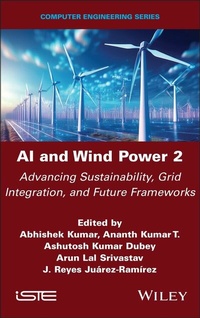
AI and Wind Power 2
Description

As wind power scales from a complementary energy source to a cornerstone of global electricity systems, the challenge is no longer simply generating more clean energy - it is integrating, sustaining and governing the energy within an increasingly complex and interconnected grid.
AI and Wind Power 2 examines how artificial intelligence (AI) is enabling this critical transition. Moving beyond turbine-level optimization, this book explores AI-driven architectures for hybrid renewable energy systems that unite wind with solar, hydro and storage. It presents advanced frameworks for smart grid management, dynamic balancing of variable resources and real-time sustainability optimization. Dedicated chapters address the economic and market impacts of AI in wind power, its role in shaping policy and regulatory frameworks, emerging applications in offshore wind, generative AI for system design and consumption behavior analysis.
An essential resource for engineers, policymakers, researchers and energy professionals, this book illuminates how intelligent systems are forging a more resilient, sustainable and adaptive energy future.
More details
Other editions
Additional editions
Persons
Abhishek Kumar is a senior IEEE member, and an assistant director and professor in the Department of Computer Science and Engineering at Chandigarh University, India.
Ananth Kumar T. is a senior IEEE member, and an associate professor and Head of the Department of Computer Science and Engineering at the IFET College of Engineering (Autonomous Institution), Tamil Nadu, India.
Ashutosh Kumar Dubey is an associate professor in the Department of Computer Science at the School of Engineering and Technology, Chitkara University, India.
Arun Lal Srivastav is an associate professor at the School of Engineering and Technology, Chitkara University, Himachal Pradesh, India.
J. Reyes Juárez-Ramírez is a professor-researcher in the Facultad de Ciencias Quíquimicas e Ingeniería, Universidad Autónoma de Baja California, Mexico.
Content
1
AI-Driven Advanced Smart Grid with Optimized Hybrid Renewable Energy Systems
1.1. Introduction
Hybrid renewable energy systems (HRES) combine multiple renewable energy sources, including solar, wind and energy storage, to provide a stable, clean and sustainable power source. By leveraging the complementary characteristics of various energy sources, HRES can minimize the reliance on traditional fossil fuels, enhance grid stability and maximize overall system reliability. Nonetheless, in spite of such advantages, HRES are fraught with inherent difficulties, such as the variability of renewable resources and energy demand and the intricacy of handling generation, storage and use simultaneously for the applications that we intend to use. Artificial Intelligence (AI) provides a revolutionary solution to overcome such difficulties by facilitating smart forecasting, control and optimization of HRES operations. Sophisticated methods, including machine learning (ML), deep learning (DL) and reinforcement learning (RL), enable these systems to forecast renewable generation and load demand accurately, adaptively regulate energy dispatch, and maximize storage use for the system under consideration, and are useful for many applications. AI-based optimization optimizes scheduling, cuts energy losses and lowers operating costs while enhancing the reliability and resilience of the power supply. The incorporation of AI into HRES has a significant effect, and not only is the technical performance improved but there are also compelling economic and environmental advantages. Through enabling accurate forecasting, component sizing at optimal levels and adaptive load management, AI-optimized systems can reduce the levelized cost of energy (LCOE) and minimize greenhouse gas emissions. With advanced smart grid infrastructures being developed, AI-optimized HRES are likely to play a central role in enabling the system practices by integrating the large-scale adoption of renewable energy, facilitating global decarbonization agendas and building a clean, self-sufficient and smart energy ecosystem for the future.
1.2. Overview of renewable energy systems
Figure 1.1. Classification of renewable energy systems.
RES use natural, renewable resources such as sunlight, wind, water, geothermal heat and biomass to produce electricity and heat. In contrast to fossil fuels, these resources are readily available, sustainable and emit very low and nominal levels of greenhouse gas emissions, rendering them crucial in countering climate change and mitigating environmental degradation (Kothona et al. 2022c). RES technologies have developed substantially, considering all the forms, from large-scale solar farms and offshore wind farms to small-scale, decentralized systems for rural electrification. Their use is necessitated by the demands for cleaner energy alternatives, energy security and adherence to the international target for sustainability. Figure 1.1 shows the categorization of renewable energy systems.
The design and operation of RES involve integrating generation technologies with supporting infrastructure such as storage units, power electronics and grid interconnections. Modern RES increasingly leverage advanced forecasting, smart grid integration and hybrid configurations to overcome intermittency and improve reliability (Diagne et al. 2013).
As technological innovation, cost reductions and supportive policies converge, RES are becoming central to global energy transitions, enabling a shift towards cleaner, more resilient and economically viable energy networks for the future.
1.2.1. Analysis of solar energy systems
Solar energy systems use sunlight to generate electricity or heat, and they provide a non-polluting, renewable energy that is sufficient (Al-Hajj et al. 2018). In general, solar energy systems operate by capturing solar radiation using photovoltaic (PV) panels or solar thermal collectors, which then convert sunlight into usable energy for residential, commercial and industrial purposes. The classification and characteristics of solar energy systems are shown in Table 1.1.
Solar energy systems' scalability enables deployment from small rooftop systems to large-scale solar farms, making them a flexible way to meet energy needs, while helping to limit reliance on fossil fuels and reduce greenhouse gas emissions. The efficiency and performance of solar energy systems depend on site-specific factors such as location, solar irradiance, panel technology, tracking methods and storage (Voyant et al. 2017). By integrating solar energy with storage and other renewable energy sources to create hybrid systems, it is possible to more reliably stabilize energy output, thus positioning solar systems to further support sustainable and resilient energy infrastructure (Kothona et al. 2021).
Table 1.1. Classification and features of solar energy systems
Type Description Key advantages Solar photovoltaic (PV) It converts sunlight directly into electricity, using semiconductor-type materials. Low maintenance, modular, scalable, silent operation. Solar thermal Uses solar energy to heat a fluid for direct heating or to produce steam for electricity generation. Efficient for heating applications, it can be integrated with industrial processes. Concentrated solar power system (CSP) Using the mirrors/lenses to concave the focus area of sunlight onto a receiver system to generate high-temperature heat for power generation. Can integrate with thermal storage for continuous generation; suitable for large-scale plants.1.2.1.1. Modeling of solar photovoltaic system
The module's current-voltage (I-V) relationship is derived from the Shockley diode equation [1.1], with additional parameters incorporated in equation [1.2] to more accurately match the PV array's measured performance
[1.1] [1.2]where qV denotes the solar irradiance falling on the PV panel surface, while Rs represents the temperature-related effect on PV parameters (Abumohsen et al. 2024). Rsh is the voltage at maximum power, and JJ is the current at that point. Figure 1.4 shows the PV solar system model.
The variables considered include the ideality factor (n), series resistance (RS) and shunt resistance (RSh). These were determined using the manufacturer-provided short-circuit current, open-circuit voltage and maximum power point from the I-V characteristics. Figure 1.2 presents the I-V curves under standard test conditions and varying solar irradiance, highlighting the temperature effect (Liao et al. 2021).
Figure 1.2. Modeling of the PV solar system.
1.2.2. Analysis of wind power systems
Wind power systems represent an important step in diversifying the global energy mix and lowering reliance on fossil fuels. Both of these objectives will help mitigate climate change and greenhouse gas emissions. Wind power is a clean form of renewable energy that can be harnessed onshore and offshore, producing sustainable electricity without depleting our natural resources (Li et al. 2025). Wind energy is an increasingly viable alternative for meeting energy demands as world energy requirements continue to increase. Wind power development protects environmental resources and supplies a reliable energy option. Therefore, wind energy will be a sustainable energy alternative for many years to come. A wide share of electricity and energy security, and independence can be sustained when incorporating wind energy. Wind power systems are categorized and classified in Table 1.2.
Technological advances, policy mechanisms and declining generation costs are some of the components that are creating a growing demand for wind power. It has also become one of the fastest-growing renewable energy technologies. Present-day wind turbines, on average, are more efficient, have higher capacity factors and include intelligent controls for better integration with the electric grid. When used alongside storage or hybrid renewable solutions, wind power can also improve supply stability, balance intermittent generation and contribute to resilient, low-carbon energy transition strategies.
Table 1.2. Classification and features of wind power systems
Type Description Key advantages Onshore wind Wind turbines are installed on land to harness wind energy. Lower installation cost, easier maintenance and established technology. Offshore wind Turbines located in oceans or large lakes for stronger, more consistent wind. Higher and more stable energy generation, minimal land use. Small-scale/micro-wind Compact wind systems for localized power generation, often for residential or remote areas. Decentralized generation is useful for off-grid applications.1.2.2.1. Analysis of the wind power modeling
We will begin by...
