

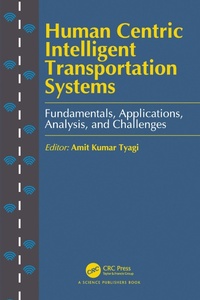
Human Centric Intelligent Transportation Systems
Fundamentals, Applications, Analysis, and Challenges
Published on 2. June 2026
408 pages
978-1-040-57275-7 (ISBN)
Description

In the era rapid technological advancement, the transportation sector stands at the cusp of a transformative era. Human-Centric Intelligent Transportation Systems (HC-ITS) represent a significant leap forward, emphasizing the integration of human factors into the design, implementation, and operation of transportation networks. This book explores the multifaceted dimensions of HC-ITS, highlighting their potential to revolutionize transportation. The foundation of HC-ITS lies in recognizing the importance of human needs, behaviors, and safety. By prioritizing these elements, HC-ITS aims to create more efficient, accessible, and safer transportation environments. This approach not only enhances user experience but also fosters a sustainable and inclusive transportation ecosystem.
This book provides a detailed overview of HC-ITS, beginning with the fundamental principles that underpin this innovative approach. It then delves into the core concepts, exploring how user-centered design, human-machine interaction, and advanced data analytics converge to create intelligent transportation solutions. The practical applications of HC-ITS are vast and varied. The volume examines their implementation in smart traffic management, public transportation systems, autonomous vehicles, and initiatives aimed at improving pedestrian and cyclist safety. Through detailed case studies and real-world examples, it illustrates how HC-ITS are being deployed to address current transportation challenges and enhance the quality of urban life.
Key features:
Explores fundamentals of human-centric ITS technologies comprehensively, including AI personalization and sensor fusion for user safety.
Provides diverse applications of human-centric ITS, such as adaptive urban mobility and personalized routing.
Provides an in-depth analysis of human-centric ITS performance metrics, like traffic flow optimization and accessibility.
Includes real-world case studies, used for emission reductions currently.
Reviews challenges and future directions of HC-ITS, focusing on privacy, equity, and multimodal integration.
This book provides a detailed overview of HC-ITS, beginning with the fundamental principles that underpin this innovative approach. It then delves into the core concepts, exploring how user-centered design, human-machine interaction, and advanced data analytics converge to create intelligent transportation solutions. The practical applications of HC-ITS are vast and varied. The volume examines their implementation in smart traffic management, public transportation systems, autonomous vehicles, and initiatives aimed at improving pedestrian and cyclist safety. Through detailed case studies and real-world examples, it illustrates how HC-ITS are being deployed to address current transportation challenges and enhance the quality of urban life.
Key features:
Explores fundamentals of human-centric ITS technologies comprehensively, including AI personalization and sensor fusion for user safety.
Provides diverse applications of human-centric ITS, such as adaptive urban mobility and personalized routing.
Provides an in-depth analysis of human-centric ITS performance metrics, like traffic flow optimization and accessibility.
Includes real-world case studies, used for emission reductions currently.
Reviews challenges and future directions of HC-ITS, focusing on privacy, equity, and multimodal integration.
More details
Language
English
Place of publication
London
United Kingdom
Publishing group
Taylor & Francis Ltd
Target group
College/higher education
Professional and scholarly
Illustrations
62 Tables, black and white; 11 Line drawings, color; 95 Line drawings, black and white; 49 Halftones, black and white; 11 Illustrations, color; 144 Illustrations, black and white
File size
28,34 MB
ISBN-13
978-1-040-57275-7 (9781040572757)
Copyright in bibliographic data and cover images is held by Nielsen Book Services Limited or by the publishers or by their respective licensors: all rights reserved.
Schweitzer Classification
Other editions
Additional editions
Amit Kumar Tyagi
Human Centric Intelligent Transportation Systems
Fundamentals, Applications, Analysis, and Challenges
Book
06/2026
1st Edition
CRC Press
€129.50
Shipment within 15-20 days
Person
Amit Kumar Tyagi has a PhD from Pondicherry Central University, Puducherry, India. He is presently working as an Assistant Professor at National Forensic Sciences University, Gandhinagar, India. Prior to this he was as an assistant professor at several institutes like Lord Krishna College of Engineering, Ghaziabad (LKCE) (for the periods of 2009-2010, and 2012-2013, Lingaya's Vidyapeeth (formerly known as Lingaya's University), Faridabad (2018-2019), VIT Chennai (2019-2022) and NIFT New Delhi (2022-2025). His supervision experience includes more than 10 Masters' dissertations and one PhD thesis. He has contributed to several projects such as "AARIN" and "P3- Block" to address some of the open issues related to the privacy breaches in Vehicular Applications like parking and Medical Cyber Physical Systems. His research focuses on Next Generation Machine Based Communications, Blockchain Technology, Smart and Secure Computing and Privacy. He is a regular member of the ACM, MIRLabs, Ramanujan Mathematical Society, Cryptology Research Society, and Universal Scientific Education and Research Network, and ISTE. He is a senior member of IEEE.
Content
Section 1: Basics and Fundamentals. 1. Digital Twins in the Modern Era of IoT and AI. 2. AI-Powered Smart Contracts in Blockchain-IoT. 3. Optimizing Vehicle-to-Cloud and Grid Interactions for Smart Energy Management of EVs. 4. Integration of 6G Technology in Transportation Systems. 5. Smart Mobility for All: Human-Centric Approaches to Personalized Transportation Solutions. Section 2: Methods and Principles. 6. Architecting IoT Edge Computing: Enhancing Resource Efficiency and Energy Optimization. 7. Network Infrastructure and Connectivity. 8. BIDA: Blockchain-Integrated Decentralized Affordable Cities Network for Modern Generation. 9. Performance Metrics and Evaluation. 10. Energy Efficient Wireless Body Area Network Technology for Prevention and Detection of Hasty Cardiac Arrest using IoT. Section 3: Applications and Use Cases. 11. Cyber Security in Intelligent Transportation Systems. 12. Predictive Maintenance Using Digital Twins: An AI-Driven Approach in IoT-Blockchain Systems. 13. Disaster-Aware Rerouting System Using Social Media-Inspired Alerts: A Network-Based Approach for Urban Traffic Management. Section 4: Open Issues and Future Research Opportunities. 14. Cybersecurity Challenges in Blockchain-IoT Ecosystems. 15. Blockestate: Revolutionizing Property Transactions. 16. Adaptive and Context-Aware Intelligent Transportation Systems toward Human-Centered Mobility for Society 5.0. 17. Integration of 6G Technology in Transportation Systems. 18. Integration of Advanced Wireless Communication Technologies 5G, 6G, and beyond in Transportation Systems: Opportunities and Challenges.
