

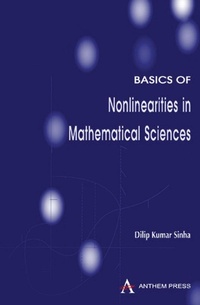
Basics of Nonlinearities in Mathematical Sciences
Description

This book is primarily an attempt to familiarize the reader with nonlinear systems, particularly qualitative characteristics, in a variety of systems amenable to mathematization. Differential equations form the bulk of the book, while the basics of nonlinearities are presented through theorems and problems, aiming to bring out the essence of some aspects of nonlinearities in the emerging discipline of mathematical science. Qualitative studies that reflect the evolution of nonlinearities have not thus far been approached in this way.
The uniqueness of the book lies in coupling historical perspectives with the latest trends in nonlinearities. Appendices are intended for inquisitive users of the book for further developments. This book will be of interest to students of mathematics at the postgraduate and undergraduate level, while those involved in the disciplines of physics, chemistry, biology, ecology, technology and economics should also find the work intriguing.
More details
Other editions
Additional editions
Person
Dilip Kumar Sinha, formerly Sir Rashbehary Ghose Professor of Applied Mathematics at the University of Calcutta is a Professor of Mathematics at Jadavpur University, Fellow of the Institute of Mathematics and its Applications (UK), Fellow of the International Academy of Mathematical Chemistry (USA Crotia) and Fellow of the National Academy of Sciences of India.
Content
Preface; Preamble; Motivation; Recapturing linear ordinary differential equations; Linear systems: qualitative behaviour; Stability studies; Study of equilibria: another approach; Non-linear vis a vis linear systems; Stability aspects: Liapunov's direct method; Manifolds: introduction and applications in nonlinearity studies; Periodicity: orbits, limit cycles, Poincare map; Bifurcations: a prelude; Catastrophes: a prelude; Theorizing, further, bifurcations and catastrophes; Dynamical systems; Epilogue; Appendix I; Appendix II; Appendix III; Appendix IV; Appendix V
