

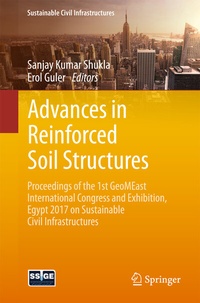
Advances in Reinforced Soil Structures
Description

Soil reinforcement is a very useful technique to construct several cost-effective soil structures in an environmentally friendly and sustainable manner. The most commonly used reinforcement materials are galvanised steel strips, geosynthetics in the form of woven geotextiles, geogrids and geocomposites, and fibres from natural and waste products. In recent years, there have been advances in the area of soil reinforcement, especially in the utilization of the technique in field projects. The researchers have also been working to understand the behaviour of reinforced soil considering the field challenges of reinforced soil structures.
This edited volume contains contributions on advances in reinforced soil structures, mainly flexible pavements, footings, embankments, stone columns/piles, and slopes, as covered in the subject areas of geosynthetic engineering and fibre-reinforced soil engineering. The first paper by Ioannis N. Markou presents the details of sand-geotextile interaction based on interface tests with conventional and large-scale direct shear equipment. The second paper by Atef Ben Othmen and Mounir Bouassida examines the interface properties of geosynthetic reinforcement by carrying out inclined plane tests under low confinement adapted to landfill covers conditions. The third paper by J.N. Jha, S.K. Shukla, A.K. Choudhary, K.S. Gill1 and B.P. Verma deals with the triaxial compression behaviour of soil reinforced with steel and aluminium solid plates in horizontal layers. The fourth paper by M. Muthukumar and S.K. Shukla describes the swelling and shrinkage behaviour of expansive soil blended with lime and fibres. The fifth paper by S.G. Shah, A.C. Bhogayata and S.K. Shukla provides the test results of shear strength of cohesionless soil reinforced with metalized plastic waste. The sixth paper by Bouacha Nadjet compares the geotextile-reinforced and geogrid-reinforced flexible pavements based on numerical analyses.
The seventh paper by S. Kumar, C.H. Solanki, J.B. Patel, P.B. Sudevan and P.M. Chaudhary reports the results of laboratory model tests carried out on a square footing resting on prestressed geotextile reinforced sand. The eighth paper by Sanoop G and Satyajit Patel presents the numerical studies on ground improvement using geosynthetic reinforced sand layer. The ninth paper by ------------------- discusses the bearing capacity prediction of inclined loaded strip footing on reinforced sand by ANN. The tenth paper by Mohamad B.D. Elsawy presents the numerical simulation of an embankment, constructed on reinforced soft soil with conventional stone piles. The eleventh paper by N.O. Sheta and R.P. Frizzi deals with the analysis, design, construction and monitoring of a geosynthetics-reinforced-earth pile-supported embankment serving as an access road. The twelfth paper by S. Banerjee, A. Adhikari, S. Chatterjee and D. Das provides the details of a case study on reinforced slope on soft soilfor the approach of a major bridge. We do hope the researchers and the engineers may find the contributions in this volume very useful. This volume is part of the proceedings of the 1st GeoMEast International Congress and Exhibition on Sustainable Civil Infrastructures, Egypt 2017.
More details
Other editions
Additional editions
Persons
Dr. Erol Guler is a full professor of geotechnical engineering at Bogazici University, Istanbul, Turkeysince 1989. He acted as the Director of Environmental Sciences Institute of Bogazici University between 1996 and 1999 and as the Chairman of the Civil Engineering Department between 2004 and 2010. He was a visiting Fulbright Professor at the University of Maryland between 1989 and 1991. Prof. Guler is the leading geosynthetic scientist in Turkey, having been an IGS Member since 1989. He founded the IGS Turkish Chapter in 2001 and served as its president until 2005, and was reelected as President again in 2011. He was the organizer for the first two national geosynthetic conferences in 2004 and 2006 and is currently the chairman of the 7th congress which will be held in 2017. He was also of the Chairman of the 2016 European Regional Conference of IGS, EuroGeo6. Prof. Guler has been a member of the International Standards Organization (ISO) Technical committee on geosynthetics as a representative of the Turkish Standards Institute since 2002. He is currently the Convener of the WG2 of ISO/TC221 (Technical Committee on geosynthetics) and is also the Convener of the WG2 of CEN-TC189 (European Committee for Standardization's Technical Committee on geosynthetics). Prof. Guler is currently an international member of the USA TRB Committee on Geosynthetics. Prof. Guler's research has focused mainly on geosynthetic reinforced walls and specifically he conducted research on the use of marginal soils in such structures and their behavior under earthquake loading conditions. His research work includes numerical studies as well as shaking table tests and full scale tests. Prof. Guler has over one hundred scientific publications. In addition to his research work, Prof. Guler has extensive practical experience, including design work for numerous projects where geosynthetics were used as reinforcement or liners.
Content
Direct Shear Testing of Sand - Geotextile Interfaces.- Consideration of geosynthetic tension in interpretation of data from inclined plane tests.- Stress -Strain Behaviour of Sand with Disc Plate-Shaped Reinforcement.- Swelling and Shrinkage Behaviour of Expansive Soil Blended with Lime and Fibres.- Feasibility of utilization of metalized plastic waste in cohesion-less soil.
