

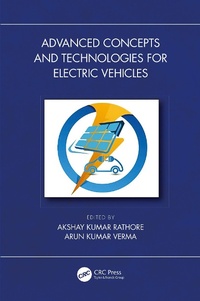
Advanced Concepts and Technologies for Electric Vehicles
1st Edition
Published on 30. August 2023
284 pages
978-1-000-92587-6 (ISBN)
Description

This book explains the basic and advanced technology behind the Power Electronics Converters for EV charging, and their significant developments, and introduces the Grid Impact issues that underpin the grid integration of electric vehicles. Advanced Concepts and Technologies for Electric Vehicles reviews state-of-the-art and new configurations and concepts of more electric vehicles and EV charging, mitigating the impact of EV charging on the power grid, and technical considerations of EV charging infrastructures.
The book considers the environmental benefits and advantages of electric vehicles and their component devices. It includes case studies of different power electronic converters used for charging EVs. It offers a review of PFC-based AC chargers, WBG-based chargers, and Wireless chargers. The authors also explore multistage charging systems and their possible implementations. The book also examines the challenges and opportunities posed by the progressive integration of electric drive vehicles on the power grid and reported solutions for their mitigation.
The book is intended for professionals, researchers, and engineers in the electric vehicle industry as well as advanced students in electrical engineering who benefit from this comprehensive coverage of electric vehicle technology. Readers can get an in-depth insight into the technology deployment in EV transportation and utilize that knowledge to develop novel ideas in the EV area.
The book considers the environmental benefits and advantages of electric vehicles and their component devices. It includes case studies of different power electronic converters used for charging EVs. It offers a review of PFC-based AC chargers, WBG-based chargers, and Wireless chargers. The authors also explore multistage charging systems and their possible implementations. The book also examines the challenges and opportunities posed by the progressive integration of electric drive vehicles on the power grid and reported solutions for their mitigation.
The book is intended for professionals, researchers, and engineers in the electric vehicle industry as well as advanced students in electrical engineering who benefit from this comprehensive coverage of electric vehicle technology. Readers can get an in-depth insight into the technology deployment in EV transportation and utilize that knowledge to develop novel ideas in the EV area.
More details
Edition
1. Auflage
Language
English
Place of publication
London
United Kingdom
Publishing group
Taylor & Francis Ltd
Target group
Professional and scholarly
Illustrations
171 Line drawings, black and white; 21 Halftones, black and white; 192 Illustrations, black and white
ISBN-13
978-1-000-92587-6 (9781000925876)
Copyright in bibliographic data and cover images is held by Nielsen Book Services Limited or by the publishers or by their respective licensors: all rights reserved.
Schweitzer Classification
Other editions
Additional editions
Akshay Kumar Rathore | Arun Kumar Verma
Advanced Concepts and Technologies for Electric Vehicles
Book
05/2025
1st Edition
CRC Press
€76.70
Shipment within 10-20 days
Akshay Kumar Rathore | Arun Kumar Verma
Advanced Concepts and Technologies for Electric Vehicles
Book
08/2023
1st Edition
CRC Press
€187.60
Shipment within 10-20 days
Persons
Akshay Kumar Rathore (IEEE Fellow) is a professor (Engineering) at the Singapore Institute of Technology, Singapore. Prior to this appointment, he served as an associate professor at Concordia University, Montreal, Canada and as an assistant professor at the National University of Singapore, Singapore. He received his Master of Technology degree in electrical machines and drives from the Indian Institute of Technology (BHU) Varanasi, India, in 2003, and his Ph.D. in power electronics from the University of Victoria, British Columbia, Canada in 2008. Dr. Rathore is a recipient of the 2013 IEEE IAS Andrew W. Smith Outstanding Young Member Achievement Award, 2014 Isao Takahashi Power Electronics Award, 2017 IEEE IES David Irwin Early Career Award, 2020 IEEE Bimal Bose Award for Industrial Electronics Applications in Energy Systems, and 2021 Nagamori Award.
Arun Kumar Verma is a senior member of IEEE, received his master's degree in Energy Studies and his Ph.D. in Power Electronics from the Indian Institute of Technology Delhi, New Delhi, India, in 2010 and 2015, respectively. He was a visiting graduate researcher with the Smart Grid Energy Research Centre(SMERC), University of California, Los Angeles, CA, USA, during 2014-2015. He was a postdoctoral research fellow with the Energy Research Institute, Nanyang Technological University, Singapore, during 2015-2016. He is currently an Associate Professor in the Department of Electrical Engineering at the Indian Institute of Technology, Jammu, India. Prior to this appointment, he served as an Assistant Professor with the Department of Electrical Engineering, Malaviya National Institute of Technology Jaipur, Jaipur, India. He won the prestigious BASE fellowship for advanced solar energy research in 2014. He has been conferred with the prestigious POSOCO Power System Research Award 2016.
Arun Kumar Verma is a senior member of IEEE, received his master's degree in Energy Studies and his Ph.D. in Power Electronics from the Indian Institute of Technology Delhi, New Delhi, India, in 2010 and 2015, respectively. He was a visiting graduate researcher with the Smart Grid Energy Research Centre(SMERC), University of California, Los Angeles, CA, USA, during 2014-2015. He was a postdoctoral research fellow with the Energy Research Institute, Nanyang Technological University, Singapore, during 2015-2016. He is currently an Associate Professor in the Department of Electrical Engineering at the Indian Institute of Technology, Jammu, India. Prior to this appointment, he served as an Assistant Professor with the Department of Electrical Engineering, Malaviya National Institute of Technology Jaipur, Jaipur, India. He won the prestigious BASE fellowship for advanced solar energy research in 2014. He has been conferred with the prestigious POSOCO Power System Research Award 2016.
Content
1. Introduction to Electric Vehicles
Kirti Mathuria, Monika Dabkara, Santhosh S, Sandeep N, Arun Kumar Verma, and Harpal Tiwari
2. Introduction to EV Charging Systems
Kirti Mathuria, Asmita Singh, Sandeep N, Arun Kumar Verma, Saravana Prakash P, and Harpal Tiwari
3. Basic Power Factor Correction (PFC) Converters for Plug-in EV Charging
Abhinandan Dixit, Karan Pande, and Akshay Kumar Rathore
4. A Comprehensive Overview of Wide Band-Gap (WBG)-Based DC-DC Converters for Fast Plug-in EV Charging
Nil Patel, Luiz A. C. Lopes, and Akshay Kumar Rathore
5. Advance Current-fed DC/DC Converters
Pan Xuewei and Akshay Kumar Rathore
6. Wireless Inductive Power Transfer
Suvendu Samanta and Akshay Kumar Rathore
7. Power Grid Impacts of Electric Vehicle (EV) Integration
D. S. Kumar, A. Sharma, and C. D. Rodriguez-Gallegos
8. Energy Storage in EVs and Mitigating Impact of EV Charging on Power Grid
B. Sivaneasan, N. K. Kandasamy, K. T. Tan, and D. R. Thinesh
9. Electric Vehicle Development in Singapore and Technical Considerations for Charging Infrastructure
Elsa Feng Xue
Kirti Mathuria, Monika Dabkara, Santhosh S, Sandeep N, Arun Kumar Verma, and Harpal Tiwari
2. Introduction to EV Charging Systems
Kirti Mathuria, Asmita Singh, Sandeep N, Arun Kumar Verma, Saravana Prakash P, and Harpal Tiwari
3. Basic Power Factor Correction (PFC) Converters for Plug-in EV Charging
Abhinandan Dixit, Karan Pande, and Akshay Kumar Rathore
4. A Comprehensive Overview of Wide Band-Gap (WBG)-Based DC-DC Converters for Fast Plug-in EV Charging
Nil Patel, Luiz A. C. Lopes, and Akshay Kumar Rathore
5. Advance Current-fed DC/DC Converters
Pan Xuewei and Akshay Kumar Rathore
6. Wireless Inductive Power Transfer
Suvendu Samanta and Akshay Kumar Rathore
7. Power Grid Impacts of Electric Vehicle (EV) Integration
D. S. Kumar, A. Sharma, and C. D. Rodriguez-Gallegos
8. Energy Storage in EVs and Mitigating Impact of EV Charging on Power Grid
B. Sivaneasan, N. K. Kandasamy, K. T. Tan, and D. R. Thinesh
9. Electric Vehicle Development in Singapore and Technical Considerations for Charging Infrastructure
Elsa Feng Xue
