

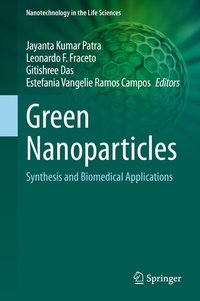
Green Nanoparticles
Synthesis and Biomedical Applications
1st Edition
Published on 6. April 2020
X, 394 pages
978-3-030-39246-8 (ISBN)
Description

Nanotechnology is the application of science to control matter at the molecular level. It has become one of the most promising applied technologies in all areas of science. Nanoparticles have multi-functional properties and have created very interesting applications in various fields such as medicine, nutrition, bioenergy, agriculture and the environment.
But the biogenic syntheses of monodispersed nanoparticles with specific sizes and shapes have been a challenge in biomaterial science. Nanoparticles are of great interest due to their extremely small size and large surface-to-volume ratio, which lead to both chemical and physical differences in their properties (e.g., mechanical properties, biological and sterical properties, catalytic activity, thermal and electrical conductivity, optical absorption and melting point) compared to bulk of the same chemical composition. Recently, however, synthesizing metal nanoparticles using green technology via microorganisms, plants, viruses, and so on, has been extensively studied and has become recognized as a green and efficient way for further exploiting biological systems as convenient nanofactories. Thus the biological synthesis of nanoparticles is increasingly regarded as a rapid, ecofriendly, and easily scaled-up technology.
Today researchers are developing new techniques and materials using nanotechnology that may be suitable for plants to boost their native functions. Recently, biological nanoparticles were found to be more pharmacologically active than physico-chemically synthesized nanoparticles. Various applications of biosynthesized nanoparticles have been discovered, especially in the field of biomedical research, such as applications to specific delivery of drugs, use for tumor detection, angiogenesis, genetic disease and genetic disorder diagnosis, photoimaging, and photothermal therapy. Further, iron oxide nanoparticles have been applied to cancer therapy,hyperthermia, drug delivery, tissue repair, cell labeling, targeting and immunoassays, detoxification of biological fluids, magnetic resonance imaging, and magnetically responsive drug delivery therapy.
Nanoparticle synthesis for plant byproducts for biomedical applications has vast potential. This book offers researchers in plant science and biomedicine the latest research and opportunity to develop new tools for the synthesis of environmentally friendly and cost-effective nanoparticles for applications in biomedicine as well as other various fields.
But the biogenic syntheses of monodispersed nanoparticles with specific sizes and shapes have been a challenge in biomaterial science. Nanoparticles are of great interest due to their extremely small size and large surface-to-volume ratio, which lead to both chemical and physical differences in their properties (e.g., mechanical properties, biological and sterical properties, catalytic activity, thermal and electrical conductivity, optical absorption and melting point) compared to bulk of the same chemical composition. Recently, however, synthesizing metal nanoparticles using green technology via microorganisms, plants, viruses, and so on, has been extensively studied and has become recognized as a green and efficient way for further exploiting biological systems as convenient nanofactories. Thus the biological synthesis of nanoparticles is increasingly regarded as a rapid, ecofriendly, and easily scaled-up technology.
Today researchers are developing new techniques and materials using nanotechnology that may be suitable for plants to boost their native functions. Recently, biological nanoparticles were found to be more pharmacologically active than physico-chemically synthesized nanoparticles. Various applications of biosynthesized nanoparticles have been discovered, especially in the field of biomedical research, such as applications to specific delivery of drugs, use for tumor detection, angiogenesis, genetic disease and genetic disorder diagnosis, photoimaging, and photothermal therapy. Further, iron oxide nanoparticles have been applied to cancer therapy,hyperthermia, drug delivery, tissue repair, cell labeling, targeting and immunoassays, detoxification of biological fluids, magnetic resonance imaging, and magnetically responsive drug delivery therapy.
Nanoparticle synthesis for plant byproducts for biomedical applications has vast potential. This book offers researchers in plant science and biomedicine the latest research and opportunity to develop new tools for the synthesis of environmentally friendly and cost-effective nanoparticles for applications in biomedicine as well as other various fields.
More details
Series
Language
English
Place of publication
Cham
Switzerland
Publishing group
Springer International Publishing
Target group
Professional and scholarly
Product notice
Reflowable
Illustrations
X, 394 p. 72 illus., 64 illus. in color.
File size
10,37 MB
ISBN-13
978-3-030-39246-8 (9783030392468)
DOI
10.1007/978-3-030-39246-8
Schweitzer Classification
Other editions
Additional editions
Jayanta Kumar Patra | Leonardo F. Fraceto | Gitishree Das
Green Nanoparticles
Synthesis and Biomedical Applications
Book
04/2020
Springer
€299.59
Shipment within 7-9 days
Persons
Jayanta KumarAssistant ProfessorResearch Institute of Biotechnology and Medical Converged ScienceDongguk UniversityRepublic of Korea
Leonardo Fernandes FracetoProfessorSão Paulo State University (UNESP)
Institute of Science and Technology of Sorocaba
Brazil
Gitishree DasAssistant ProfessorResearch Institute of Biotechnology and Medical Converged ScienceDongguk UniversityRepublic of Korea
Estefânia Vangelie Ramos Campos
São Paulo State University (UNESP)
Institute of Science and Technology of Sorocaba
Brazil
Leonardo Fernandes FracetoProfessorSão Paulo State University (UNESP)
Institute of Science and Technology of Sorocaba
Brazil
Gitishree DasAssistant ProfessorResearch Institute of Biotechnology and Medical Converged ScienceDongguk UniversityRepublic of Korea
Estefânia Vangelie Ramos Campos
São Paulo State University (UNESP)
Institute of Science and Technology of Sorocaba
Brazil
Content
Preface.- Biomedical applications of stimuli responsive hydrogels.- Nanosystem for local anesthetics: A review of patents and commercial products.- Application of biosynthesized metal-based nanoparticles.- Topical delivery of drugs for skin diseases treatment.- Challenges in nanobiosensors for bioscience applications.- Anti-cancer nanomaterials.- Evaluation of the safety of nanomaterials in medical applications.- Green Synthesis of nanoparticles by mangrove plant and its biomedical application.- Biological synthesis of nanoparticles and their applications.- Nanoparticles in biomedical applications.- Nanoparticles and its application in DNA technology.- Nanotoxicology in Plants.- Nanoparticles on Phytosynthesis of plants: effects and role.- Carbon nanotubes as plant growth regulators: future prospects.- Index.
