

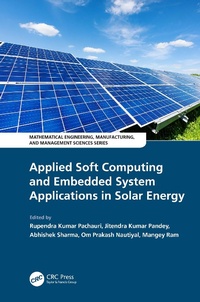
Applied Soft Computing and Embedded System Applications in Solar Energy
1st Edition
Published on 26. May 2021
254 pages
978-1-000-39169-5 (ISBN)
Description

Applied Soft Computing and Embedded System Applications in Solar Energy deals with energy systems and soft computing methods from a wide range of approaches and application perspectives. The authors examine how embedded system applications can deal with the smart monitoring and controlling of stand-alone and grid-connected solar photovoltaic (PV) systems for increased efficiency. Growth in the area of artificial intelligence with embedded system applications has led to a new era in computing, impacting almost all fields of science and engineering. Soft computing methods implemented to energy-related problems regularly face data-driven issues such as problems of optimization, classification, clustering, or prediction. The authors offer real-time implementation of soft computing and embedded system in the area of solar energy to address the issues with microgrid and smart grid projects (both renewable and non-renewable generations), energy management, and power regulation. They also discuss and examine alternative solutions for energy capacity assessment, energy efficiency systems design, as well as other specific smart grid energy system applications. The book is intended for students, professionals, and researchers in electrical and computer engineering fields, working on renewable energy resources, microgrids, and smart grid projects.
Examines the integration of hardware with stand-alone PV panels and real-time monitoring of factors affecting the efficiency of the PV panels
Offers real-time implementation of soft computing and embedded system in the area of solar energy
Discusses how soft computing plays a huge role in the prediction of efficiency of stand-alone and grid-connected solar PV systems
Discusses how embedded system applications with smart monitoring can control and enhance the efficiency of stand-alone and grid-connected solar PV systems
Explores swarm intelligence techniques for solar PV parameter estimation
Dr. Rupendra Kumar Pachauri is Assistant Professor - Selection Grade in the Department of Electrical and Electronics Engineering, University of Petroleum and Energy Studies (UPES), Dehradun, India.
Dr. Jitendra Kumar Pandey is Professor & Head of R&D in the University of Petroleum and Energy Studies (UPES), Dehradun, India.
Mr. Abhishek Sharma is working as a research scientist in the research and development department (UPES, India).
Dr. Om Prakash Nautiyal is working as a scientist in Uttarakhand Science Education & Research Centre (USERC), Department of Information and Science Technology, Govt. of Uttarakhand, Dehradun, India.
Prof. Mangey Ram is working as a Research Professor at Graphic Era Deemed to be University, Dehradun, India.
Examines the integration of hardware with stand-alone PV panels and real-time monitoring of factors affecting the efficiency of the PV panels
Offers real-time implementation of soft computing and embedded system in the area of solar energy
Discusses how soft computing plays a huge role in the prediction of efficiency of stand-alone and grid-connected solar PV systems
Discusses how embedded system applications with smart monitoring can control and enhance the efficiency of stand-alone and grid-connected solar PV systems
Explores swarm intelligence techniques for solar PV parameter estimation
Dr. Rupendra Kumar Pachauri is Assistant Professor - Selection Grade in the Department of Electrical and Electronics Engineering, University of Petroleum and Energy Studies (UPES), Dehradun, India.
Dr. Jitendra Kumar Pandey is Professor & Head of R&D in the University of Petroleum and Energy Studies (UPES), Dehradun, India.
Mr. Abhishek Sharma is working as a research scientist in the research and development department (UPES, India).
Dr. Om Prakash Nautiyal is working as a scientist in Uttarakhand Science Education & Research Centre (USERC), Department of Information and Science Technology, Govt. of Uttarakhand, Dehradun, India.
Prof. Mangey Ram is working as a Research Professor at Graphic Era Deemed to be University, Dehradun, India.
More details
Series
Edition
1. Auflage
Language
English
Place of publication
London
United Kingdom
Publishing group
Taylor & Francis Ltd
Target group
Professional and scholarly
Illustrations
39 Tables, black and white; 77 Line drawings, black and white; 53 Halftones, black and white; 130 Illustrations, black and white
ISBN-13
978-1-000-39169-5 (9781000391695)
Copyright in bibliographic data and cover images is held by Nielsen Book Services Limited or by the publishers or by their respective licensors: all rights reserved.
Schweitzer Classification
Other editions
Additional editions
Rupendra Kumar Pachauri | Jitendra Kumar Pandey | Abhishek Sharmu
Applied Soft Computing and Embedded System Applications in Solar Energy
Book
09/2023
1st Edition
CRC Press
€76.50
Shipment within 15-20 days
Rupendra Kumar Pachauri | Jitendra Kumar Pandey | Abhishek Sharmu
Applied Soft Computing and Embedded System Applications in Solar Energy
Book
05/2021
1st Edition
CRC Press
€206.50
Shipment within 15-20 days
Persons
Dr. Rupendra Kumar Pachauri is Assistant Professor- Selection Grade in the Department of Electrical and Electronics Engineering, University of Petroleum and Energy Studies (UPES), Dehradun, India.
Dr. Jitendra Kumar Pandey is Professor & Head R&D in the University of Petroleum and Energy Studies (UPES), Dehradun, India.
Mr. Abhishek Sharma is working as a research scientist in research and development department (UPES, India).
Dr. Om Prakash Nautiyal is working as a 'Scientist' in Uttarakhand Science Education & Research Centre (USERC), Department of Information and Science Technology, Govt. of Uttarakhand, Dehradun, India.
Prof. Mangey Ram is working as a Research Professor at Graphic Era Deemed to be University, Dehradun, India.
Dr. Jitendra Kumar Pandey is Professor & Head R&D in the University of Petroleum and Energy Studies (UPES), Dehradun, India.
Mr. Abhishek Sharma is working as a research scientist in research and development department (UPES, India).
Dr. Om Prakash Nautiyal is working as a 'Scientist' in Uttarakhand Science Education & Research Centre (USERC), Department of Information and Science Technology, Govt. of Uttarakhand, Dehradun, India.
Prof. Mangey Ram is working as a Research Professor at Graphic Era Deemed to be University, Dehradun, India.
Content
1. MPPT Control Systems for PV Power Plants.
2. Relay Coordination Optimization for Solar PV Integrated Grid Using the Water Cycle Optimization Algorithm.
3. Experimental Investigation of Performance of PV Array Topologies under Simulated PSCs.
4. Artificial Intelligence in PV System.
5. Thermodynamic Approaches and Techniques for Solar Energy Conversion.
6. Memristive Behavior: Tool for Fault Detection and Repairing Dye Solar Cells.
7. Development of IoT-Based Data Acquisition System for Real-Time Monitoring of Solar PV System.
8. Marine Photovoltaics - An IoT-Integrated Approach to Enhance Efficiency.
9. Deep Learning Approach towards Solar Energy Forecast.
10. The Imperative Role of Solar Power Assistance for Embedded Based Climatic Parameters Measurement Systems.
11. IoT with Automation Clustering to Detect Power Losses with Energy Consumption and Survey of Defense Machinery against Attacks
2. Relay Coordination Optimization for Solar PV Integrated Grid Using the Water Cycle Optimization Algorithm.
3. Experimental Investigation of Performance of PV Array Topologies under Simulated PSCs.
4. Artificial Intelligence in PV System.
5. Thermodynamic Approaches and Techniques for Solar Energy Conversion.
6. Memristive Behavior: Tool for Fault Detection and Repairing Dye Solar Cells.
7. Development of IoT-Based Data Acquisition System for Real-Time Monitoring of Solar PV System.
8. Marine Photovoltaics - An IoT-Integrated Approach to Enhance Efficiency.
9. Deep Learning Approach towards Solar Energy Forecast.
10. The Imperative Role of Solar Power Assistance for Embedded Based Climatic Parameters Measurement Systems.
11. IoT with Automation Clustering to Detect Power Losses with Energy Consumption and Survey of Defense Machinery against Attacks
