

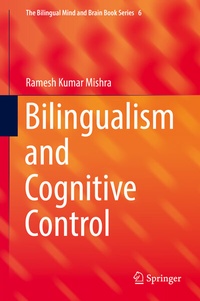
Bilingualism and Cognitive Control
Description

This thought-provoking monograph makes a multidisciplinary case for bilingualism as a possible enhancer of executive function, particularly cognitive control. Its central focus is the cognitive operations of the bilingual brain in processing two languages and whether they afford the brain a greater edge on neuroplasticity-in short, a cognitive advantage. Major issues and controversies in the debate are analyzed from cognitive neuroscience, psycholinguistic, and integrative perspectives, with attention paid to commonly and rarely studied domains at work in bilingual processing. The author also pinpoints future areas for improved research such as recognizing the diversity of bilingualism, not simply in languages spoken but also in social context, as seen among immigrants and refugees.
Included in the coverage:
-
The evolution of bilingualism.
-
What goes on in a bilingual mind? The core cognitive mechanisms.
-
Cognitive advantage ofbilingualism and its criticisms.
-
Neuroscience of bilingualism.
-
Bilingualism, context, and control.
-
Attention, vision, and control in bilinguals.
With its cogent takes on ongoing questions and emerging issues, Bilingualism and Cognitive Control is of immediate interest to bilingual researchers and practitioners interested in understanding the behavioral aspects and neurobiology of bilingualism and the dynamic character of the bilingual/multilingual/second language learner's mind, as well as the growing number of advanced undergraduate and graduate students interested in the psychology/psycholinguistics of bilingualism, bilingual cognitive psychology, cognitive science, and cognitive neuroscience.
More details
Other editions
Additional editions
Person
Ramesh Kumar Mishra is a cognitive scientist and chair of the Center for Neural and Cognitive Sciences, University of Hyderabad, a major research university of India. He has published widely in the areas of attention, visual processing, bilingualism and language processing. He has also published on literacy and its influence on cognition. He has edited or authored three books (Mishra, 2015; Mishra, Huettig, & Srinivasan, 2015; Mishra & Srinivasan, 2011) so far in the area of language-vision interaction. He is also an editorial board member of Bilingualism: Language and Cognition . His dual expertise in cognitive psychology (attention, vision and executive control) and psycholinguistics of bilingualism (language non-selective activation, visual world eye tracking) helps him to explore in-depth the cognitive science angle to the bilingual advantage effect. He is the Editor-in-Chief of the International Journal of Cultural Cognitive Science (Springer) and is a fellow of the Psychonomic Society.
Content
Chapter 1: Introduction.- Chapter 2: The Evolution of Bilingualism.- Chapter 3: What Goes On in a Bilingual Mind? The Core Cognitive Mechanisms.- Chapter 4: Cognitive Advantage of Bilingualism and its Criticisms.- Chapter 5: Neuroscience of Bilingualism.- Chapter 6: Bilingualism, Context, and Control.- Chapter 7: Attention, Vision, and Control in Bilinguals.- Chapter 8: Conclusion.
