

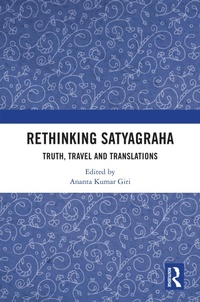
Rethinking Satyagraha
Truth, Travel and Translation
Published on 9. June 2025
356 pages
978-1-040-36220-4 (ISBN)
Description

Rethinking Satyagraha: Truth, Travel and Translations explores the multi-dimensional aspects of Satyagraha as a movement of being with and striving for and fighting for Truth and Truth realizations. The book goes beyond the conventional discourse of Satyagraha as a social and political action that Gandhi undertook, and links this to the wider moral, philosophical and spiritual quest that are implicated in Satyagraha with and beyond Gandhi. It links Satyagraha to our efforts to overcome the dualism between self and other in various ways. It also relates work and meditation with Truth in Satyagraha to translation and travel. It cultivates a new hermeneutics, politics and spirituality of Satyagraha which is simultaneously everyday and epochal. The book further invites us to rethink and transform the post-Truth discourse and live with Truth and truths-relative, relational and Absolute-with care, courage, creativity and transcendence.
With contribution from leading scholars from across the world, Rethinking Satyagraha is a pioneering effort in reiterating the epochal significance of Satyagraha for the 21st century. It makes an important contribution to contemporary Gandhian scholarship and new horizons of social and political theory. It will be of interest to scholars and researchers of movement and resistance studies, Gandhi, Indian philosophy, cultural studies, literary studies, religious studies, development studies, sociology, anthropology, political science and future studies.
With contribution from leading scholars from across the world, Rethinking Satyagraha is a pioneering effort in reiterating the epochal significance of Satyagraha for the 21st century. It makes an important contribution to contemporary Gandhian scholarship and new horizons of social and political theory. It will be of interest to scholars and researchers of movement and resistance studies, Gandhi, Indian philosophy, cultural studies, literary studies, religious studies, development studies, sociology, anthropology, political science and future studies.
Reviews / Votes
Satyagraha, the centre of gravity of this timely book, is a phenomenon that has a venerable, indeed, a noble history. It denotes the defining human characteristic of spontaneity - the embodied force striving towards and driving the non-violent renewal of the human form of life through enlightenment and liberation asobserved, for example, in social activism and movements. While oriented towards real achievements under concrete conditions, the process is nevertheless throughout directed and guided by deep-seated concerns regarding adequate knowledge of our world, the moral organisation of social and political life and ethical subjectivity.Although the enabling spontaneous striving is thus firmly undergirded, such intuitive awareness of the structure of human activity by nomeans occludes the process, barring pathological cases, but rather infinitely keeps it open. As the title of the collection assembled under the able editorship of Ananta Kumar Giri intimates, satyagraha possesses an acute relevance for our 21st-century crisis-ridden global world that we should reflexively re-appropriate and make our own.Piet Strydom, University College Cork, Ireland
This remarkable collection opens up new horizons for scholars, activists and critical thinkers by looking through and beyond the concept of Satyagraha to pose new questions about movement, co-productive dialogue and the dynamic nature of truth. It is a philosophical work that refuses any quick road to transcendence.
Arjun Appadurai, Emeritus Professor of Media, Culture and Communication, New York University
This book is a timely gift to humanity. At a time ofwarmongering and of barbarian destruction of peoples, livelihoods and cultures this book invites us to pause and to meditate on and valorize all the convivial potential of Satyagraha. Gandhi was a remarkable intercultural translator and Ananta Kumar Giri and his fellow contributors follow his lead enriching it with new and innovative perspectives in light of the new challenges the world is facing.
Boaventura de Sousa Santos, Emeritus Professor, University of Coimbra, Portugal, and author of Law and the Epistemologies of the South (2023)
An ensemble of scholars gathered here to engage in a dialogue with Gandhi. Of the themes discussed, the exploration of the significance of walking in Gandhi's life is especially interesting. Like spinning cotton on the charkha, it was primarily a form of meditation, besides and before its place and symbolism (from the solitary walk to the collective padayatra) in the campaign against colonial rule. We live in a violent world which hardly leaves a space for dialogue. We live in a solipsistic world (of SUVs with dark windows) which leaves no room for the other. This anthology invites us to walk together - with each other, with the contributors, and with Gandhiji - to rediscover the power of dialogue (with open ears, no earbuds) and the joy of walking.
Daniel Raveh, Professor of Indian and Comparative Philosophy, Tel Aviv University, Israel
With millions dying due to intrastate and interstate wars, Gandhi's "experiments with truth" are proving ever more wise and urgent.These excellent essays should be read and their advice heeded.
Robert McDermott, President Emeritus and Professor Emeritus, California Institute of Integral Studies (CIIS), San Francisco, USA
More details
Language
English
Place of publication
London
United Kingdom
Publishing group
Taylor & Francis Ltd
Target group
College/higher education
File size
1,56 MB
ISBN-13
978-1-040-36220-4 (9781040362204)
Copyright in bibliographic data and cover images is held by Nielsen Book Services Limited or by the publishers or by their respective licensors: all rights reserved.
Schweitzer Classification
Other editions
Additional editions
Book
06/2025
1st Edition
Routledge
€198.30
Shipment within 15-20 days
Person
Ananta Kumar Giri is the Founding Honorary Executive Trustee of Vishwaneedam Center for Asian Blossoming, Puducherry and Chennai. After three decades of service, he retired as a Professor from the Madras Institute of Development Studies, Chennai, India, in March 2025. He has taught and done research in many universities in India and abroad, including Aalborg University (Denmark), Maison des sciences de l'homme (Paris, France), the University of Kentucky (USA), University of Freiburg & Humboldt University (Germany), Jagiellonian University (Poland), and Jawaharlal Nehru University (New Delhi). He has an abiding interest in social movements and cultural change, criticism, creativity and contemporary dialectics of transformation, theories of self, culture and society, and creative streams in education, philosophy, and literature. Dr Giri has written and edited more than six dozen books in Odia and English.
Content
Rethinking Satyagraha: An Introduction and an Invitation
Part I: Rethinking Satyagraha: Truth, Travel and Translation
1. Rethinking Satyagraha: Truth, Travel and Translation
2. Rethinking Gandhi's Philosophy and Practice of Satyagraha: Insights, Misconceptions, and Reformulations
3. Reclaiming Satyagraha: Truth, Travel and Translation
4. In Search of Inter-religious Truth: The Acts of Travel and Translation in Comparative Theology
Part II: Rethinking Satyagraha: Religion, Spirituality and Beyond
5. Imam Hussain, Gandhi, Gaffar Khan and the Traditions of Satyagraha and Winning Martyrdom in Islam
6. Satyagraha and Gandhi's Religious Ethics
7. Satyagraha: The Complex Legacy of Gandhi and Buber
8. Gandhi-Religion-Spirituality: Satyagraha in the 21st Century
9. Satyagraha and the making and un-making of Gandhi's Swaraj
10. Satyagraha, Three Gunas and the Calling of Hope: Plato, Gandhi, Moltzman and Beyond
11 Gandhi and Mandela, The Two Pioneers of Satyagraha Movement: A Comparative Analysis
12. Spirituality, Seva and the Art of Seeking the Truth: Perspectives from the Guru-led Seva Movements in India
Part III: Rethinking Satyagraha: Ethics, Aesthetics, Politics and Beyond
13. Gandhi on Non-Violence in Action, Education and Satyagraha
14. Satyagraha as Emancipation: Gandhi, Kallenbach and Naidoo
15. Wittgenstein and Gandhi: Religion, Politics, Mysticism and Social Critique
16. Satyagraha as Pure Means: Recovering Gandhi's Politics of the Body in Dialogue with Agamben's Contemporary Political Theory
17. Doing Without a Patrimonial Ruler and the Divine Right of Kings: Satyagraha, Democracy and Egalitarianism
18. Gandhi's Experiment with Walking / Padayatras: An unfolding of a Moral Space
Afterword by Marcus Bussey
Part I: Rethinking Satyagraha: Truth, Travel and Translation
1. Rethinking Satyagraha: Truth, Travel and Translation
2. Rethinking Gandhi's Philosophy and Practice of Satyagraha: Insights, Misconceptions, and Reformulations
3. Reclaiming Satyagraha: Truth, Travel and Translation
4. In Search of Inter-religious Truth: The Acts of Travel and Translation in Comparative Theology
Part II: Rethinking Satyagraha: Religion, Spirituality and Beyond
5. Imam Hussain, Gandhi, Gaffar Khan and the Traditions of Satyagraha and Winning Martyrdom in Islam
6. Satyagraha and Gandhi's Religious Ethics
7. Satyagraha: The Complex Legacy of Gandhi and Buber
8. Gandhi-Religion-Spirituality: Satyagraha in the 21st Century
9. Satyagraha and the making and un-making of Gandhi's Swaraj
10. Satyagraha, Three Gunas and the Calling of Hope: Plato, Gandhi, Moltzman and Beyond
11 Gandhi and Mandela, The Two Pioneers of Satyagraha Movement: A Comparative Analysis
12. Spirituality, Seva and the Art of Seeking the Truth: Perspectives from the Guru-led Seva Movements in India
Part III: Rethinking Satyagraha: Ethics, Aesthetics, Politics and Beyond
13. Gandhi on Non-Violence in Action, Education and Satyagraha
14. Satyagraha as Emancipation: Gandhi, Kallenbach and Naidoo
15. Wittgenstein and Gandhi: Religion, Politics, Mysticism and Social Critique
16. Satyagraha as Pure Means: Recovering Gandhi's Politics of the Body in Dialogue with Agamben's Contemporary Political Theory
17. Doing Without a Patrimonial Ruler and the Divine Right of Kings: Satyagraha, Democracy and Egalitarianism
18. Gandhi's Experiment with Walking / Padayatras: An unfolding of a Moral Space
Afterword by Marcus Bussey
