

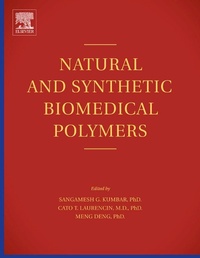
Natural and Synthetic Biomedical Polymers
Published on 21. January 2014
420 pages
978-0-12-397290-3 (ISBN)
Description

Polymers are important and attractive biomaterials for researchers and clinical applications due to the ease of tailoring their chemical, physical and biological properties for target devices. Due to this versatility they are rapidly replacing other classes of biomaterials such as ceramics or metals. As a result, the demand for biomedical polymers has grown exponentially and supports a diverse and highly monetized research community. Currently worth $1.2bn in 2009 (up from $650m in 2000), biomedical polymers are expected to achieve a CAGR of 9.8% until 2015, supporting a current research community of approximately 28,000+.
Summarizing the main advances in biopolymer development of the last decades, this work systematically covers both the physical science and biomedical engineering of the multidisciplinary field. Coverage extends across synthesis, characterization, design consideration and biomedical applications. The work supports scientists researching the formulation of novel polymers with desirable physical, chemical, biological, biomechanical and degradation properties for specific targeted biomedical applications.
- Combines chemistry, biology and engineering for expert and appropriate integration of design and engineering of polymeric biomaterials
- Physical, chemical, biological, biomechanical and degradation properties alongside currently deployed clinical applications of specific biomaterials aids use as single source reference on field.
- 15+ case studies provides in-depth analysis of currently used polymeric biomaterials, aiding design considerations for the future
More details
Other editions
Additional editions
Sangamesh G. Kum Bar | Cato Laurencin | Meng Deng
Natural and Synthetic Biomedical Polymers
Book
01/2014
Elsevier
€120.50
Shipment within 15-20 days
Content
Section 1. Synthesis and Characterization1.1. Polymer Synthesis: the design and synthesis of important classes of polymeric biomaterials involving different monomers will be discussed.1.2. Characterization of Polymeric Biomaterials: in vitro and in vivo characterization of advanced biomaterials, (cell and tissue interactions with polymeric biomaterials with various physico-chemical, mechanical properties, surface and degradation propertiesSection 2. Currently Used Materials2.1. Proteins and poly(amino acids) including collagen, poly(amino acids), elastin and elastin-like polypeptides, albumin, and fibrin2.2. Polysaccharides including hyaluronic acid, chondroitin sulfate, chitin and chitosan, and alginic acid2.3. Poly(a-ester)s including polylactides, polyglycolide, poly(lactide-co-glycolide), polycaprolactone, and bacterial polyesters2.4. Polyurethanes2.5. Poly(ester amide)2.6. Poly(ortho esters)2.7. Polyanhydrides2.8. Poly(propylene fumarate)2.9. Polyphosphazenes2.10. Pseudo poly(amino acid)s2.11. Polyphosphoester2.12. Polyacetals2.13. Poly(ethylene glycol)-based biomaterials2.14. Dendrimers2.15. ElastomersSection 3. Biomedical Applications of Polymeric Biomaterials3.1. Polymeric Biomaterials in Biomedical Implants3.2. Polymeric Biomaterials in Drug Delivery3.3. Polymeric Biomaterials in Tissue Engineering3.4. Polymeric Biomaterials in Medical Diagnostics
