

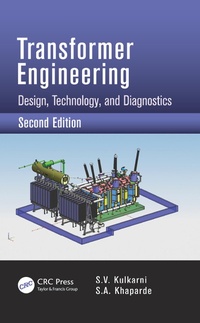
Transformer Engineering
Design, Technology, and Diagnostics, Second Edition
2nd Edition
Published on 19. December 2017
750 pages
978-1-4398-5418-1 (ISBN)
Description

Transformer Engineering: Design, Technology, and Diagnostics, Second Edition helps you design better transformers, apply advanced numerical field computations more effectively, and tackle operational and maintenance issues. Building on the bestselling Transformer Engineering: Design and Practice, this greatly expanded second edition also emphasizes diagnostic aspects and transformer-system interactions.
What's New in This Edition
Three new chapters on electromagnetic fields in transformers, transformer-system interactions and modeling, and monitoring and diagnostics
An extensively revised chapter on recent trends in transformer technology
An extensively updated chapter on short-circuit strength, including failure mechanisms and safety factors
A step-by-step procedure for designing a transformer
Updates throughout, reflecting advances in the field
A blend of theory and practice, this comprehensive book examines aspects of transformer engineering, from design to diagnostics. It thoroughly explains electromagnetic fields and the finite element method to help you solve practical problems related to transformers. Coverage includes important design challenges, such as eddy and stray loss evaluation and control, transient response, short-circuit withstand and strength, and insulation design. The authors also give pointers for further research. Students and engineers starting their careers will appreciate the sample design of a typical power transformer.
Presenting in-depth explanations, modern computational techniques, and emerging trends, this is a valuable reference for those working in the transformer industry, as well as for students and researchers. It offers guidance in optimizing and enhancing transformer design, manufacturing, and condition monitoring to meet the challenges of a highly competitive market.
What's New in This Edition
Three new chapters on electromagnetic fields in transformers, transformer-system interactions and modeling, and monitoring and diagnostics
An extensively revised chapter on recent trends in transformer technology
An extensively updated chapter on short-circuit strength, including failure mechanisms and safety factors
A step-by-step procedure for designing a transformer
Updates throughout, reflecting advances in the field
A blend of theory and practice, this comprehensive book examines aspects of transformer engineering, from design to diagnostics. It thoroughly explains electromagnetic fields and the finite element method to help you solve practical problems related to transformers. Coverage includes important design challenges, such as eddy and stray loss evaluation and control, transient response, short-circuit withstand and strength, and insulation design. The authors also give pointers for further research. Students and engineers starting their careers will appreciate the sample design of a typical power transformer.
Presenting in-depth explanations, modern computational techniques, and emerging trends, this is a valuable reference for those working in the transformer industry, as well as for students and researchers. It offers guidance in optimizing and enhancing transformer design, manufacturing, and condition monitoring to meet the challenges of a highly competitive market.
Reviews / Votes
Praise for the Previous Edition"... the timely publication of this book is quite a welcome delight. ... the authors provide in-depth coverage on both theory and practical application of modern computational techniques in transformer engineering. ... this book is an easy-to-use reference source and is recommended for academic and research libraries."
-E-Streams
"... contains practical information used in the industry."
-IEEE Electrical Insulation Magazine
"Authors' personal research and their experience in industry and in education is the source for the numerous worked examples-very useful for didactic purposes. ... More than 400 references are mentioned, spread in the 12 chapters. The book is written in an impressively deep analytical spirit."
-IEEE Power Electronics Society Newsletter
More details
Edition
2nd edition
Language
English
Place of publication
Baton Rouge
United States
Publishing group
Taylor & Francis Inc
Target group
College/higher education
Electrical, electronics, power, mechanical, design, manufacturing, and industrial engineers; and upper-level undergraduate and graduate students in these disciplines.
Edition type
Revised edition
Illustrations
270 s/w Abbildungen, 11 s/w Tabellen
11 Tables, black and white; 270 Illustrations, black and white
File size
10,40 MB
ISBN-13
978-1-4398-5418-1 (9781439854181)
Copyright in bibliographic data and cover images is held by Nielsen Book Services Limited or by the publishers or by their respective licensors: all rights reserved.
Schweitzer Classification
Other editions
Additional editions
S.V. Kulkarni | S.A. Khaparde
Transformer Engineering
Design, Technology, and Diagnostics, Second Edition
Book
09/2012
2nd Edition
CRC Press
€275.80
Shipment within 15-20 days
Persons
S.V. Kulkarni is a professor in the Department of Electrical Engineering, Indian Institute of Technology Bombay. Previously, he worked at Crompton Greaves Limited and specialized in the design and development of transformers up to 400 kV class. He received the Young Engineer Award from the Indian National Academy of Engineering (INAE) for his contributions to electromagnetic field computations and high voltage insulation design in transformers. Professor Kulkarni has organized a number of training courses on the topics of transformers and computational electromagnetics for industry and academia in India. He has also delivered tutorials and keynote lectures in international conferences/workshops on transformers. He is a senior member of the IEEE. He is also a Fellow of INAE and an editor of IEEE Transactions on Power Delivery.
S.A. Khaparde is a professor in the Department of Electrical Engineering, Indian Institute of Technology Bombay. He received his Ph.D. in 1981 from the Indian Institute of Technology Kharagpur. He is a member of the advisory committee to the Maharashtra Electricity Regulatory Commission (MERC), India and the Indian Energy Exchange. Professor Khaparde is a senior member of the IEEE and editor of the International Journal of Emerging Electrical Power Systems. He is also a consultant to MERC, the Indian Energy Exchange, and Power Grid Corporation of India Ltd, etc. He is a BIS (Bureau of Indian Standards) LITD-10 Committee Member and Chair of the Working Group on Common Information Model (CIM). He is member of IEC TC57 for working groups 13 and 16 representing India.
S.A. Khaparde is a professor in the Department of Electrical Engineering, Indian Institute of Technology Bombay. He received his Ph.D. in 1981 from the Indian Institute of Technology Kharagpur. He is a member of the advisory committee to the Maharashtra Electricity Regulatory Commission (MERC), India and the Indian Energy Exchange. Professor Khaparde is a senior member of the IEEE and editor of the International Journal of Emerging Electrical Power Systems. He is also a consultant to MERC, the Indian Energy Exchange, and Power Grid Corporation of India Ltd, etc. He is a BIS (Bureau of Indian Standards) LITD-10 Committee Member and Chair of the Working Group on Common Information Model (CIM). He is member of IEC TC57 for working groups 13 and 16 representing India.
Content
Transformer Fundamentals. Magnetic Characteristics. Impedance Characteristics. Eddy Currents and Winding Stray Losses. Stray Losses in Structural Components. Short-Circuit Stresses and Strength. Surge Phenomena in Transformers. Insulation Design. Cooling Systems. Structural Design. Special Transformers. Electromagnetic Fields in Transformers: Theory and Computations. Transformer-System Interactions and Modeling. Monitoring and Diagnostics. Recent Trends in Transformer Technology. Appendix A: Sample Design. Appendix B: Vector Groups. Appendix C: Fault Calculations. Appendix D: Stress and Capacitance Formulae. Index.
