

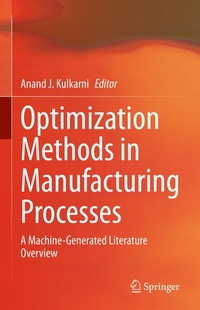
Optimization Methods in Manufacturing Processes
Description

This book presents the result of an innovative challenge, to create a systematic literature overview driven by machine-generated content. Questions and related keywords were prepared for the machine to query, discover, collate and structure by Artificial Intelligence (AI) clustering. The AI-based approach seemed especially suitable to provide an innovative perspective as the topics are indeed both complex, interdisciplinary and multidisciplinary, for example, climate, planetary and evolution sciences. Springer Nature has published much on these topics in its journals over the years, so the challenge was for the machine to identify the most relevant content and present it in a structured way that the reader would find useful. The automatically generated literature summaries in this book are intended as a springboard to further discoverability. They are particularly useful to readers with limited time, looking to learn more about the subject quickly and especially if they are new to the topics. Springer Nature seeks to support anyone who needs a fast and effective start in their content discovery journey, from the undergraduate student exploring interdisciplinary content to Master- or PhD-thesis developing research questions, to the practitioner seeking support materials, this book can serve as an inspiration, to name a few examples.
It is important to us as a publisher to make the advances in technology easily accessible to our authors and find new ways of AI-based author services that allow human-machine interaction to generate readable, usable, collated, research content.
More details
Other editions
Additional editions
Person
Anand J. Kulkarni holds a PhD in Artificial Intelligence (AI) with a focus on Distributed Optimization from Nanyang Technological University in Singapore. He also earned his MS in AI from the University of Regina in Canada. Previously, he served as a Postdoctoral Research Fellow at the Odette School of Business at the University of Windsor, Canada. Since 2021, he has been working as a Research Professor and Associate Director of the Institute of Artificial Intelligence at MIT World Peace University (MITWPU) in Pune, India. His research interests encompass AI-based nature-inspired optimization algorithms and self-organizing systems. Anand has pioneered several optimization methodologies, including Cohort Intelligence, the Ideology Algorithm, the Expectation Algorithm, the Socio-Evolution & Learning Optimization Algorithm, the Leader-Advocate-Believer Algorithm, and the Snail Homing & Mating Search Algorithm. He has published over 120 research papers in peer-reviewed journals, book chapters, and conference proceedings, along with 7 authored books and 15 edited volumes. Dr. Anand has guided 6 doctoral students, 10 master's students, and more than 60 undergraduate students. He has received several accolades, including the Best Paper Award at the IEEE International Conference on Networks, Systems, and Control (ICNSC) in Chicago, USA, and the Swatantryveer Savarkar Award in 2023 from the Pune Marathi Granthalay for his Marathi book titled "Artificial Intelligencechya Watewar."
Content
1. Optimization Methods in Material Handling.- 2. Optimization Methods in Traditional Machining Processes.- 3. Optimization Methods in Advanced Machining Processes.- 4. Optimization Methods in Production Planning and Scheduling.- 5. Optimization Methods in Assembly Line Management.- 6. Optimization Methods in Fault Detection and Diagnosis.- 7. Optimization Methods in Material Waste Management.- 8. Optimization Methods in Staff Scheduling and Allocation.- 9. Optimization Methods in Machine Drawings.- 10. Optimization Methods in Maintenance of Machines.
