

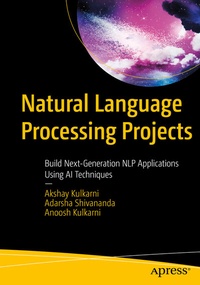
Natural Language Processing Projects
Description

Leverage machine learning and deep learning techniques to build fully-fledged natural language processing (NLP) projects. Projects throughout this book grow in complexity and showcase methodologies, optimizing tips, and tricks to solve various business problems. You will use modern Python libraries and algorithms to build end-to-end NLP projects.
The book starts with an overview of natural language processing (NLP) and artificial intelligence to provide a quick refresher on algorithms. Next, it covers end-to-end NLP projects beginning with traditional algorithms and projects such as customer review sentiment and emotion detection, topic modeling, and document clustering. From there, it delves into e-commerce related projects such as product categorization using the description of the product, a search engine to retrieve the relevant content, and a content-based recommendation system to enhance user experience. Moving forward, it explains how to build systems to find similar sentences using contextual embedding, summarizing huge documents using recurrent neural networks (RNN), automatic word suggestion using long short-term memory networks (LSTM), and how to build a chatbot using transfer learning. It concludes with an exploration of next-generation AI and algorithms in the research space.
What You Will Learn
- Implement full-fledged intelligent NLP applications with Python
- Translate real-world business problem on text data with NLP techniques
- Leverage machine learning and deep learning techniques to perform smart language processing
- Gain hands-on experience implementing end-to-end search engine information retrieval, text summarization, chatbots, text generation, document clustering and product classification,and more
Who This Book Is For
Data scientists, machine learning engineers, and deep learning professionals looking to build natural language applications using Python
Reviews / Votes
"For experienced NLP analysts, the book does provide an interesting collection of example problems and solutions, but such readers will need to exert some effort to extract useful knowledge and practice from the content." (Harry J. Foxwell, Computing Reviews, November 11, 2022)More details
Other editions
Additional editions
Persons
Akshay R Kulkarni is a renowned AI and machine learning (ML) evangelist and thought leader. He has consulted with Fortune 500 and global enterprises to drive AI and data science-led strategic transformations. Akshay has experience building and scaling AI and ML businesses and creating significant impact. He is currently Manager of Data Science & AI at Publicis Sapient on their core data science and AI team where he is part of strategy and transformation interventions through AI. He manages high-priority growth initiatives around data science and works on AI engagements by applying state-of-the-art techniques. He is a Google Developers Expert-Machine Learning, published author of books on NLP and deep learning, and a regular speaker at major AI and data science conferences (including Strata, O'Reilly AI Conf, and GIDS). Akshay is a visiting faculty member for some of the top graduate institutes in India. In 2019, he was featured as one of Top 40 under 40 Data Scientists in India. In his spare time, he enjoys reading, writing, and coding, and help aspiring data scientists. He lives in Bangalore with his family.
Adarsha Shivananda is a senior data scientist on Indegene's Product and Technology team where he works on building machine learning and artificial intelligence (AI) capabilities for pharma products. He aims to build a pool of exceptional data scientists within and outside of the organization to solve problems through training programs, and always wants to stay ahead of the curve. Previously, he worked with Tredence Analytics and IQVIA. Adarsha has worked extensively in the pharma, healthcare, retail, and marketing domains. He lives in Bangalore and loves to read and teach data science.
Anoosh Kulkarni is a data scientist and senior consultant focused on artificial intelligence (AI). He has worked with global clients across multiple domains and helped them solve their business problems using machine learning (ML), natural language processing (NLP), and deep learning. Presently, he is working with Subex AI labs. Previously, he was a data scientist at one of the leading ecommerce companies in the UAE. Anoosh is passionate about guiding and mentoring people in their data science journey. He leads data science/machine learning meet ups in Bangalore and helps aspiring data scientists navigate their careers. He also conducts ML/AI workshops at universities and is actively involved in conducting webinars, talks, and sessions on AI and data science. He lives in Bangalore with his family.Content
Extraction Using Machine Learning.- Chapter 4: Enhancing E-commerce Using an Advanced Search
Engine and Recommendation System.- Chapter 5: Creating a Resume Parsing, Screening, and Shortlisting
System.- Chapter 6: Creating an E-commerce Product Categorization Model Using Deep Learning.- Chapter 7: Predicting Duplicate Questions in Quora.- Chapter 8: Named Entity Recognition Using CRF and
BERT.- Chapter 9: Building a Chatbot Using Transfer Learning.- Chapter 10: News Headline Summarization.- Chapter 11: Text Generation - Next Word Prediction.- Chapter 12: Conclusion and Future Trends.
