

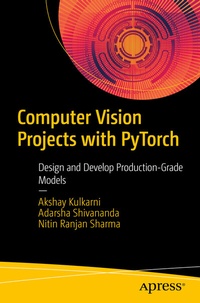
Computer Vision Projects with PyTorch
Design and Develop Production-Grade Models
Published on 18. July 2022
XVI, 346 pages
978-1-4842-8273-1 (ISBN)
Description

Design and develop end-to-end, production-grade computer vision projects for real-world industry problems. This book discusses computer vision algorithms and their applications using PyTorch.
The book begins with the fundamentals of computer vision: convolutional neural nets, RESNET, YOLO, data augmentation, and other regularization techniques used in the industry. And then it gives you a quick overview of the PyTorch libraries used in the book. After that, it takes you through the implementation of image classification problems, object detection techniques, and transfer learning while training and running inference. The book covers image segmentation and an anomaly detection model. And it discusses the fundamentals of video processing for computer vision tasks putting images into videos. The book concludes with an explanation of the complete model building process for deep learning frameworks using optimized techniques with highlights on model AI explainability.
After reading this book, you will be able to build your own computer vision projects using transfer learning and PyTorch.
What You Will Learn
Who This Book Is For
Data scientists and machine learning engineers interested in building computer vision projects and solving business problems
The book begins with the fundamentals of computer vision: convolutional neural nets, RESNET, YOLO, data augmentation, and other regularization techniques used in the industry. And then it gives you a quick overview of the PyTorch libraries used in the book. After that, it takes you through the implementation of image classification problems, object detection techniques, and transfer learning while training and running inference. The book covers image segmentation and an anomaly detection model. And it discusses the fundamentals of video processing for computer vision tasks putting images into videos. The book concludes with an explanation of the complete model building process for deep learning frameworks using optimized techniques with highlights on model AI explainability.
After reading this book, you will be able to build your own computer vision projects using transfer learning and PyTorch.
What You Will Learn
- Solve problems in computer vision with PyTorch.
- Implement transfer learning and perform image classification, object detection, image segmentation, and other computer vision applications
- Design and develop production-grade computer vision projects for real-world industry problems
- Interpret computer vision models and solve business problems
Who This Book Is For
Data scientists and machine learning engineers interested in building computer vision projects and solving business problems
More details
Series
Edition
1st ed.
Language
English
Place of publication
Berkeley
United States
Publishing group
APRESS
Target group
Professional and scholarly
Product notice
Reflowable
Illustrations
XVI, 346 p. 154 illus.
File size
10,59 MB
ISBN-13
978-1-4842-8273-1 (9781484282731)
DOI
10.1007/978-1-4842-8273-1
Schweitzer Classification
Other editions
Additional editions
Akshay Kulkarni | Adarsha Shivananda | Nitin Ranjan Sharma
Computer Vision Projects with PyTorch
Design and Develop Production-Grade Models
Book
07/2022
APress
€64.19
Shipment within 15-20 days
Persons
Akshay R Kulkarni
is an AI and machine learning (ML) evangelist and a thought leader. He has consulted for Fortune 500 and global enterprises to drive AI and data science-led strategic transformations. He is currently the manager of data science & AI at Publicis Sapien. He is a Google developer and author of the book
Natural Language Processing Recipes
(Apress). He is a regular speaker at major AI and data science conferences (including Strata, O'Reilly AI Conf, and GIDS). Akshay is a visiting faculty member for some of the top graduate institutes in India. In 2019, he was featured as one of the top 40 under 40 Data Scientists in India. In his spare time, he enjoys reading, writing, coding, and helping aspiring data scientists. He lives in Bangalore with his family.
Adarsha Shivananda is a senior data scientist on Indegene's product and technology team where he works on building machine learning and artificial intelligence (AI) capabilitiesfor pharma products. He aims to build a pool of exceptional data scientists within and outside of the organization to solve problems through training programs, and always wants to stay ahead of the curve. Previously, he worked with Tredence Analytics and IQVIA. He has worked extensively in the pharma, healthcare, retail, and marketing domains. He lives in Bangalore and loves to read and teach data science.
Nitin Ranjan Sharma is a manager at Novartis, involved in leading a team to develop products using multi-modal techniques. He has been a consultant developing solutions for Fortune 500 companies, involved in solving complex business problems using machine learning and deep learning frameworks. His major focus area and core expertise are computer vision and solving some of the challenging business problems dealing with images and video data. Before Novartis, he was part of the data science team at Publicis Sapient, EY, and TekSystems Global Services. Heis a regular speaker at data science communities and meet-ups and also an open-source contributor. He has also been training and mentoring data science enthusiasts.
Adarsha Shivananda is a senior data scientist on Indegene's product and technology team where he works on building machine learning and artificial intelligence (AI) capabilitiesfor pharma products. He aims to build a pool of exceptional data scientists within and outside of the organization to solve problems through training programs, and always wants to stay ahead of the curve. Previously, he worked with Tredence Analytics and IQVIA. He has worked extensively in the pharma, healthcare, retail, and marketing domains. He lives in Bangalore and loves to read and teach data science.
Nitin Ranjan Sharma is a manager at Novartis, involved in leading a team to develop products using multi-modal techniques. He has been a consultant developing solutions for Fortune 500 companies, involved in solving complex business problems using machine learning and deep learning frameworks. His major focus area and core expertise are computer vision and solving some of the challenging business problems dealing with images and video data. Before Novartis, he was part of the data science team at Publicis Sapient, EY, and TekSystems Global Services. Heis a regular speaker at data science communities and meet-ups and also an open-source contributor. He has also been training and mentoring data science enthusiasts.
Content
Chapter 1: The Building Blocks of Computer Vision.- Chapter 2: Image Classification.- Chapter 3: Building Object Detection Model.- Chapter 4: Building Image Segmentation Model.- Chapter 5: Image-Based Search and Recommendation System.- Chapter 6: Pose Estimation.- Chapter 7: Image Anomaly Detection.- Chapter 8: Image Super-Resolution.- Chapter 9: Video Analytics.- Chapter 10: Explainable AI for Computer Vision.
