

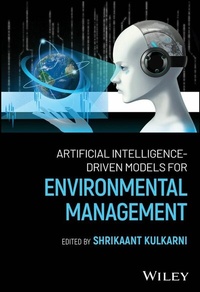
Artificial Intelligence-Driven Models for Environmental Management
Description

Step-by-step guidelines for the development of artificial neural network-based environmental pollution models
Artificial Intelligence-Driven Models for Environmental Management delves into the application of AI across a plethora of areas in environmental management, including climate forecasting, natural resource optimization, waste management, and biodiversity conservation. This book shows how AI can help in monitoring, predicting, and mitigating environmental impacts with tremendous accuracy and speed by leveraging machine learning, deep learning, and other data-driven models. The methodologies explored in this volume reflect a synthesis of computational intelligence, data science, and ecological expertise, underscoring how AI-driven systems have been making strides in managing and preserving our planet's natural resources.
The text is structured to guide readers through numerous AI models and their practical environmental management applications, showcasing theoretical foundations as well as case studies. This book also addresses the challenges and ethical considerations related to deploying AI in ecological contexts, underscoring the importance of transparency, inclusivity, and alignment with sustainability goals.
Sample topics discussed in Artificial Intelligence-Driven Models for Environmental Management include:
- Tools and methods for monitoring and predicting environmental pollutants faster and more accurately
- AI technology for the protection of water supplies from contamination to produce healthier foods
- Use of AI for the evaluation of the impacts of environmental pollution on human health
- AI and waste management technologies for sustainable agriculture and soil management
- The role of AI in environmental research and sustainability and key social and economic aspects of natural resource management through AI
Artificial Intelligence-Driven Models for Environmental Management is a timely, forward-thinking resource for a diverse readership, including researchers, policymakers, environmental scientists, and AI practitioners.
More details
Other editions
Additional editions
Person
Shrikaant Kulkarni, Ph.D., is a Research Professor at Sanjivani University, Kopargaon, India, and an Adjunct Professor at Faculty of Business, Victorian Institute of Technology, Melbourne, Australia. Dr. Kulkarni has been a senior academic and researcher for more than four decades. He has published over 100 research papers, 100+ book chapters, and edited 50+ reference books.
Content
List of Contributors xxi
Preface xxiii
Part I Foundations of AI in Environmental Management 1
1 Application of AI in Environmental Sustainability 3
Pawan Whig, Shashi Kant Gupta, Rahul Reddy Nadikattu, and Pavika Sharma
1.1 Introduction 3
1.1.1 Importance of AI in Addressing Environmental Challenges 4
1.2 AI Applications in Environmental Monitoring 6
1.2.1 Remote Sensing and Satellite Imaging 6
1.2.2 IoT Sensors and Data Collection 7
1.2.3 Predictive Analytics for Environmental Health 8
1.2.4 Real-Time Monitoring of Air and Water Quality 8
1.3 AI in Climate Change Mitigation 9
1.3.1 Predicting and Analyzing Climate Trends 10
1.3.2 AI-Driven Carbon Footprint Reduction Strategies 10
1.3.3 Renewable Energy Optimization Through AI 11
1.3.4 AI in Forest Conservation and Reforestation 12
1.4 AI in Resource Management 13
1.4.1 Sustainable Agriculture and AI-Assisted Precision Farming 13
1.4.2 AI in Water Resource Management and Conservation 14
1.4.3 Waste Management and Recycling Optimization 15
1.4.4 Circular Economy and Resource Efficiency 16
1.5 AI in Biodiversity Conservation 17
1.5.1 Wildlife Monitoring and Poaching Prevention 18
1.5.2 AI-Assisted Habitat Restoration 18
1.5.3 Species Identification and Population Tracking 19
1.5.4 Marine Ecosystem Management Through AI 20
1.6 AI in Sustainable Urban Planning 21
1.6.1 Smart Cities and Sustainable Infrastructure 21
1.6.2 AI in Reducing Urban Energy Consumption 22
1.6.3 Optimizing Urban Traffic for Reduced Emissions 23
1.6.4 AI-Enabled Green Building Design 24
1.7 Ethical and Governance Considerations 25
1.7.1 Ethical Implications of AI in Environmental Management 25
1.7.2 AI and Environmental Justice 27
1.7.3 Regulatory Frameworks for AI in Sustainability 28
1.7.4 Data Privacy and Security in Environmental AI Applications 29
1.7.5 Case Study 30
1.7.5.1 Background 30
1.7.5.2 Conclusion 32
1.8 Challenges and Future Prospects 33
1.8.1 Technological and Resource Limitations 33
1.8.2 Potential Risks and Unintended Consequences 34
1.8.3 AI's Role in Achieving Global Sustainability Goals 35
1.8.4 Future Directions in AI for Environmental Sustainability 36
1.9 Conclusion 38
References 38
2 The Role of AI in Environmental Research and Sustainability 43
Iti Batra, Seema Nath Jain, Nikhitha Yathiraju, and Kavita Mittal
2.1 Introduction 43
2.1.1 Overview of AI in Environmental Research 44
2.1.2 Importance of AI in Sustainability Efforts 44
2.1.3 Scope and Objectives of the Study 45
2.2 AI Applications in Environmental Monitoring 46
2.2.1 Remote Sensing and Satellite Imaging 47
2.2.2 AI for Climate Modeling and Forecasting 48
2.2.3 Real-Time Environmental Data Collection 49
2.3 AI in Natural Resource Management 50
2.3.1 Optimizing Water and Energy Use 50
2.3.2 Smart Agriculture and Precision Farming 51
2.3.3 AI for Sustainable Fisheries and Forest Management 52
2.4 AI for Biodiversity and Ecosystem Conservation 53
2.4.1 AI-Powered Species Identification and Tracking 53
2.4.2 Monitoring and Protecting Endangered Species 54
2.4.3 Predictive Analytics in Habitat Restoration 55
2.5 AI in Urban Sustainability 56
2.5.1 AI in Smart Cities and Sustainable Urban Planning 56
2.5.2 Optimizing Transportation and Energy Grids 57
2.5.3 Waste Management and Recycling Innovations 58
2.6 Reducing Environmental Footprints with AI 59
2.6.1 AI for Energy Efficiency in Industries 59
2.6.2 AI and Carbon Emissions Reduction 60
2.6.3 AI in the Circular Economy and Waste Reduction 61
2.7 Ethical Considerations in AI-Driven Environmental Research 62
2.7.1 AI Ethics and Environmental Justice 62
2.7.2 Data Privacy and Security in Environmental Monitoring 63
2.7.3 Accountability and Transparency in AI Models 64
2.8 Case Study 65
2.8.1 Background 65
2.8.2 AI Implementation 65
2.8.3 Quantitative Analysis 66
2.8.4 Challenges and Opportunities 67
2.9 Conclusion 67
References 68
3 AI and Environmental Data Science 71
Ashima Bhatnagar Bhatia, Meghna Sharma, and Bhupesh Bhatia
3.1 Introduction 71
3.1.1 Background of AI in Environmental Science 71
3.1.2 Importance of Data Science in Environmental Studies 72
3.1.3 Objectives of the Study 73
3.2 Fundamentals of Artificial Intelligence 74
3.2.1 Overview of AI Techniques 74
3.2.2 Machine Learning vs. Traditional Approaches 74
3.2.3 Deep Learning and its Applications 75
3.3 Environmental Data Science 76
3.3.1 Definition and Scope 77
3.3.2 Types of Environmental Data 77
3.3.2.1 Satellite Imagery 77
3.3.2.2 Sensor Data 78
3.3.2.3 Climate and Weather Data 78
3.3.3 Data Collection and Management 79
3.4 AI Applications in Environmental Science 80
3.4.1 Predictive Modeling of Climate Change 80
3.4.2 Ecosystem Monitoring and Assessment 81
3.4.3 Biodiversity Conservation Efforts 82
3.4.4 Pollution Detection and Management 82
3.5 Case Studies 83
3.5.1 AI in Climate Resilience Planning 83
3.5.1.1 Case Study: City of San Francisco's Climate Resilience Strategy 83
3.5.2 Machine Learning for Wildlife Conservation 84
3.5.2.1 Case Study: African Wildlife Foundation's (AWF) Anti-poaching Initiative 84
3.5.3 Applications in Water Quality Monitoring 85
3.5.3.1 Case Study: The United Nations' "Water Quality and Ecosystems" Project 85
3.6 Challenges and Limitations 86
3.6.1 Data Quality and Availability 86
3.6.2 Interpretability of AI Models 86
3.6.3 Ethical Considerations 87
3.7 Case Study 88
3.7.1 Objective 88
3.7.2 Data Collection and AI Model Deployment 89
3.7.3 Results and Quantitative Analysis 89
3.7.4 Discussion 90
3.7.5 Challenges and Limitations 90
3.8 Future Directions 91
3.8.1 Emerging Trends in AI and Environmental Science 91
3.8.2 Integrating AI with Traditional Environmental Practices 92
3.8.3 Policy Implications and Recommendations 93
3.9 Conclusion 94
References 95
Part II AI in Natural Resource Management 99
4 Application of AI for Natural Source Management 101
Pawan Whig, Rahul Reddy Nadikattu, Shashi Kant Gupta, and Shrikaant Kulkarni
4.1 Introduction 101
4.1.1 Importance of Natural Resource Management 101
4.1.2 Role of AI in Enhancing Resource Management 102
4.2 AI Technologies in NRM 103
4.2.1 Machine Learning Applications 103
4.2.2 Remote Sensing and Data Analysis 104
4.2.3 Predictive Analytics for Resource Forecasting 104
4.2.4 Geographic Information Systems (GIS) 105
4.3 Applications of AI in Specific Natural Resource Sectors 106
4.3.1 Water Resource Management 106
4.3.2 Forest Management and Conservation 106
4.3.3 Biodiversity Monitoring and Conservation 107
4.3.4 Agriculture and Land Use Optimization 107
4.4 Case Studies 108
4.4.1 AI in Water Quality Monitoring 108
4.4.2 Machine Learning for Forest Fire Prediction 108
4.4.3 AI-Driven Biodiversity Assessment 109
4.4.4 Smart Agriculture Solutions 109
4.5 Challenges and Limitations 110
4.5.1 Data Quality and Availability 110
4.5.2 Ethical Considerations 110
4.5.3 Implementation Barriers 111
4.5.4 Need for Interdisciplinary Collaboration 111
4.6 Future Directions 112
4.6.1 Innovations in AI Technologies 112
4.6.2 Enhancing Policy Frameworks 112
4.6.3 Public Engagement and Awareness 113
4.6.4 Integration of AI with Other Technologies 113
4.7 Case Study: Application of AI in NRM 114
4.7.1 Introduction 114
4.7.2 Objective 114
4.7.3 Approach 114
4.7.4 Results 115
4.7.4.1 Region A (Water Resource Management) 115
4.7.5 Discussion 115
4.7.6 Key Takeaways 115
4.7.7 Conclusion 116
4.7.8 Future Work 117
References 117
5 Future Prospects of AI for Management of Natural Resources 121
Meghna Sharma, Ashima Bhatnagar Bhatia, and Bhupesh Bhatia
5.1 Introduction 121
5.1.1 Importance of AI in Natural Resource Management 122
5.1.2 Objectives of the Study 122
5.2 Overview of AI Technologies 123
5.2.1 Machine Learning 123
5.2.2 Predictive Analytics 123
5.2.3 Real-Time Data Collection 124
5.2.4 Case Studies of AI Applications 124
5.3 AI in Water Management 125
5.3.1 Water Resource Allocation 125
5.3.2 Predicting Water Demand 126
5.3.3 Monitoring Water Quality 127
5.4 AI in Forestry 127
5.4.1 Forest Inventory and Monitoring 128
5.4.2 Predictive Modeling for Forest Health 128
5.4.3 Enhancing Reforestation Efforts 129
5.5 AI in Agriculture 129
5.5.1 Precision Agriculture 130
5.5.2 Crop Yield Prediction 130
5.5.3 Pest and Disease Management 131
5.6 AI in Biodiversity Conservation 131
5.6.1 Species Monitoring 132
5.6.2 Habitat Assessment 132
5.6.3 Predictive Conservation Planning 133
5.7 Challenges and Barriers to AI Implementation 134
5.7.1 Data Privacy Concerns 134
5.7.2 Ethical Considerations 134
5.7.3 The Digital Divide 135
5.8 Case Study 136
5.8.1 Objectives of the Case Study 136
5.8.2 Methodology 136
5.8.3 Quantitative Analysis 136
5.9 Conclusion 139
References 139
Part III AI Models for Climate Change Mitigation and Adaptation 143
6 AI in Climate Change Prediction 145
Seema Sharma, Anupriya Jain, Sachin Sharma, and Sonia Duggal
6.1 Introduction 145
6.1.1 Role of AI in Climate Science 145
6.1.2 How AI Enhances Climate Change Prediction 146
6.1.3 Real-World Applications of AI in Climate Prediction 147
6.1.4 AI and Climate Mitigation 147
6.1.5 Challenges and Limitations of AI in Climate Prediction 148
6.2 AI Technologies in Climate Prediction 148
6.2.1 Machine Learning for Climate Data Analysis 149
6.2.2 Deep Learning in Climate Models 149
6.2.3 AI-Powered Satellite Imagery Analysis 149
6.2.4 AI in Weather Forecasting and Extreme Event Prediction 150
6.3 AI Applications in Climate Science 150
6.3.1 Predicting Extreme Weather Events 150
6.3.2 Long-Term Climate Projections 151
6.3.3 AI in Ocean and Polar Ice Monitoring 151
6.3.4 AI in Air Quality and Pollution Forecasting 152
6.4 AI for Climate Mitigation and Adaptation 152
6.4.1 Optimizing Energy Consumption and Emission Reduction 153
6.4.2 AI in Renewable Energy Integration 153
6.4.3 AI in Smart Grids and Infrastructure 153
6.4.4 AI for Carbon Sequestration and Natural Resource Management 154
6.5 Case Studies 155
6.5.1 Google's AI for Weather Forecasting 155
6.5.2 IBM's Green Horizon Project for Air Quality Prediction 155
6.5.3 AI and Sea-Level Rise Monitoring by the European Space Agency 155
6.5.4 AI in Urban Climate Adaptation 156
6.6 Case Study: IBM's Green Horizon Project for Air Quality Prediction 156
6.6.1 Methodology 157
6.6.2 Results 157
6.6.3 Conclusion 158
6.6.4 Future Work 159
References 159
7 AI-Driven Environmental Real-Time Monitoring, and Screening 163
Kavita Mittal, Rahul Reddy Nadikattu, Pawan Whig, and Iti Batra
7.1 Introduction 163
7.1.1 Background and Importance of Environmental Monitoring 163
7.1.2 Overview of AI Technologies in Environmental Applications 164
7.1.3 Objectives of the Document 165
7.2 Understanding AI in Environmental Monitoring 166
7.2.1 Definition of AI and its Components 166
7.2.2 Key Technologies: Machine Learning, IoT, and Remote Sensing 167
7.2.3 Role of Big Data in Environmental Monitoring 167
7.3 Applications of AI in Real-Time Environmental Monitoring 168
7.3.1 Air Quality Monitoring 168
7.3.2 Water Quality Assessment 169
7.3.3 Soil Health Monitoring 170
7.3.4 Biodiversity Tracking and Conservation 170
7.4 AI Techniques for Screening Environmental Data 171
7.4.1 Data Collection and Integration 171
7.4.2 Predictive Analytics for Environmental Changes 172
7.4.3 Anomaly Detection in Environmental Data 173
7.4.4 Visualization Tools and Techniques 173
7.5 Case Studies of AI-Driven Environmental Monitoring 174
7.5.1 Successful Implementations in Urban Areas 174
7.5.1.1 Case Study: Barcelona, Spain 174
7.5.1.2 Case Study: Singapore 175
7.5.2 Rural Applications and Impact Assessments 175
7.5.2.1 Case Study: Precision Agriculture in India 175
7.5.2.2 Case Study: Wildlife Conservation in Africa 176
7.5.3 Lessons Learned from Global Practices 176
7.6 Challenges in Implementing AI for Environmental Monitoring 177
7.6.1 Technical Barriers and Data Quality Issues 177
7.6.2 Ethical Considerations and Privacy Concerns 178
7.6.3 Financial Constraints and Resource Allocation 178
7.6.4 Interoperability and Standardization Issues 179
7.7 Case Study 180
7.8 Implementation of the AI System 180
7.9 Quantitative Analysis 180
7.10 Conclusion 181
References 182
8 AI-Driven Environmental Problem Design for Sustainable Solutions 185
Rattan Sharma, Pawan Whig, and Shashi Kant Gupta
8.1 Introduction 185
8.1.1 Role of AI in Sustainability 186
8.1.2 Research Objectives and Scope 187
8.2 AI Technologies and Techniques 188
8.2.1 Machine Learning Algorithms 188
8.2.2 Data Mining and Predictive Analytics 189
8.2.3 Optimization Models 190
8.3 AI in Real-Time Monitoring Systems 191
8.4 Environmental Problem Design Using AI 192
8.4.1 Identifying Environmental Issues 192
8.5 AI for Resource Management and Efficiency 193
8.6 AI-Driven Solutions for Carbon Footprint Reduction 194
8.7 Case Studies: AI Applications in Waste Management and Energy Conservation 195
8.7.1 AI-Enabled Sustainable Solutions 196
8.7.1.1 Optimizing Renewable Energy Systems 196
8.7.1.2 AI in Water Resource Management 197
8.7.1.3 Sustainable Agriculture through AI 198
8.7.1.4 AI for Ecosystem and Biodiversity Conservation 199
8.7.2 Challenges and Limitations of AI in Environmental Solutions 200
8.7.2.1 Data Availability and Quality Issues 200
8.7.2.2 Ethical and Socioeconomic Considerations 201
8.7.2.3 Technical and Implementation Barriers 201
8.7.2.4 Addressing Unintended Consequences 202
8.8 Case Study 203
8.8.1 AI Solution: Smart Irrigation System 203
8.8.2 Quantitative Analysis 204
8.8.3 Environmental Impact 205
8.8.4 Challenges 205
8.9 Conclusion 205
8.9.1 Future Directions and Opportunities 206
8.9.2 AI for Climate Change Adaptation and Mitigation 206
8.10 Conclusion 207
8.10.1 The Future of AI in Sustainable Development 207
References 208
9 AI in Soil Health Management for Health Food Production 211
Rashmi Gera and Anupriya Jain
9.1 Introduction 211
9.1.1 Importance of Soil Health in Agriculture 211
9.1.2 Role of AI in Agriculture 212
9.2 Understanding Soil Health 213
9.2.1 Key Indicators of Soil Health 213
9.2.2 Soil Composition and Structure 214
9.2.3 Impact of Soil Health on Food Production 214
9.3 AI Technologies in Soil Health Management 215
9.3.1 Remote Sensing and Soil Monitoring 215
9.3.2 Machine Learning for Soil Analysis 215
9.3.3 Predictive Analytics in Soil Health 216
9.4 AI Applications in Soil Health Management 216
9.4.1 Precision Soil Sampling 216
9.4.2 Real-Time Soil Condition Monitoring 217
9.4.3 Nutrient Management and Optimization 217
9.5 Case Studies 218
9.5.1 AI in Soil Fertility Assessment 218
9.5.2 Successful AI Implementations in Crop Management 218
9.5.3 AI-Driven Soil Remediation Strategies 218
9.6 Case Study 219
9.6.1 Objectives 219
9.6.2 Methodology 219
9.6.3 Results 220
9.6.4 Conclusion 220
9.6.5 Future Scope 221
References 222
Part IV AI in Pollution Control and Waste Management 225
10 AI for Evaluation of the Impacts of Environmental Pollution on Human Health 227
Anumaan Whig, Vaibhav Gupta, and Pawan Whig
10.1 Introduction 227
10.1.1 Role of AI in Addressing Environmental Health Challenges 228
10.1.2 Importance of Data-Driven Approaches in Pollution and Health Studies 228
10.1.3 AI Applications in Environmental Monitoring 229
10.1.4 Real-time Air Quality Monitoring 229
10.1.5 Water Contamination Detection and Analysis 230
10.1.6 Remote Sensing for Pollution Tracking 230
10.1.7 AI in Health Impact Assessment 231
10.1.8 Machine Learning for Identifying Health-Pollution Correlations 232
10.1.9 Predictive Modeling of Health Risks from Pollution 232
10.2 Case Studies: Respiratory and Cardiovascular Diseases Linked to Air Pollution 233
10.2.1 Data Sources and Integration 234
10.2.1.1 Environmental Sensors and GIS Data 235
10.2.2 Public Health Data and Electronic Health Records (EHRs) 235
10.2.3 Integration of Environmental and Health Data for AI Models 236
10.2.4 AI Techniques in Pollution and Health Evaluation 237
10.2.4.1 Supervised and Unsupervised Learning 238
10.2.5 Neural Networks and Deep Learning for Pattern Recognition 238
10.2.6 Geographic Information Systems (GIS) and AI for Spatial Analysis 239
10.3 Case Studies 240
10.3.1 AI-Based Air Pollution Analysis in Urban Areas 241
10.3.2 Water Quality and Health Impact Studies Using AI 241
10.3.3 Cross-Regional Pollution Impact Evaluations with AI 242
10.4 Case Study 243
10.4.1 Data Sources and AI Models 244
10.4.2 Methodology 244
10.4.3 Results and Quantitative Analysis 244
10.4.4 Policy Implications and Economic Impact 245
10.4.5 Future Directions 245
10.4.6 Emerging AI Trends in Environmental Health Research 245
10.4.7 Integrating AI into Public Health Policy 246
10.4.8 AI for Sustainable Urban and Environmental Planning 247
10.4.9 Conclusion 248
References 249
11 Artificial Intelligence for Air/Water Quality Prediction 253
Shashi Kant Gupta, Ashima Bhatnagar Bhatia, Vinay Aseri, and Shrikaant Kulkarni
11.1 Introduction 253
11.1.1 Importance of Air and Water Quality Monitoring 254
11.1.2 Role of AI in Environmental Prediction 255
11.1.3 Overview of Air and Water Pollution 256
11.1.3.1 Common Air Pollutants and Their Sources 256
11.1.3.2 Common Water Pollutants and Their Sources 258
11.1.3.3 Impact on Health and the Environment 259
11.1.4 Artificial Intelligence Techniques for Prediction 260
11.1.4.1 Machine Learning Algorithms 261
11.1.4.2 Neural Networks 261
11.1.4.3 Support Vector Machines (SVMs) 261
11.1.4.4 Decision Trees 262
11.1.4.5 Deep Learning Approaches 262
11.1.4.6 Convolutional Neural Networks (CNNs) 262
11.1.4.7 Recurrent Neural Networks (RNNs) 263
11.1.5 Reinforcement Learning in Environmental Predictions 263
11.1.5.1 Mechanism of Reinforcement Learning 263
11.1.5.2 Applications in Environmental Predictions 264
11.1.5.3 Data Collection and Preprocessing 264
11.1.5.4 Data Cleaning and Feature Selection 266
11.1.5.5 Handling Missing and Incomplete Data 267
11.1.5.6 Ozone and Nitrogen Dioxide Prediction 270
11.1.5.7 Real-time Air Quality Monitoring Systems 271
11.1.5.8 Sensor Networks and IoT Integration 271
11.1.5.9 Predictive Models for Real-time Monitoring 272
11.1.5.10 Mobile and Cloud-based Solutions 272
11.1.5.11 Early Warning and Alert Systems 272
11.1.5.12 AI Models for Water Quality Prediction 273
11.1.5.13 Predictive Models for pH, Dissolved Oxygen, and Contaminants 273
11.2 Monitoring Waterborne Pollutants 274
11.2.1 Sensor Networks for Water Quality Monitoring 274
11.2.1.1 Predictive Maintenance for Sensor Networks 275
11.2.1.2 Early Warning Systems for Water Contamination 275
11.3 Case Studies and Applications 276
11.3.1 AI-Driven Air Quality Prediction Systems in Cities 277
11.3.1.1 Case Study: Beijing, China 277
11.3.1.2 Case Study: Los Angeles, USA 277
11.3.1.3 Case Study: River Thames, UK 278
11.3.1.4 Case Study: Ganges River, India 278
11.3.1.5 Smart City Case Study: Amsterdam, Netherlands 278
11.3.1.6 Smart City Case Study: Barcelona, Spain 279
11.4 Challenges and Limitations 279
11.4.1 Data Availability and Quality Issues 279
11.4.1.1 Insufficient Data 279
11.4.1.2 Data Quality Issues 280
11.4.1.3 Solutions and Strategies 280
11.4.2 Model Accuracy and Computational Limitations 280
11.4.3 Ethical Considerations in Environmental AI 281
11.4.3.1 Accountability and Transparency 281
11.4.3.2 Equity and Access 281
11.4.3.3 Data Privacy and Security 281
11.4.3.4 Solutions and Strategies 282
11.5 Case Study 282
11.5.1 Data Collection 282
11.5.2 Model Development 283
11.5.3 Quantitative Analysis 283
11.5.3.1 Model Performance 283
11.5.3.2 Results Interpretation 283
11.5.3.3 Implementation and Impact 284
11.5.3.4 Outcomes 284
11.6 Conclusion 285
References 285
12 AI Technology for Protection of Water Supplies from Contamination to Produce Healthy Foods 289
Sonia Duggal and Anupriya Jain
12.1 Introduction 289
12.1.1 Importance of Protecting Water Supplies for Healthy Food Production 289
12.1.1.1 Impact of Water Contamination on Agriculture 290
12.1.1.2 Key Contaminants and Their Sources 290
12.1.2 Role of AI in Water Resource Management 291
12.1.2.1 AI for Real-Time Water Quality Monitoring 291
12.1.2.2 Predictive Modeling for Contamination Prevention 291
12.1.2.3 Optimizing Water Use in Agriculture 292
12.1.2.4 Early Warning Systems for Waterborne Contaminants 292
12.2 Water Contamination and its Impact on Food Production 292
12.2.1 Common Waterborne Contaminants 293
12.2.1.1 Pathogens 293
12.2.1.2 Chemicals and Pesticides 293
12.2.1.3 Heavy Metals 294
12.2.1.4 Industrial and Agricultural Waste 294
12.2.2 Effects of Contaminated Water on Agriculture and Food Safety 294
12.2.2.1 Reduced Crop Productivity 294
12.2.2.2 Contamination of Food Products 295
12.2.2.3 Impact on Livestock and Animal Products 295
12.2.2.4 Economic and Environmental Impact 296
12.3 AI Technologies for Water Quality Monitoring 296
12.3.1 Real-Time Sensor Networks 296
12.3.1.1 Key Parameters Monitored 297
12.3.1.2 Role of AI in Sensor Data Processing 297
12.3.1.3 IoT Integration for Real-Time Monitoring 297
12.3.2 Machine Learning for Water Contamination Detection 298
12.3.2.1 Types of Machine Learning Models Used 298
12.3.2.2 Application of Machine Learning in Water Contamination 298
12.3.2.3 Automation and Efficiency Gains 299
12.3.3 Predictive Analytics for Early Warning Systems 299
12.3.3.1 Data Sources for Predictive Models 299
12.3.3.2 How Predictive Analytics Works 300
12.3.3.3 Benefits of Early Warning Systems 300
12.4 AI-Driven Water Management in Agriculture 301
12.4.1 Optimizing Water Usage in Irrigation 301
12.4.1.1 Smart Irrigation Systems 301
12.4.1.2 Predictive Analytics for Irrigation 302
12.4.1.3 Drip Irrigation with AI 302
12.4.1.4 Water Conservation through Irrigation Optimization 302
12.4.2 AI for Monitoring Nutrient Levels and Soil Health 303
12.4.2.1 AI-Driven Soil Analysis 303
12.4.2.2 Soil Moisture and Temperature Monitoring 303
12.4.2.3 Remote Sensing and AI for Soil Health 304
12.4.3 AI for Precision Agriculture and Water Conservation 304
12.4.3.1 Precision Irrigation 304
12.4.3.2 AI-Enhanced Water Conservation Techniques 304
12.4.3.3 AI-Driven Water Use Efficiency (WUE) 305
12.4.3.4 Sustainable Agriculture and AI 305
12.5 Case Studies 305
12.5.1 Project Components 306
12.5.2 Results 306
12.5.3 Key Takeaways 306
12.6 AI in Precision Irrigation for Water Contamination Prevention 307
12.6.1 Technology and Implementation 307
12.6.2 Impact 307
12.7 Challenges and Limitations 307
12.8 Data Quality and Availability 308
12.8.1 Inconsistent and Incomplete Data 308
12.8.2 Lack of Historical Data 308
12.8.3 Data Sensitivity and Privacy Concerns 309
12.8.4 Implementation Costs and Technical Barriers 309
12.8.4.1 High Initial Costs 309
12.8.4.2 Technical Expertise and Capacity Building 309
12.8.5 Scalability and Adaptability 310
12.9 Regulatory and Ethical Considerations 310
12.9.1 Lack of Standardization 310
12.9.2 Ethical Issues in AI Development and Use 311
12.9.3 Data Ownership and Governance 311
12.9.4 Conclusion 311
12.10 Case Study 312
12.10.1 Project Overview 312
12.10.2 Objectives 312
12.10.3 Methodology 312
12.10.4 Quantitative Results 313
12.10.5 Challenges Faced 314
12.10.6 Conclusion 314
12.11 Future Directions in AI for Water and Food Safety 314
12.11.1 Integration of AI with IoT and Big Data 315
12.11.1.1 AI-Enabled IoT Networks for Real-Time Water Monitoring 315
12.11.1.2 Big Data for Predictive Analytics and Long-Term Planning 315
12.11.1.3 Cloud-Based Solutions for Data Sharing and Collaboration 316
12.11.2 AI for Climate-Resilient Water Management 316
12.11.2.1 AI for Drought and Flood Management 316
12.11.2.2 AI-Driven Climate Adaptation Strategies for Agriculture 316
12.11.3 Enhancing Global Water Safety through Collaborative AI Solutions 317
12.11.3.1 International Cooperation for Water Management 317
12.11.3.2 AI for Sustainable Agricultural Practices 317
12.11.3.3 AI-Driven Policy and Regulation 318
12.11.4 Conclusion 318
References 319
13 AI in Waste Management Technologies for Sustainable Agriculture 323
Nikhitha Yathiraju, Meghna Sharma, and Sonia Duggal
13.1 Introduction 323
13.1.1 Role of Waste in Agriculture 324
13.1.2 Artificial Intelligence in Waste Management 324
13.2 AI Applications in Agricultural Waste Management 325
13.2.1 Waste Monitoring and Pr
1
Application of AI in Environmental Sustainability
Pawan Whig1, Shashi Kant Gupta2, Rahul Reddy Nadikattu3, and Pavika Sharma4
1 Department of Information Technology, Vivekananda Institute of Professional Studies-Technical Campus (VIPS-TC), New Delhi, India,
2 Department of Computer Science and Engineering, Eudoxia Research University, New Castle, DE, USA,
3 Department of Information Technology, University of the Cumberland, Cumberland, MD, USA,
4 Department of Electronics and Communication Engineering, Bhagwan Parshuram Institute of Technology, Affiliated to Guru Gobind Singh Indraprastha University, New Delhi, India,
1.1 Introduction
Artificial intelligence (AI) is a transformative technology that has the potential to revolutionize a wide range of industries, including environmental sustainability. AI refers to the simulation of human intelligence in machines that are designed to think, learn, and adapt autonomously. By leveraging complex algorithms, machine learning, and data analytics, AI systems can process vast amounts of information, recognize patterns, and make decisions with minimal human intervention [1].
Environmental sustainability, on the other hand, refers to practices and strategies that ensure the responsible use of natural resources to meet present needs without compromising the ability of future generations to meet their own. This concept encompasses a broad spectrum of issues, including climate change mitigation, resource conservation, pollution control, biodiversity protection, and the promotion of renewable energy [2].
In recent years, the convergence of AI and environmental sustainability has garnered significant attention due to the urgent need to address global environmental challenges. AI-driven technologies offer innovative solutions that can enhance our ability to monitor, analyze, and manage ecosystems, resources, and environmental risks [3]. From optimizing energy consumption to predicting climate patterns and improving waste management, AI plays an increasingly crucial role in supporting sustainable development [4].
The integration of AI in environmental management can be categorized into three primary areas:
- Data Collection and Monitoring: AI enables advanced environmental monitoring systems, such as remote sensing and Internet of Things (IoT)-based networks, that can collect real-time data on ecosystems, weather patterns, and human activities.
- Predictive Modeling and Analytics: By applying machine learning and big data analytics, AI can model environmental scenarios, forecast changes, and recommend actionable strategies to mitigate adverse impacts.
- Automation and Optimization: AI-driven automation helps in optimizing processes such as energy consumption, transportation, agriculture, and resource management to reduce waste and environmental harm.
The potential of AI to contribute to environmental sustainability is vast, but its implementation must be done in a way that balances technological advancement with ecological protection, ethical considerations, and social responsibility.
1.1.1 Importance of AI in Addressing Environmental Challenges
AI's role in addressing environmental challenges is multifaceted and vital. As the world faces escalating issues such as climate change, deforestation, resource depletion, pollution, and biodiversity loss, traditional methods of environmental management often fall short in providing timely and scalable solutions [5-7]. AI, however, offers unique capabilities to overcome these limitations by processing complex datasets, delivering accurate predictions, and enabling rapid decision-making.
- Climate Change Mitigation and Adaptation: Climate change is one of the most pressing environmental challenges of our time. AI can contribute to mitigating its effects by improving the efficiency of renewable energy systems, such as wind and solar power. By analyzing vast amounts of data from weather stations and energy grids, AI can optimize the operation of these systems, reducing reliance on fossil fuels. AI is also being used to predict climate changes, identify vulnerable regions, and provide insights into potential strategies for adaptation, such as enhanced disaster preparedness and resilient infrastructure development [8].
- Resource Conservation and Management: Natural resources, such as water, forests, and minerals, are increasingly under pressure due to population growth and industrialization. AI can assist in managing these resources more sustainably. For example, AI-powered precision agriculture can help farmers optimize water usage, reduce fertilizer application, and improve crop yields, leading to more sustainable food production. Similarly, AI is used in water resource management to monitor and predict water levels, ensuring that this critical resource is used efficiently [9].
- Pollution Control and Waste Management: AI is instrumental in tackling pollution, which adversely affects air, water, and soil quality. Through advanced monitoring systems, AI can detect pollution sources in real time, allowing for immediate intervention to prevent further damage. In waste management, AI-driven robots and sorting systems can separate recyclable materials more effectively, reducing the amount of waste that ends up in landfills and improving recycling rates [10].
- Biodiversity and Ecosystem Protection: The loss of biodiversity due to human activities, such as habitat destruction and poaching, poses a significant threat to ecosystems worldwide. AI tools are being developed to monitor endangered species, track their movements, and prevent illegal activities like poaching. AI can also support habitat restoration efforts by analyzing environmental conditions and predicting the most suitable areas for conservation [11].
- Urban Sustainability and Smart Cities: As urban areas expand, they contribute to environmental degradation through increased energy consumption, waste generation, and transportation emissions. AI can make cities more sustainable by optimizing traffic flow to reduce congestion and emissions, improving the efficiency of public transportation, and managing urban energy grids for reduced consumption. Smart city initiatives that integrate AI technology have the potential to significantly reduce the carbon footprint of urban environments while enhancing the quality of life for residents [12].
- Disaster Risk Reduction: AI plays a critical role in disaster risk management by predicting natural disasters such as floods, hurricanes, and wildfires. Through advanced algorithms and machine learning models, AI can analyze meteorological and environmental data to forecast events, giving governments and communities valuable time to prepare and mitigate the impact of such disasters [13].
The importance of AI in addressing environmental challenges extends beyond technical applications. It also fosters a shift toward more sustainable economic models, such as the circular economy, where AI aids in reducing resource extraction, extending product life cycles, and promoting recycling and reuse. By optimizing industrial processes and supply chains, AI contributes to a reduction in carbon emissions and environmental degradation, helping industries align with global sustainability targets [14-17].
However, while AI offers enormous potential, it is essential to recognize that its deployment in environmental contexts must be guided by ethical considerations. AI systems must be designed to minimize potential unintended consequences, such as the exacerbation of inequality or the reinforcement of unsustainable practices. Furthermore, the energy consumption of AI itself-especially in training large models-must be managed to avoid contributing to the very environmental problems AI seeks to solve [18-20]. The intersection of AI and environmental sustainability presents a powerful opportunity to address some of the most significant challenges of our time. By leveraging AI's ability to analyze, predict, and optimize, we can move closer to achieving global sustainability goals and ensuring a healthier planet for future generations [21].
1.2 AI Applications in Environmental Monitoring
Environmental monitoring plays a pivotal role in understanding and addressing the planet's growing ecological challenges. Traditionally, monitoring relied on manual data collection and localized observations, which limited the scope and effectiveness of interventions. However, with the advent of AI, environmental monitoring has evolved, becoming more comprehensive, precise, and scalable [22-24]. AI applications enable the collection, analysis, and interpretation of large volumes of data in real time, providing actionable insights to guide environmental protection efforts. Below are some of the key AI-driven technologies used in environmental monitoring [25].
1.2.1 Remote Sensing and Satellite Imaging
Remote sensing and satellite imaging technologies have revolutionized environmental monitoring, providing a global perspective on natural phenomena, land use, and human activities. AI plays a crucial role in interpreting the data collected through these systems, enabling real-time monitoring and predictive analysis on a large scale...
