

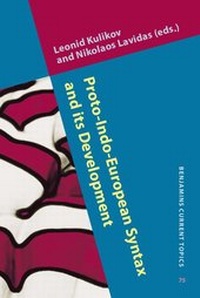
Proto-Indo-European Syntax and its Development
1st Edition
Published on 16. July 2015
V, 158 pages
978-90-272-6828-0 (ISBN)
Description

Although for some scholars the very possibility of syntactic reconstruction remains dubious, numerous studies have appeared reconstructing a variety of basic elements of Proto-Indo-European syntax based on evidence available particularly from ancient and/or archaic Indo-European languages. The papers in this volume originate from the Workshop "PIE Syntax and its Development" (Thessaloniki 2011), which aimed to bring together scholars interested in these problems and to shine new light on current research into ancient Indo-European syntax. Special attention was paid to the development of the hypothetical reconstructed features within the documented history of Indo-European languages.
The articles in this volume were originally published in the Journal of Historical Linguistics Vol. 3:1 (2013).
The articles in this volume were originally published in the Journal of Historical Linguistics Vol. 3:1 (2013).
More details
Other editions
Additional editions
Leonid Kulikov | Nikolaos Lavidas
Proto-Indo-European Syntax and its Development
Book
07/2015
John Benjamins Publishing Co
€90.10
Shipment within 10-15 days
Persons
Content
- Proto-Indo-European Syntax and its Development
- Editorial page
- Title page
- LCC data
- Table of contents
- Preface
- References
- Reconstructing Proto-Indo-European categories
- 1. Introduction
- 2. Reflexivity and the Middle in IE languages
- 3. Focusing on Hittite -z
- 3.1 Functions of the middle/reflexive -z
- 3.2 The data
- 3.2.1 First group: Transitive reflexive
- 3.2.2 Second group: Subjective reflexive
- 3.2.3 Third group: Objective reflexive
- 4. Functional extension of reflexive constructions in IE languages
- 5. Reconstructing the PIE category 'Middle'
- 6. Conclusions
- References
- The rise of 'subordination features' in the history of Greek and their decline
- 1. Introduction
- 2. The problem
- 3. The distinction root vs. non-root clauses
- 4. Pre-Classical Greek
- 4.1 Stage a and subordinating conjunctions (T1): Genesis of complementizers
- 4.2 Stage a: Tense shift (T4) instead of mood shift (T3)
- 5. Classical Greek: Stage b and the system of subordination traits
- 5.1 Stage b: Subordinating conjunctions (T1) pertaining to the complementizer hóti
- 5.2 Stage b: Infinitival complement clauses (T0)
- 5.3 Stage b: Mood shift (T3)
- 5.4 Stage b and clause connecting words (T1) again: Additional specialized properties of complementizers
- 5.5 Classical Greek: Some interpretations and conclusions
- 6. Stage c: Non-literary koine texts
- 6.1 Stage c and mood shift (T3)
- 6.2 Stage c: Subordinating conjunctions (T1), person shift (T2) and the T1-T2 Cluster
- 6.3 Stage c: T1 in hos-complement clauses?
- 7. Post-Koine Greek (stage d)
- 8. Summary and conclusions
- References
- Proto-Indo-European verb-finality
- 1. The issues
- 2. Comparative evidence for verb-finality
- 3. Relative clauses, SOV typology, and the reconstruction of PIE
- 3.1 General typological issues
- 3.1.1 Lehmann vs. Friedrich
- 3.1.2 Subordination and the finiteness constraint
- 3.2 Finite relativization and SOV
- 3.3 Some special features of early relative-correlatives
- 3.4 Apparent difficulties
- 3.4.1 "Replacive" relative clauses
- 3.4.2 Old Hittite "embedded" relatives
- 3.5 Conclusions regarding relativization
- 4. Prosodically motivated changes confirming the verb-final reconstruction
- 4.1 Suprasegmental effects of verb finality
- 4.2 Segmental effects of verb finality
- 4.3 Verb-finality effects as evidence that the SOV reconstruction is a fruitful hypothesis
- 5. Summary and conclusions
- Abbreviations
- References
- Hittite pai- 'come' and uwa- 'go' as Restructuring Verbs
- 1. Introduction
- 2. The Hittite phraseological construction
- 3. Restructuring and Clitic Climbing
- 4. The phraseological construction as an instance of Restructuring
- 4.1 Restructuring and finite clauses
- 4.2 The position of the matrix verb
- 4.3 uwa- as a raising verb
- 5. Conclusion
- References
- Reconstructing passive and voice in Proto-Indo-European
- 1. Introduction
- 2. Background
- 2.1 Passive and Passivization
- 2.2 The passive in ancient Indo-European languages
- 3. Lack of specialized passive morphology in IE: Evidence from Greek
- 4. Evidence from Vedic: Traces of IE passive?
- 5. Concluding remarks: Proto-Indo-European sources of Indo-European passives
- References
- Toward a syntactic phylogeny of modern Indo-European languages
- 1. Introduction
- 2. Indo-European classifications on a quantitative basis
- 2.1 Quantitative taxonomies
- 2.2 Beyond classical trees
- 3. Indo-European classification on a syntactic basis
- 3.1 The rise of PCM
- 3.2 The parametric database
- 3.3 Phylogenetic algorithms
- 3.4 Distance-based trees and networks
- 3.5 Syntax and lexicon
- 4. Further testing
- 4.1 Multiple ancestors: A character-based experiment
- 4.2 Preliminary character-based phylogenies
- 4.3 Some remarks on language contact
- 5. Summary
- References
- Appendix
- Subject index
