

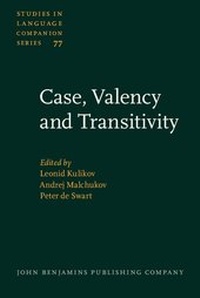
Case, Valency and Transitivity
1st Edition
Published on 15. November 2006
XX, 503 pages
978-90-272-9311-4 (ISBN)
Description

The three concepts of case, valency and transitivity belong to the most discussed topics of modern linguistics. On the one hand, they are crucially connected with morphological aspects of the clause, including case marking, person agreement and voice. On the other hand, they are related to several semantic issues such as the meaning of case, semantico-syntactic verbal classes, and the semantic correlates of transitivity. The volume unifies papers written within different theoretical frameworks and representing variegated approaches (Optimality Theory, Government and Binding, various versions of the Functional approach, Cross-linguistic and Typological analyses), containing both numerous new findings in individual languages and valuable observations and generalizations related to case, valency and transitivity.
More details
Other editions
Additional editions
Leonid Kulikov | Andrej L. Malchukov | Peter Swart
Case, Valency and Transitivity
Book
11/2006
John Benjamins Publishing Co
€153.70
Shipment within 10-15 days
Persons
Content
- Case, Valency and Transitivity
- Editorial page
- Title page
- LCC data
- Table of contents
- Introduction
- 1. Morphological case
- 1. Syntactic vs. morphological case
- 2. Case systems in a diachronic perspective
- 3. Emergence of morphological cases in South Mande
- 4. Issues of morphological ergativity in the Tsimshian languages
- 5. Direction marking and case in Menominee
- 2. Case marking and transitivity
- 6. Bare and prepositional differentialcase marking
- 7. Control infinitives and case in Germanic
- 8. Experiencer coding in Nakh-Daghestanian
- 9. 'Argument sharing' in Oriya serial verb constructions
- 10. Two approaches to specificity
- 11. Case markedness
- 12. Incremental distinguishability of subject and object
- 13. The woman showed the baby to her sister
- 14. Case semantics and the agent-patient opposition
- 15. Transitivity parameters and transitivity alternations
- 16. Transitivity in Songhay
- 3. Transitivity and valency change
- 17. Syntactic valence, information structure, and passive constructions in Kaqchikel
- 18. A very active passive
- 19. Case marking, possession and syntactic hierarchies in Khakas causative constructions in comparison with other Turkic languages
- 20. Transitivity increase markers interacting with verb semantics
- 21. Extraversive transitivization in Yucatec Maya and the nature of the applicative
- Language index
- Subject index
- The series Studies in Language Companion Series
