

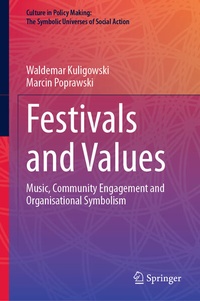
Festivals and Values
Description

This is an original book, covering all the past areas of research anyone would need to know about festivals and 'event-based culture'. It is based on academic research but written in a way relevant for cultural professionals - uniquely explaining the cultural power of festivals, and with original empirical research, the realities of organisation and management, and social and economic value.
Dr Jonathan Vickery, Reader in Cultural Policy Studies and Director: Centre for Cultural and Media Policy Studies, Univeristy of Warwick.
This book discusses music festivals in the context of the specific values they convey. Today, music festivals are a permanent feature of national, regional and local cultural policies, a valuable asset in the tourism industry and a significant source of income for an industry that has been adversely affected by the steady decline in physical sales of music. For the audience, on the other hand, it is an opportunity to escape from everyday life, multi-sensory contact with art, an activity that stands for "full-body participation"- a cultural phenomenon that drags people out of their homes like no other. There is one common denominator linking the above-mentioned features of contemporary music festivals - namely the world of values. This is evident from the non-accidental locations, festivals spaces' design, planning and the line-ups created consciously, with great care. The organisers' "missions", logos, and other symbolic organisational artefacts communicate specific values. These values are explicitly mentioned by artists and audiences: they can be easily identified in online forums and media reports; participant behaviour, festival "rituals" and additional festival programs are shaped on the basis of values, and cooperation is built between the festival and the local community.
As the reader will quickly realize, numbers and statistics sit alongside descriptions and quotations in this book, and the organisers' statements are accompanied by the opinions of academics, but above all the festival audience is given a voice - both through quotations and their drawings. This voice is by no means uniform, as it turned out that research into values was often transformed into a pretext for spinning tales about one's life situation, one's political preferences, and one's understanding of freedom and responsibility. Memories were mixed with declarations, joy with regret, curses with dreams, prose with poetry. Thomas Pettitt was not wrong in noting that "Social history has learnt to appreciate festival as a valuable window on society and its structures". The authors have tried to open all the windows available.
Students and researchers in the fields of cultural anthropology, social psychology, folklore studies, comparative religion, sociology of culture, cultural policy, cultural history, and cultural management will find this book highly interesting.
More details
Other editions
Additional editions
Persons
Waldemar Kuligowski is a professor at the Department of Anthropology and Ethnology at Adam Mickiewicz University in Poznan, Poland. He's also a head of the Section of Cultural Anthropology. He was conducting fieldworks in Europe, Asia, and North America. His research interests focus on the theory of culture, reflexive ethnography, anthropology of motorway, festivals and festivalization. His essays and articles has been published in many international journals such as "East European Politics and Societies", "Transfers. Interdisciplinary Journal of Mobility Studies", "Anthropos. International Review of Anthropology and Linguistic" and "Punk & Post-Punk". Recently, he has been implementing a 3-year research project devoted to music festivals as tools for communicating values and norms. In addition, he is a juror of the competition for the largest music award in Poland "Fryderyk", as well as a supporting member of the Chamber of Commerce for Managers of Polish Artists.
Marcin Poprawski (PhD) is a senior lecturer at the Humak University of Applied Sciences in Helsinki. His academic interests include arts organisations, ethical and ecological dimensions of cultural management, cultural policies, audience engagement, aesthetics, and festivals as organisations. He coordinates COSM (cosm.humak.fi). He is Finnish team's manager and researcher in the Horizon Europe 'EKIP' (European Cultural and Creative Industries Policy Platform) led by Lund University. He is an expert of the Association of Polish Cities and the European Expert Network on Culture (Interarts Barcelona) operating for the European Commission. In the years 2013-2018, he was the vice-president of ENCATC (Brussels). Previously, he worked for over 20 years at the Adam Mickiewicz University in Poznan. He was also a guest lecturer at European University Viadrina, University of Arts in Helsinki, University of Salento in Lecce, Theater Academy (DAMU) in Prague, ZHAW in Zurich, Academy of Music (JAMU) in Brno, and the Heritage Academy of the International Cultural Center in Cracow. For 17 years he worked as a cultural manager in the private, public, and civic sectors, including 8 years as a music festival director.
