

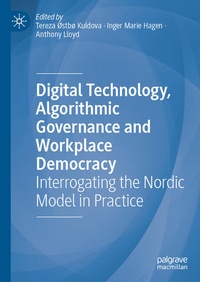
Digital Technology, Algorithmic Governance and Workplace Democracy
Description

Globally, 2 billion workers are in precarious informal jobs without protection. The Nordic Model privileges co-determination and worker participation in employment relations which can foreclose precarity and the absence of protection. However, the growth of digitalization and algorithmic governance within the workplace raises questions about labour process, worker agency, co-determination, governance, power, surveillance, control, and representation in all parts of the world, including the Nordic countries. This interdisciplinary edited collection offers a unique combination of macro level and micro level analyses of digitalization, algorithmic governance and workplace democracy in the context of Nordic labour markets.
Including studies from the finance industry, hospitals, higher education, police, and journalism, this collection teases out similarities and differences across labour markets and employment sectors and seeks to reflect nuances in terms of worker autonomy and agency, transformation of professional discretion, modes of resistance, representation and co-determination, and employment relations. It will be of great importance to the scholars and students of labour studies, workplace governance, HRM and the sociology of work.
More details
Other editions
Additional editions
Persons
Content
Chapter 1: Introduction Digital Technology Algorithmic Governance and the Nordic Model in Practice.- Chapter 2: Digitalization Algorithmic Management and the Norwegian Model of Labour Market Regulation.- Chapter 3: Digitalization Algorithmic Governance and the Limits of Workplace Democracy.- Chapter 4: The Trade Union Contradiction After the COVID 19 Pandemic Social Harm and the Failure to Transform Work.- Chapter 5: From Taylorism to Algorithmic Governance Debating Control and Democratization at Work at the International Labour Organization ca 1970 to 1990.- Chapter 6: The Politics of Employees Critique and Whistleblowing in a Digitized Norwegian Working Life.- Chapter 7: Algorithmic Governance Power and Social Dialogue in White Collar Work in Norway Negotiating the Impossible.- Chapter 8: AI and Data intensive Surveillance in Professional Work Transforming Discretion and Accountability.- Chapter 9: Social Dialogue on Digitalization in the Pipeline Results from Two Representative Surveys among Norwegian Employees and Managers.- Chapter 10: Professional Responses to Digital Projects and Systems in Norwegian Hospitals Retaining Autonomy Through Negotiation Strategic Adaptation and Opposition.- Chapter 11: When Shall we Meet Digitalization of Workforce Planning in the Norwegian Police.- Chapter 12: Now we Know Quantified Epistemology in News Production and Outpowered Unions.
