

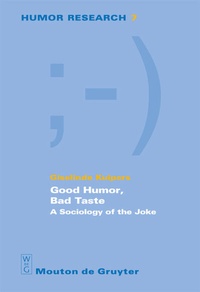
Good Humor, Bad Taste
Description

Good Humor, Bad Taste is the first extensive sociological study of the relationship between humor and social background. Using a combination of interview materials, survey data, and historical materials, the book explores the relationship between humor and gender, age, regional background, and especially, humor and social class in the Netherlands. The final chapter focuses on national differences, exploring the differences between the American and the Dutch sense of humor, again using a combination of interview and survey materials.
The starting point for this exploration of differences in sense of humor is one specific humorous genre: the joke. The joke is not a very prestigious genre; in the Netherlands even less so than in the US. It is precisely this lack of status that made it a good starting point for asking questions about humor and taste. Interviewees generally had very pronounced opinions about the genre, calling jokes "their favorite kind humor", but also "completely devoid of humor" and "a form of intellectual poverty". Good Humor, Bad Taste attempts to explain why jokes are good humor to some, bad taste to others.
The focus on this one genre enables Good Humor, Bad Taste to have a very wide scope. The book not only covers the appreciation and evaluation of jokes by different social groups and in different cultures, and its relationship with wider humor styles. It also describes the genre itself: the history of the genre, its decline in status from the sixteenth century onward, and the way the topics and the tone of jokes have changed over the last fifty years of the twentieth century.
Reviews / Votes
"[...] Good Humor, Bad Tast is an important book"Elliott Oring in: Journal of American Folklore 2009 "This is an insightful and very clearly espressed study of an important social phenomenon -humor. Besides, it contains, if I may say so without losing cast in Batavia, some very funny jokes."Christie Davies in: American Journal of Sociology 2008 "[...] this is a valuable and insightful contribution to the scholarship on jokes and humor that opens up many possibilities for future research."Moira Smith in: Journal of Folklore Research 2/2008More details
Other editions
Additional editions
Person
Content
- Intro
- Chapter 1. Introduction: Jokes, humor, and taste
- Part I. Style and social background
- Chapter 2. The joke: Genesis of an oral genre
- Chapter 3. Joke telling as communication style
- Chapter 4. The humor divide: Class, age, and humor styles
- Chapter 5. The logic of humor styles
- Part II. Taste and quality
- Chapter 6. The repertoire: Dutch joke culture
- Chapter 7. Temptation and transgression
- Chapter 8. Sense and sociability
- Part III. Comparing humor styles
- Chapter 9. National humor styles: Joke telling and social background in the United States
- Chapter 10. Conclusion: Sociology and the joke
- Appendix 1 : The jokes used in the Dutch survey
- Appendix 2: Dutch humorists and television programs
- Notes
- References
- Index
