

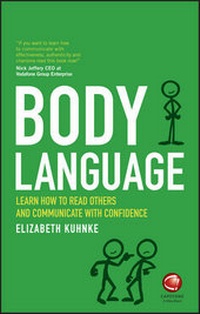
Body Language
Description

More details
Other editions
Additional editions
Person
Content
1
What Your Body Language Says About You
"There's language in her eye, her cheek, her lip, Nay, her foot speaks; her wanton spirits look out At every joint and motive of her body."
William Shakespeare
Feeling hot, engaged, and passionate? Feeling low, aloof, and cool? You don't need to answer that question. Your body says it all.
Standing proud and strutting your stuff indicates that you're ready and raring to go, while slumping your shoulders and shuffling your feet shows that you're carrying a heavy load. Hanging out on the sidelines with your arms crossed, a frown on your face, and your head burrowed into your chest suggests you're suspiciously watchful; meanwhile, engaging with a group of people, using open gestures and animated expressions, implies that you're prepared to party.
The Inner and Outer Connection
What you might find interesting about non-verbal behaviour - and body language in particular - is the relationship between values, beliefs, attitudes - and gestures, facial expressions, posture.
For example:
If openness is important to someone, you can expect to see that value reflected in free, approachable, and receptive movements and facial expressions. If they value privacy, their body language is more closed and contained.
If you hold the belief that you're unworthy, insignificant, and somehow "lacking", you might (1) overcompensate by being loud, brash, and seeking attention; or (2) withdraw, physically cave in on yourself, and avoid engaging with others. On the contrary, if you believe that you're an okay person, you will likely greet other people with warmth, curiosity, and generosity.
If your attitude is "I can't be bothered", your facial expressions are slack and your movements lack spontaneity. When you embrace a "Go, get 'em!" attitude, your body bursts with liveliness. Smiles surge across your face and you fist-pump the air as you jump for joy. Or a modified version of that.
In addition, consider the connection between feelings and behaviour. Whether you're conscious of them or not, your emotions, moods and state of mind play out in the way your body moves.
For instance, feeling upbeat and wanting to spread the love? Note your gestures and facial expressions: smiling, open, with a spring in your step and a sparkle in your eye. Feeling downbeat and demoralized? Look at yourself now: limp, bowed, with little sign of life.
" Even if you're trying to hide what you're experiencing, little leakages, "tells", and mini micro expressions give the game away every time.?"
Little Things Mean A Lot
A client asked me to join her while she interviewed a potential member of her leadership team. Both when she asked the candidate about his contribution to the success of the previous team he led and what value he could bring to the organization, I observed micro expressions flash across his face and body movements that indicated a high level of defensiveness. These consisted of:
- pursed lips
- flared nostrils
- tossing head and casting sky shots
- forced laughter
- fake smile
- shifting in his seat
- jiggling feet
- pulling backwards into his seat while crossing his arms and legs and tilting his head sideways.
Although the facial expressions were fleeting, they were telling, as were his body movements and gestures. Together, they conveyed the message that he was feeling the pressure. And, no surprise. Turns out that the candidate wasn't all he claimed to be.
Had my client not trusted my observations, she could have made an expensive mistake. While he told a good tale - spinning and exaggerating here and there - his body's movements told a truer story.
Not even your thoughts and intentions are immune to reflecting themselves in your movements and facial expressions. For example, your boss says something that you think is the stupidest thing you've ever heard. Before you know it, your eyes are rolling around in your head, which is the rudest facial expression a person can display, next to gagging. At that point, you might consider looking for a new job, as you may have blotted your copy book by demonstrating your derision and disdain.
Another example. You see someone who catches your attention. And you catch theirs. Observe how your bodies speak. Your eyes connect and hold the gaze. Your lips slide into shy, sensuous, inviting smiles. Your chests and chins may lift as your bodies tilt forward, all of which indicate that your intention is to get to know one another.
"It's amazing how many things you can do when you're just pretending."
-Kim Gordon
Applying the "As If" Principle
Frequently, clients ask me to help them develop and project confidence. From the C-suite to the up and coming stars, confidence is the number one quality they all want to possess. No matter how successful they are at their day jobs, each one has a little voice inside their heads telling them that they're not very good at demonstrating, for instance:
- poise
- assertiveness
-
self-assurance.
Frequently they ask me how they can convey:
- calmness in a crisis
- conviction
- courage.
I tell them, "Act as if."
According to the "as if" principle, you can create whatever state you desire by acting "as if" you already have what you would like to have. Like a child at play, you pretend to be who - or what - you want to be. And bingo! Before you know it, you've convinced yourself and others that you are, in this instance, confident.
" When you act "as if" you create a new reality for yourself.?"
The irony is, you don't even have to experience the feelings that go with the mental state you want to project, which is good news if, for example, you're feeling doubtful and you want to convey certainty. As long as you act "as if", the rest takes care of itself.
Basic behaviours that demonstrate confidence include the following.
- Posture. Upright, chest expanded, head lifting upwards from the crown, chin held in a horizontal position, the sensation that the shoulder blades are meeting at the spinal cord and melting downward. Weight evenly distributed.
- Eye contact. When speaking, look at the other person 45-75% of the time. When listening, aim for 65-85%. Too much eye contact can make a person look defensive or threatening. Too little indicates signs of discomfort, including shame or shyness.
- Facial expressions. Think "Calm. Open. Positive." A warm smile welcomes others into your arena and makes you appear in control of your environment. Avoid big, toothy grins, as they can make you appear more comic-like than confident.
- Gestures. Contain your gestures. Be in command of your movements. Keep them simple and clear. Gesturing higher than the shoulders implies a lack of control, while gesturing below the waist indicates a lack of interest.
Once you take on the behaviours that demonstrate confidence, you'll be amazed at what happens. The more you act "as if", the more others react to you as if that's who you really are. The more they react positively towards you, the more you feel comfortable with the behaviours. As your feelings change, so does your thinking; and as your thinking changes, so do your behaviours. The cycle of thoughts, behaviours, and feelings comes full circle.
For an excellent, short YouTube video that demonstrates this principle, go to https://www.youtube.com/watch?v=Ngr2kG48Xvw
Be advised: while the behaviours listed above are acknowledged as being those that confident people demonstrate, we are all different and therefore may have variations on how we project confidence. Whichever behaviours you choose, make sure that they are true to who you are and what you stand for.
" When you act "as if", you take on the behaviours of the state you want to project in order to create your desired outcomes.?"
Reading People's Emotions
"In this respect, I suppose I'm the total opposite of Garry [Kasparov]. With his very emotive body language at the [chess] board he shows and displays all his emotions. I don't."
-Vladimir Kramnik
Some people wear their feelings on their sleeves and act out what they're experiencing at the time. Others choose to suppress their moods in an effort to conceal their feelings. When you're deciphering other people's emotions, remember the following:
- Look for clusters.
- Read body language in context.
- Some non-verbal behaviour is culture specific.
- Observe what's happening in the present.
- Don't judge what you notice based on past...
