

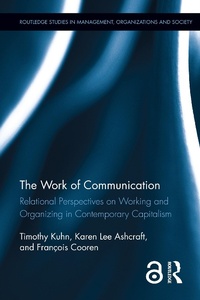
The Work of Communication
Relational Perspectives on Working and Organizing in Contemporary Capitalism
Published on 6. July 2017
232 pages
978-1-317-39798-4 (ISBN)
Description

The Work of Communication: Relational Perspectives on Working and Organizing in Contemporary Capitalism revolves around a two-part question: "What have work and organization become under contemporary capitalism-and how should organization studies approach them?" Changes in the texture of capitalism, heralded by social and organizational theorists alike, increasingly focus attention on communication as both vital to the conduct of work and as imperative to organizational performance. Yet most accounts of communication in organization studies fail to understand an alternate sense of the "work of communication" in the constitution of organizations, work practices, and economies. This book responds to that lack by portraying communicative practices-as opposed to individuals, interests, technologies, structures, organizations, or institutions-as the focal units of analysis in studies of the social and organizational problems occasioned by contemporary capitalism.
Rather than suggesting that there exists a canonically "correct" route communicative analyses must follow, The Work of Communication: Relational Perspectives on Working and Organizing in Contemporary Capitalism explores the value of transcending longstanding divides between symbolic and material factors in studies of working and organizing. The recognition of dramatic shifts in technological, economic, and political forces, along with deep interconnections among the myriad of factors shaping working and organizing, sows doubts about whether organization studies is up to the vital task of addressing the social problems capitalism now creates. Kuhn, Ashcraft, and Cooren argue that novel insights into those social problems are possible if we tell different stories about working and organizing. To aid authors of those stories, they develop a set of conceptual resources that they capture under the mantle of communicative relationality. These resources allow analysts to profit from burgeoning interest in notions such as sociomateriality, posthumanism, performativity, and affect. It goes on to illustrate the benefits that investigations of work and organization can realize from communicative relationality by presenting case studies that analyze (a) the becoming of an idea, from its inception to solidification, (b) the emergence of what is taken to be the "the product" in high-tech startup entrepreneurship, and (c) the branding of work (in this case, academic writing and commercial aviation) through affective economies. Taken together, the book portrays "the work of communication" as simultaneously about how work in the "new economy" revolves around communicative practice and about how communication serves as a mode of explanation with the potential to cultivate novel stories about working and organizing.
Aimed at academics, researchers, and policy makers, this book's goal is to make tangible the contributions of communication for thinking about contemporary social and organizational problems.
Rather than suggesting that there exists a canonically "correct" route communicative analyses must follow, The Work of Communication: Relational Perspectives on Working and Organizing in Contemporary Capitalism explores the value of transcending longstanding divides between symbolic and material factors in studies of working and organizing. The recognition of dramatic shifts in technological, economic, and political forces, along with deep interconnections among the myriad of factors shaping working and organizing, sows doubts about whether organization studies is up to the vital task of addressing the social problems capitalism now creates. Kuhn, Ashcraft, and Cooren argue that novel insights into those social problems are possible if we tell different stories about working and organizing. To aid authors of those stories, they develop a set of conceptual resources that they capture under the mantle of communicative relationality. These resources allow analysts to profit from burgeoning interest in notions such as sociomateriality, posthumanism, performativity, and affect. It goes on to illustrate the benefits that investigations of work and organization can realize from communicative relationality by presenting case studies that analyze (a) the becoming of an idea, from its inception to solidification, (b) the emergence of what is taken to be the "the product" in high-tech startup entrepreneurship, and (c) the branding of work (in this case, academic writing and commercial aviation) through affective economies. Taken together, the book portrays "the work of communication" as simultaneously about how work in the "new economy" revolves around communicative practice and about how communication serves as a mode of explanation with the potential to cultivate novel stories about working and organizing.
Aimed at academics, researchers, and policy makers, this book's goal is to make tangible the contributions of communication for thinking about contemporary social and organizational problems.
Reviews / Votes
'I highly recommend this book to those who are looking for a fresh view on what is going on in communication studies and how it connects to similar lines of thought in practice-based studies or in affect studies.' - Silvia Gherardi, University of Trento, Italy'The Work of Communication is an important step in the study of organizations in terms of grappling with the central question about symbolicity and materiality that, while it can never be completely resolved (Burke, 1969), offers us something to learn from the ongoing effort to answer it. The Work of Communication will stimulate further discussions and debates on both theoretical and practical levels, and that is one of the most important stated goals for this impressive and path-breaking volume.' - George Cheney, University of Colorado Colorado Springs, USA
More details
Series
Language
English
Place of publication
London
United Kingdom
Publishing group
Taylor & Francis Ltd
Target group
Professional and scholarly
College/higher education
File size
2,06 MB
ISBN-13
978-1-317-39798-4 (9781317397984)
Copyright in bibliographic data and cover images is held by Nielsen Book Services Limited or by the publishers or by their respective licensors: all rights reserved.
Schweitzer Classification
Other editions
Additional editions
Timothy Kuhn | Karen L. Ashcraft | Francois Cooren
The Work of Communication
Relational Perspectives on Working and Organizing in Contemporary Capitalism
Book
06/2019
1st Edition
Routledge
€68.30
Shipment within 15-20 days
Timothy Kuhn | Karen L. Ashcraft | Francois Cooren
The Work of Communication
Relational Perspectives on Working and Organizing in Contemporary Capitalism
Book
06/2017
1st Edition
Routledge
€206.30
Shipment within 10-20 days
Persons
Timothy Kuhn is a Professor in the Department of Communication at the University of Colorado Boulder, USA.
Karen Lee Ashcraft is a Professor in the Department of Communication at the University of Colorado Boulder, USA.
Francois Cooren is a Professor in the Department of Communication at the Universite de Montreal, Canada.
Karen Lee Ashcraft is a Professor in the Department of Communication at the University of Colorado Boulder, USA.
Francois Cooren is a Professor in the Department of Communication at the Universite de Montreal, Canada.
Content
1. Encountering Working and Organizing Under Contemporary Capitalism, 2. Relationality: Cultivating Novelty in Explorations of Working and Organizing, 3. Communicative Relationality, 4. Creativity and Relationality: Following the Becoming of an Idea, 5. Speculative Value: Articulating and Materializing the "Product" in High-Tech Startup Entrepreneurship, 6. Branding Work: Occupational Identity as Affective Economy (Aka The Glass Slipper, Take Two), 7. Conclusion: The Value(s) of Communicative Relationality
