

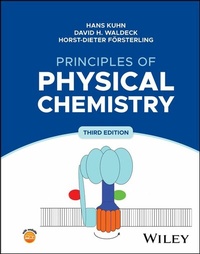
Principles of Physical Chemistry
Description

Core textbook showcasing the broad scope and coherence of physical chemistry
Principles of Physical Chemistry introduces undergraduate students to the concepts and methods of physical chemistry, which are fundamental to all of Chemistry. In their unique approach, the authors guide students along a logically consistent pathway from the principles of quantum mechanics and molecular structure to the properties of ensembles and supramolecular machines, with many examples from biology and nanoscience. By systematically proceeding from atoms to increasingly complex forms of matter, the book elucidates the connection between recognizable paradigms and modern chemistry research in a student-friendly manner. To promote intuition and understanding for beginning students, the text introduces concepts before proceeding to more rigorous treatments. Rigorous proofs and derivations are provided, as electronic supplements, for more advanced students.
The book poses over 900 exercises and problems to help the student learn and master methods for physicochemical reasoning. Computational supplementary material, including Fortran simulations, MathCAD exercises, and Mathematica programs, are included on a companion website.
Some topics discussed in the text are:
- Electronic structure and Variational Principle, including Pauli exclusion, spin-orbit interactions, and electron confinement in quantum dots.
- Chemical bonding and molecular structure, including electron tunneling, comparison of electron-in-a-box models and electron orbital methods, and the mechanics of chemical bonds.
- Absorption and emission of light, including transition dipoles for p-electron systems, coupled chromophores, excitons, and chiroptical activity.
- Statistical description of molecular ensembles, including microscopic interpretations of phase transitions, entropy, work, and heat.
- Chemical equilibria, including statistical description of equilibrium constants, electrochemistry, and the exposition of fundamental reaction types.
- Reaction kinetics and reaction dynamics, including nonlinear coupled reactions, femtochemistry, and solvent effects on reactions.
- Physicochemical properties of macromolecules and the principles of supramolecular assemblies, including polymer dynamics and chemical control of interfaces.
- The logic of supramolecular machines and their manipulation of photon, electron, and nuclear motion.
With its highly coherent and systematic approach to the subject, Principles of Physical Chemistry is an ideal textbook and resource for students in undergraduate physical chemistry courses, especially those in programs of study related to chemistry, engineering, and molecular and chemical biology.
More details
Other editions
Additional editions
Persons
Hans Kuhn, Dr. phil., (deceased) was Professor and Director of the Institute of Physical Chemistry at the Philipps-University of Marburg from 1953-1970. In 1970 he became Director at the Max Planck Institute for Biophysical Chemistry (Karl-Friedrich-Bonhoeffer-Institute) until he retired in 1985. He died in 2012.
David H. Waldeck, PhD, is Professor of Chemistry and Director of the Petersen Institute for Nanoscience and Engineering at the University of Pittsburgh.
Horst-Dieter Försterling, Dr. phil., was Professor in the Department of Physical Chemistry at the Philipps-University of Marburg from 1972 until his retirement in 1999.
Content
Preface Third Edition xxv
Acknowledgement xxvii
List of Symbols xxix
About the Companion Website xxxi
Introduction xxxiii
1 Wave-Particle Duality 1
2 Essential Aspects of Structure and Bonding 17
3 Schrödinger Equation 36
4 Hydrogen Atom 67
5 Atoms and Variational Principle 86
6 A Quantitative View of Chemical Bonding 123
7 Bonding Described by Electron Pairs and Molecular Orbitals 142
8 Molecules with p-Electron Systems 177
9 Absorption of Light 208
10 Emission of Light 262
11 Nuclei: Particle and Wave Properties 282
12 Nuclear Spin 330
13 Solids and Intermolecular Forces 345
14 Thermal Motion of Molecules 376
15 Energy Distribution in Molecular Assemblies 411
16 Work w, Heat q, and Internal Energy U 453
17 Reversible Work wrev, Reversible Heat qrev, and Entropy S 482
18 General Conditions for Spontaneity and its Application to Equilibria of Ideal Gases and Dilute Solutions 525
19 Formal Thermodynamics and Its Application to Phase Equilibria 567
20 Real Gases 590
21 Real Solutions 612
22 Reaction Equilibria in Aqueous Solutions and Biosystems 633
23 Chemical Reactions in Electrochemical Cells 658
24 Chemical Kinetics 689
25 Transition States and Chemical Reactions 740
26 Macromolecules 775
27 Organized Molecular Assemblies 809
28 Supramolecular Machines 835
29 Origin of Life. Matter Carrying Information 899
Appendices 930
A Data Tables 930
B Mathematical Tables 946
C Mathematical Miscellany 952
Index 979
