

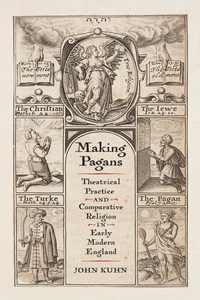
Making Pagans
Description

How early modern theatrical practice helped construct the category of "pagan" as a tool of European self-definition and colonial ambition
In Making Pagans, John Kuhn argues that drama played a powerful role in the articulation of religious difference in the seventeenth century. Tracing connections between the history of stagecraft and ethnological disciplines such as ethnography, antiquarianism, and early comparative religious writing, Kuhn shows how early modern repertory systems that leaned heavily on thrift and reuse produced an enduring theatrical vocabulary for understanding religious difference through the representation of paganism-a key term in the new taxonomy of world religions emerging at this time, and a frequent subject and motif in English drama of the era.
Combining properties such as triumphal chariots, trick alters, and moving statues with music, special effects, and other elements, the spectacular set-pieces that were mostly developed for plays set in antiquity, depicting England's pre-Christian past, were frequently repurposed in new plays, in representations of Native Americans and Africans in colonial contact zones. Kuhn argues that the recycling of these set-pieces encouraged audiences to process new cultural sites through the lens of old performance tropes, and helped produce fictitious, quasi-ethnographic knowledge for spectators, generating the idea of a homogeneous, trans-historical, trans-geographical "paganism." Examining the common scenes of pagan ritual that filled England's seventeenth-century stages-magical conjurations, oracular prophecies, barbaric triumphal parades, and group suicides-Kuhn traces these tropes across dozens of plays, from a range of authors including Ben Jonson, Christopher Marlowe, John Dryden, and Philip Massinger.
Drawing together theater history, Atlantic studies, and the history of comparative religion, Making Pagans reconceptualizes the material and iterative practices of the theater as central to the construction of radical religious difference in early modernity and of the category of paganism as a tool of European self-definition and colonial ambition.
More details
Person
Content
Contents
Introduction. English Theatrical Practice and the Uses of Pagan Homology
Chapter 1. "The Tricks of the Pagan Priests": Staging Prophetic Altars from Sejanus to The Widow Ranter
Chapter 2. "I Could Not Triumph If These Were Not My Slaves": Staging the Pagan Triumph from The Wounds of Civil War to The Indian Queen
Chapter 3. The Magician in His Study: Staging Pagan Textuality from Doctor Faustus to The Indian Emperour
Chapter 4. "I Come to Thee!": Staging Reunion Suicides and Pagan Heavens from Tamburlaine to Oroonoko
Conclusion
Notes
Index
Acknowledgments
