

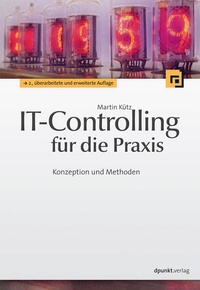
IT-Controlling für die Praxis
Konzeption und Methoden
2nd Edition
Published on 17. May 2013
340 pages
978-3-86491-290-0 (ISBN)
Available for download
Description

Das Buch entwickelt eine zeitgemäße Controlling-Konzeption für die IT. Martin Kütz beschreibt Prozesse, Instanzen und Objekte des IT-Controllings und leitet daraus ein Prozessmodell ab. Der Leser erhält Hinweise für den Aufbau, die organisatorische Einbindung und personelle Ausstattung eines IT-Controlling-Dienstes. Weiter werden die wichtigsten Methoden der Kosten-, Leistungs- und Wirtschaftlichkeitsrechnung dargestellt. Die 2. Auflage wurde komplett überarbeitet und vertieft Themen wie Multiprojektmanagement, Kostenrechnung, interne Leistungsverrechnung sowie Entscheidungsunterstützung.
More details
Other editions
Additional editions
Book
05/2013
2nd Edition
dpunkt
€44.90
Shipment within 5-7 days
Person
Prof. Dr. Martin Kütz lehrt Wirtschaftsinformatik an der Hochschule Anhalt und ist geschäftsführender Gesellschafter des Beratungsunternehmens TESYCON GmbH. Er verbindet langjährige praktische Erfahrungen in IT-Management und IT-Beratung mit einem starken Interesse an theoretischen und methodischen Fragestellungen. Seine Erfahrungen gibt er in Lehrveranstaltungen, Beratungsprojekten, Veröffentlichungen, Vorträgen und Seminaren weiter. Er arbeitet aktiv in der Fachgruppe IT-Controlling der Gesellschaft für Informatik e.V. mit.
Content
- Cover
- Titel
- Impressum
- Vorwort zur zweiten Auflage
- Vorwort zur 1. Auflage
- Inhaltsverzeichnis
- 1 Einleitung
- 2 Das IT-Controlling-Konzept
- 2.1 IT-Controlling als System
- 2.1.1 Das allgemeine Controllingsystem
- 2.1.2 Adressaten des IT-Controllings
- 2.1.3 Objekte des IT-Controllings
- 2.1.4 IT-Controllingsysteme in der Literatur
- 2.1.5 IT-Supply-Controlling
- Service- und Serviceportfolio-Controlling
- Prozess- und Prozessportfolio-Controlling
- System- und Systemportfolio-Controlling
- Projekt- und Projektportfolio-Controlling
- Ressourcencontrolling
- GRC-Controlling
- 2.1.6 Schwerpunkte des IT-Supply-Controllings
- Bereitstellungswirtschaftlichkeit und Wertbeitrag
- Leistungsverrechnung und Profit Center
- Fixkosten und Gemeinkosten
- 2.1.7 IT-Demand-Controlling
- Service- und Serviceportfolio-Controlling
- Projekt- und Projektportfolio-Controlling
- Ressourcencontrolling
- GRC-Controlling
- 2.1.8 Schwerpunkte des IT-Demand-Controllings
- Verwendungswirtschaftlichkeit und Wertbeitrag
- Effizienzsteigerung
- Restrukturierung
- Innovation
- Initiierung von IT-Projekten
- Sicherstellung von IT-Kompetenz
- 2.1.9 IT-Governance-Controlling
- Service- und Serviceportfolio-Controlling
- Prozess- und Prozessportfolio-Controlling
- System- und Systemportfolio-Controlling
- Projekt- und Projektportfolio-Controlling
- Ressourcencontrolling
- GRC-Controlling
- 2.1.10 Schwerpunkte des IT-Governance-Controllings
- Koordination
- Sourcing
- E-Business und E-Government
- 2.2 IT-Controlling als Prozess
- 2.2.1 Prozessmodell für das IT-Controlling
- 2.2.2 Alternative Prozessmodelle
- Controllingprozessmodell des ICV
- IT-Controlling nach Krcmar/Buresch
- Controllingprozesse in COBIT
- Controllingprozesse in ITIL
- 2.2.3 Operatives IT-Controlling
- 2.2.4 Strategisches IT-Controlling
- 2.2.5 Benchmarking
- Formen des Benchmarkings
- Daten für das IT-Benchmarking
- Auswahl von Benchmarks
- 2.3 IT-Controlling als Instanz
- 2.3.1 Allgemeine Ansätze
- 2.3.2 Integration des IT-Controllings in die Organisation
- 2.3.3 Gremien
- 2.3.4 Anforderungen an IT-Controller
- 2.3.5 Abgrenzungen zu Finanzbereich und Revision
- 2.3.6 Aufbau eines IT-Controllings
- 2.4 Sonderfälle des IT-Controllings
- 2.4.1 Ausgliederung und Auslagerung der IT
- Transformation in ein Profit Center
- Auslagerung in ein IT-Systemhaus
- Auslagerung der IT an einen externen IT-Dienstleister
- 2.4.2 Transfer von IT-Organisationen
- 2.4.3 E-Business und E-Government
- 3 Die Controlling-Methoden
- 3.1 Kostenrechnung in der IT
- 3.1.1 Grundlagen und Begriffe
- Kostenarten
- Kostenstellen
- Kostenträger
- 3.1.2 Fixe und variable Kosten
- 3.1.3 Einzel- und Gemeinkosten
- 3.1.4 Voll- und Teilkostenrechnung
- 3.1.5 Plankostenrechnung
- 3.1.6 Prozesskostenrechnung
- 3.1.7 Stückkostenrechnung
- 3.1.8 Total Cost of Ownership
- 3.1.9 Zielkostenrechnung
- 3.2 Leistungsrechnung in der IT
- 3.2.1 Grundlagen und Begriffe
- 3.2.2 Servicedefinition und Prozessmodellierung
- 3.2.3 Service Level Agreements
- 3.2.4 Stückkosten und Verrechnungspreise
- 3.2.5 Leistungsverrechnung
- 3.3 Wirtschaftlichkeitsrechnung in der IT
- 3.3.1 Grundlagen und Begriffe
- 3.3.2 Rentabilität
- 3.3.3 Statische Investitionsrechnung
- 3.3.4 Dynamische Investitionsrechnung
- 3.3.5 Der Projektabbruch
- 3.3.6 Der IT-Wertbeitrag
- 3.3.7 Bewertung von Nutzeffekten
- 3.3.8 Einflussfaktoren
- 3.4 IT-Kennzahlensysteme
- 3.4.1 Grundlagen und Begriffe
- 3.4.2 Kategorien für IT-Kennzahlen
- 3.4.3 Handlungsorientierung von IT-Kennzahlen
- 3.4.4 Strukturierung von IT-Kennzahlensystemen
- 3.4.5 IT Balanced Scorecard
- 3.4.6 Nutzung von IT-Kennzahlensystemen
- 3.4.7 Praxisbeispiele
- 3.5 Planungsverfahren
- 3.5.1 Grundlagen und Begriffe
- 3.5.2 Budgetplanung
- 3.5.3 Projektplanung
- 3.5.4 Projektorganisation und Kommunikation
- 3.5.5 Projektsteuerung und Qualitätssicherung
- 3.5.6 Vorgehensmodelle
- 3.5.7 Puffermanagement
- 3.5.8 Portfolioplanung
- 3.5.9 Aufwandsschätzungen
- 3.6 Analyse- und Prognoseverfahren
- 3.6.1 Grundlagen und Begriffe
- 3.6.2 Datenerhebung
- 3.6.3 Zeitreihenanalysen
- 3.6.4 ABC-Analysen
- 3.6.5 Sensitivitätsanalysen
- 3.6.6 Prognoserechnungen
- 3.6.7 Risikomanagement
- 3.7 Entscheidungsunterstützung
- 3.7.1 Grundlagen und Begriffe
- 3.7.2 Ermittlung einer Präferenzordnung
- 3.7.3 Bestimmung von Nutzenfunktionen
- 3.7.4 Der Analytische Hierarchieprozess
- 3.7.5 Portfolioanalysen
- 4 Nachwort
- Abkürzungen
- Literatur
- Stichwortverzeichnis
