

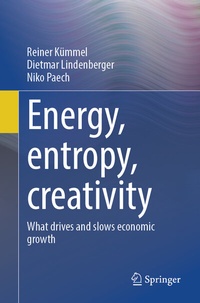
Energy, entropy, creativity
Description

This book helps to understand the importance of thermodynamics for economics, the environment and society. It argues for the integration of the first two laws of thermodynamics into textbook economics. In doing so, systemic similarities in thermodynamics and the theory of economic growth lead to the use of similar mathematical methods that allow industrial economies to be described realistically. From this, the authors propose tools for solving social and environmental problems.
The book is aimed at all those interested in interdisciplinary research on the development problems of the economy and society and who want to understand what drives their upheavals.
The authors of the book have been dealing with these development problems for a long time: the theoretical physicist Reiner Kümmel from the University of Würzburg, the physicist and economist Dietmar Lindenberger from the University of Cologne and the Energy Economics Institute at this university, and the economist Niko Paech from the University of Siegen.
"It is my pleasure to recommend this book to readers. It is driven by the idea of exploring the physical limits of human economic activity using thermodynamics, one of the most universal physical theories we have."
Comment on the original German edition by Dieter Meschede, Professor of Physics, University of Bonn
More details
Other editions
Additional editions
Persons
Reiner Kümmel, born in 1939, is a retired professor of theoretical physics. His fields of work are the theory of superconductivity, semiconductor theory and energy science. Before his appointment at the University of Würzburg in 1974, he studied/researched/taught at the TH Darmstadt (physics diploma), the University of Illinois at Champaign-Urbana (research assistant to John Bardeen), the University of Frankfurt/M.. (doctorate and habilitation) and the Universidad del Valle in Cali, Colombia. From 1996 to 1998 he was chairman of the Energy Working Group of the German Physical Society.
PD Dr. Dietmar Lindenberger studied economics and physics in Stuttgart, Würzburg and Albany (USA), received his doctorate in 1999 on questions of energy and economic growth and habilitated in 2005 at the University of Cologne. At the Institute of Energy Economics (EWI) in Cologne, he is active in teaching, research and consulting, among others for the EU Commission, the Federal Chancellery, federal and state ministries, national and international energy companies and research funding institutions. He has published widely on energy issues and is, among other things, lead author of the energy scenarios for the German government's energy concept.
Apl. Prof. Dr. Niko Paech studied economics, received his doctorate in 1993, habilitated in 2005 and held the Chair of Production and Environment at Carl von Ossietzky University Oldenburg from 2008 to 2016. He currently researches and teaches at the University of Siegen in the Master's programme in Plural Economics. His main research interests are post-growth economics, climate change mitigation, sustainable consumption, sustainable supply chain management, sustainability communication and innovation management. He is active in various sustainability-oriented research projects, networks and initiatives as well as in the supervisory board of two cooperatives.
Content
Entropy and upheaval
Energy and life
Economic growth
Post-growth economics
Countries in transition
Stationary or space.
