

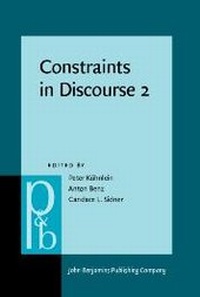
Constraints in Discourse 2
1st Edition
Published on 14. April 2010
V, 180 pages
978-90-272-8854-7 (ISBN)
Description

Text is highly structured, and structured at a variety of levels. But what are the units of text, which levels are at stake, and what establishes the structure that binds the units together? This volume, just as the predecessor a spin off of one of the workshops on constraints in discourse, contains the most recent, thoroughly reviewed papers by specialists in the area that try to give answers to such questions. It helps deepening the understanding of a multiplicity of mechanisms and constraints that are at work during production and comprehension of well-formed discourse. Researchers from linguistics, both formal and psycholinguistics, artificial intelligence, and cognitive sciences will appreciate this book as a valuable resource for information and inspiration.
More details
Other editions
Additional editions
Peter Kuehnlein | Anton Benz | Candace L. Sidner
Constraints in Discourse 2
Book
04/2010
John Benjamins Publishing Co
€100.70
Shipment within 10-15 days
Persons
Content
- Constraints in Discourse 2
- Editorial page
- Title page
- LCC data
- Table of contents
- Rhetorical structure
- 0.1. General remarks
- 0.2. Elementary units
- 0.3. Rhetorical relations
- 0.4. Structures and their properties
- 0.5. About the papers
- Bibliography
- Clause-internal coherence
- 1. Introduction
- 2. The Abduction framework
- 3. Classes of clause-internal coherence
- 3.1. The data
- 3.2 Clause-internal coherence from explicit signals
- 3.3 Intra-clausal coherence as coreference
- 3.4 Problematic residue
- 4. Further examples of clause-internal coherence
- 4.1. Science article
- 4.2 Business news
- 4.3 The novelette
- 4.4 Shakespeare's sonnet
- 5. Summary
- References
- Optimal interpretation for rhetorical relations
- 1. Optimality theoretic pragmatics
- 2. Pragmatic constraints
- 3. What should a theory of rhetorical structure achieve?
- 4. Pragmatic constraints in rhetorical structure
- 5. Coherence
- 6. Rhetorical relations
- 7. Discourse trees
- 8. Context dependency
- 9. Conclusion
- References
- Modelling discourse relations by topics and implicatures
- 1. Motivation
- 2. Outline of the theory
- 2.1 Definitions
- 2.2 Constraints
- 3. Predictions
- 3.1. The default case
- 3.2 The effect of continuation intonation and the conjunction and
- 4. Intonation and conjunction in spontaneous speech
- 5. Conclusions and outlook
- References
- The role of logical and generic document structure in relational discourse analysis
- 1. Introduction
- 2. Representation of relational discourse structure
- 3. Cues and constraints from logical document structure
- 4. Cues and constraints from generic document structure
- 4.1. Interrelations between generic document structure and relational discourse structure
- 4.2 Canonical sequence of global text type structure categories
- 4.3 Correlations between text type structure categories and rhetorical relations
- 5. Conclusion and outlook
- References
- Obligatory presupposition in discourse
- 1. Introduction
- 2. Data
- 2.1 Background: Obligatoriness of too and other additives
- 2.1.1 Kaplan
- 2.1.2 Krifka
- 2.1.3 Sæbo
- 2.1.4 Intermediate conclusion
- 2.2 The role of presupposition
- 2.2.1 Discourse particles
- 2.2.2 Accessibility differences
- 2.3 Generalization
- 2.3.1 Inventory
- 2.3.2 Definition of the class
- 3. Pragmatic explanation
- 4. Interaction with discourse structure
- 4.1 Discourse sensitivity
- 4.2 Preliminary "implementation" in SDRT
- 5. Conclusion
- References
- Conventionalized speech act formulae
- 1. Introduction
- 2. Empirical motivation
- 3. Cypriot Greek speech act formulae
- 4. The specification of formulae in HPSG
- 5. Dual uptake
- 6. Conclusion and future work
- References
- Constraints on metalinguistic anaphora
- 1. Formal varieties of metalinguistic anaphora
- 2. Constraints on the antecedent and referent of the antecedent
- 3. A top-down approach
- 4. What endows linguistic referents with the required level of salience?
- 4.1 What enables those linguistic entities to function as referents?
- 4.2 What brings linguistic entities into focus?
- 5. Role of the predicate elsewhere
- 6. Robustness of the proposed account
- 7. Plausible explanations
- 7.1 The lexical meaning of the antecedent
- 7.2 Inherent salience of certain words or phrases
- 7.3 A general pragmatic framework
- 8. Binding or accommodation?
- 9. Conclusion
- References
- Appositive Relative Clauses and their prosodic realization in spoken discourse
- 0. Introduction
- 0.1. Outline
- 0.2 Methodology
- 1. Appositive Relative Clauses and their functions in discourse
- 1.1 Relevance ARCs
- 1.2 Subjectivity ARCs
- 1.3 Continuative ARCs
- 1.4 Morphosyntactic, semantic and prosodic characteristics
- 2. Prosodic analysis
- 2.1. Fundamental prosodic conceptions
- 2.2 Prosodic representations
- 2.3 Prosodic dimensions
- 2.4 Data extraction
- 2.4.1 Discourse annotation
- 2.4.2 Prosodic annotation
- 3. Results
- 3.1. ARCs as parentheticals
- 3.2 Differences between types of ARCs
- 4. Discussion
- 5. Conclusion
- References
- Index
- The series Pragmatics & Beyond New Series
