

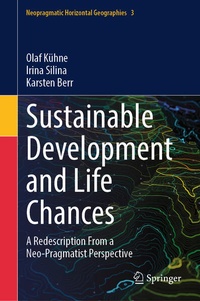
Sustainable Development and Life Chances
Description

Sustainable development is now considered one of the major narratives shaping society's future. At the same time, it is proving to be an area of conflict where expectations, morals, politics, and ideas of scientific evidence collide. This book shows why current discourses on sustainability are reaching their limits. But it also shows how a new, openly conceived approach to sustainable development can emerge. Based on Richard Rorty's neopragmatism and Ralf Dahrendorf's concept of life chances, Olaf Kühne, Karsten Berr, and Irina Silina develop an innovative perspective: sustainable development is not understood as a teleologically defined goal but as a contingent, dialogical process that must be constantly reshaped, in which people generate life chances. The focus is on questions such as how people create meaning, how conflicts can become productive, and how individual freedom can be linked to collective responsibility. The book combines theoretical foundations, from vocabulary analyses to various forms of criticism of the Sustainable Development Goals (SDGs), with a comprehensive redescription of sustainable development. Following the guiding principle of liberal ironist Richard Rorty, an approach is developed that understands freedom from humiliation, compassion, processes of understanding, and the expansion of the "we" as prerequisites for a resonant culture of sustainability.
The book is a committed and reflective plea for sustainability research that does not cover up conflicts but takes them seriously-and thinks of the future as a shared, open possibility, giving high priority to individual life chances.
More details
Other editions
Additional editions
Persons
Dr. Dr. Olaf Kühne is Professor of Urban and Regional Development in the Department of Geography and the Institute of Political Science at the University of Tübingen, Germany.
Irina Silina is Postdoctoral Researcher at the Jülich Forschungszentrum, Jülich, Germany.
Dr. Karsten Berr is a research associate at the Chair of Urban and Regional Development at the Eberhard Karls University of Tübingen, Germany.
Content
Chapter 1. Introduction.- Chapter 2. Analytical Tools: Three-world Theory and Understandings of Criticism.- Chapter 3. Neopragmatism as a Theoretical-conceptual Framework.- Chapter 4. Balancing the Individual and Society.- Chapter 5. From a Summary of the Theoretical Background to Criteria for Further Developing the Vocabulary of Sustainable Development.- Chapter 6. Historical Review of Sustainability, the SDGs, and Differentiated Approaches to Sustainable Development.- Chapter 7. Criticism of the SDGs.- Chapter 8. Life Chances and Sustainable Development.- Chapter 9. Redescription of the Life Chances-oriented Understanding of Sustainability Based on Neopragmatism.- Chapter 10. Conclusion.
