

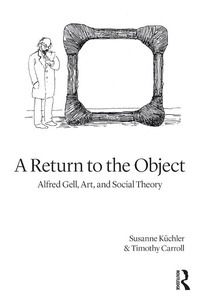
A Return to the Object
Alfred Gell, Art, and Social Theory
1st Edition
Published on 26. November 2020
268 pages
978-1-000-18234-7 (ISBN)
Description

This book draws on the work of anthropologist Alfred Gell to reinstate the importance of the object in art and society. Rather than presenting art as a passive recipient of the artist's intention and the audience's critique, the authors consider it in the social environment of its production and reception.
A Return to the Object introduces the historical and theoretical framework out of which an anthropology of art has emerged, and examines the conditions under which it has renewed interest. It also explores what art 'does' as a social and cultural phenomenon, and how it can impact alternative ways of organising and managing knowledge. Making use of ethnography, museological practice, the intellectual history of the arts and sciences, material culture studies and intangible heritage, the authors present a case for the re-orientation of current conversations surrounding the anthropology of art and social theory.
This text will be of key interest to students and scholars in the social and historical sciences, arts and humanities, and cognitive sciences.
A Return to the Object introduces the historical and theoretical framework out of which an anthropology of art has emerged, and examines the conditions under which it has renewed interest. It also explores what art 'does' as a social and cultural phenomenon, and how it can impact alternative ways of organising and managing knowledge. Making use of ethnography, museological practice, the intellectual history of the arts and sciences, material culture studies and intangible heritage, the authors present a case for the re-orientation of current conversations surrounding the anthropology of art and social theory.
This text will be of key interest to students and scholars in the social and historical sciences, arts and humanities, and cognitive sciences.
Reviews / Votes
'This book is at once penetrating and kaleidoscopic, full of exposition coupled with evocative ethnographic illustration. It extends Gell's ideas into new domains... The synthesis is extraordinary. Ranging across time and space and diversity of perspectives compared and contrasted, this volume will take its place alongside others-one thinks of The Savage Mind, Purity and Danger.'- Frederick H. Damon, University of Virginia 'This book is at once penetrating and kaleidoscopic, full of exposition coupled with evocative ethnographic illustration. It extends Gell's ideas into new domains... The synthesis is extraordinary. Ranging across time and space and diversity of perspectives compared and contrasted, this volume will take its place alongside others-one thinks of The Savage Mind, Purity and Danger.'
- Frederick H. Damon, University of Virginia, USA
"Kuechler and Carroll have brought their different anthropological experiences and deep knowledge together in a book to engage the anthropology of art with a deep reading and extension of Alfred Gell's framework. Calling for a "return to the object," a theoretical project that follows Gell's movement away from the emphasis on signification and to the study of "relations immanent within objects", the book is ethnographically detailed and philosophically articule. Readers may find it a challenging formulation, spanning over numerous case studies, but it rewards us in profoundly enriching the possibilities of the anthropology of art."
- Fred Myers, New York University, USA
"Vivid, generous, and theoretically exciting, Kuechler and Carroll bring the Anthropology of Art back to the world of big ideas. But never at the expense of the objects themselves. Featuring an extraordinary array of ethnographic detail and insight, this landmark publication is a must-read for anyone seeking to become more alive to the generative, relational, and conceptual capacities of images and objects. The work of apprehension it argues for-and offers up-is astonishing."
- Jennifer Deger, James Cook University, Australia
More details
Edition
1. Auflage
Language
English
Place of publication
London
United Kingdom
Publishing group
Taylor & Francis Ltd
Target group
College/higher education
Product notice
Reflowable
Illustrations
21 Line drawings, black and white; 21 Illustrations, black and white
ISBN-13
978-1-000-18234-7 (9781000182347)
Copyright in bibliographic data and cover images is held by Nielsen Book Services Limited or by the publishers or by their respective licensors: all rights reserved.
Schweitzer Classification
Other editions
Additional editions
Book
11/2020
1st Edition
Routledge
€61.40
Shipment within 15-20 days
Book
11/2020
1st Edition
Routledge
€206.60
Shipment within 15-20 days
Persons
Susanne Kuechler is Professor of Anthropology and Material Culture at University College London.
Timothy Carroll is a UK Research and Innovation Future Leader Fellow in Anthropology at University College London.
Timothy Carroll is a UK Research and Innovation Future Leader Fellow in Anthropology at University College London.
Content
Introduction: Gell and his influences Part I: Rethinking the frame Chapter 1: Lessons from the Art Nexus Chapter 2: The index and indexicality Chapter 3: The prototype and the model Chapter 4: Immanent relationality and its consequences Part II: Following the Prototype Chapter 5: Virtuosity and style Chapter 6: Aesthetics and the ethics of relation Chapter 7: Generativity and transformation Chapter 8: Agency (social) Part III: Rediscovering the object Chapter 9: Material agency Chapter 10: Colour, Palette and Gestalt Chapter 11: Patterns and their Transposition Chapter 12: Motile Animacy
