

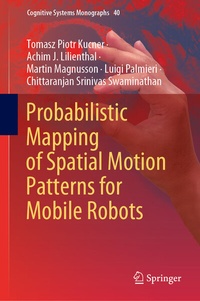
Probabilistic Mapping of Spatial Motion Patterns for Mobile Robots
1st Edition
Published on 28. March 2020
XXV, 151 pages
978-3-030-41808-3 (ISBN)
Description

This book describes how robots can make sense of motion in their surroundings and use the patterns they observe to blend in better in dynamic environments shared with humans.The world around us is constantly changing. Nonetheless, we can find our way and aren't overwhelmed by all the buzz, since motion often follows discernible patterns. Just like humans, robots need to understand the patterns behind the dynamics in their surroundings to be able to efficiently operate e.g. in a busy airport. Yet robotic mapping has traditionally been based on the static world assumption, which disregards motion altogether. In this book, the authors describe how robots can instead explicitly learn patterns of dynamic change from observations, store those patterns in Maps of Dynamics (MoDs), and use MoDs to plan less intrusive, safer and more efficient paths. The authors discuss the pros and cons of recently introduced MoDs and approaches to MoD-informed motion planning, and provide an outlook on future work in this emerging, fascinating field.
Reviews / Votes
"The purpose of this book is to provide an idea for motion planning of robots realizing tasks in unknown environment and self-control their work. The book should be of interest to master and Ph.D. students as well as practicing and research engineers in the field of robotics." (Clementina Mladenova, zbMATH 1478.93002, 2022)More details
Series
Language
English
Place of publication
Cham
Switzerland
Publishing group
Springer International Publishing
Target group
Professional and scholarly
Product notice
Reflowable
Illustrations
XXV, 151 p. 69 illus., 66 illus. in color.
File size
8,00 MB
ISBN-13
978-3-030-41808-3 (9783030418083)
DOI
10.1007/978-3-030-41808-3
Schweitzer Classification
Other editions
Additional editions
Tomasz Piotr Kucner | Achim J. Lilienthal | Martin Magnusson
Probabilistic Mapping of Spatial Motion Patterns for Mobile Robots
Book
03/2020
Springer
€128.39
Shipment within 7-9 days
Persons
Tomasz Piotr Kucner
received his B.Sc. in Computer Management Systems inManufacturing (2011) and M.Sc. in Robotics (2012) at Wroclaw University of Tech-nology. In 2018, he received a tekn. dr. (Ph. D.) degree from Örebro University.During his PhD studies he was part of KKS research project ALLO and EU FP7research rpoject SPENCER. His work in these projects was focussed on buildingspatial models of dynamics. Dr. Kucner currently works as Post-doctoral researcherin the Mobile Robotics & Olfaction lab of AASS at Örebro University, Sweden. He ismainly involved in the EU H2020 research project ILIAD, where he is working withmethods for automatic map quality assessment and building spatio-temporal modelsof dynamics.
Achim J. Lilienthal is full professor of Computer Science at Örebro Universitywhere he leads the Mobile Robotics and Olfaction (MRO) Lab. His core researchinterests are perception systems in unconstrained, dynamic environments. Typicallybased on approaches that leverage domain knowledge and Arti?cial Intelligence, hisresearch work addresses rich 3D perception and navigation of autonomous transportrobots, mobile robot olfaction, human robot interaction and mathematics educationresearch. Achim J. Lilienthal obtained his Ph.D. in computer science from TübingenUniversity. The Ph.D. thesis addresses gas distribution mapping and gas source lo-calisation with mobile robots. He has published more than 250 refereed conferencepapers and journal articles and is senior member of IEEE.
Martin Magnusson is currently docent (associate professor) in Computer Scienceat the Center of Applied Autonomous Sensor Systems (AASS), Örebro University,Sweden. He received his M.Sc. degree in Computer Science from Uppsala University,Sweden, in 2004 and Ph.D. degree from Örebro University in 2009. Dr. Magnussonhas been vice-chair of the working group for the IEEE/RAS standards for 2D and 3Dmap representations and is deputy chair for the eu-Robotics topic group on robotsfor logistics and transport. His research interests include 3D perception (includinge?cient and versatile 3D surface representations), creation and usage of robot mapsthat go beyond mere geometry, and methods for making use of heterogeneous mapswith high uncertainty.
Luigi Palmieri is a research scientist at Robert Bosch GmbH - Corporate Re-search. His research focuses currently on the topic of motion planning and control incluttered and dynamic environments for wheeled mobile robotics, machine learningand social-navigation. He earned his PhD degree in robot motion planning from theUniversity of Freiburg, Germany. During his PhD he was responsible for the motionplanning task of the EU FP7 project Spencer. He currently has the same responsi-bility in the EU H2020 project ILIAD. He has co-authored multiple papers at RA-L,ICRA, IROS, IJRR, FSR about combinations of motion planning with control, search,machine learning and human motion prediction.
Chittaranjan Srinivas Swaminathan is a doctoral student in Computer Scienceat Örebro University, Sweden. He received his M.Sc. degree in Computer Sciencefrom Örebro University in June, 2017, and his Bachelor of Technology in Mecha-tronics from SASTRA University, Thanjavur, India, in September, 2012. His interestsinclude motion planning, control and multi-agent coordination in dynamic environ-ments. He is also involved in the software integration and motion planning tasks inthe EU H2020 project ILIAD.
Achim J. Lilienthal is full professor of Computer Science at Örebro Universitywhere he leads the Mobile Robotics and Olfaction (MRO) Lab. His core researchinterests are perception systems in unconstrained, dynamic environments. Typicallybased on approaches that leverage domain knowledge and Arti?cial Intelligence, hisresearch work addresses rich 3D perception and navigation of autonomous transportrobots, mobile robot olfaction, human robot interaction and mathematics educationresearch. Achim J. Lilienthal obtained his Ph.D. in computer science from TübingenUniversity. The Ph.D. thesis addresses gas distribution mapping and gas source lo-calisation with mobile robots. He has published more than 250 refereed conferencepapers and journal articles and is senior member of IEEE.
Martin Magnusson is currently docent (associate professor) in Computer Scienceat the Center of Applied Autonomous Sensor Systems (AASS), Örebro University,Sweden. He received his M.Sc. degree in Computer Science from Uppsala University,Sweden, in 2004 and Ph.D. degree from Örebro University in 2009. Dr. Magnussonhas been vice-chair of the working group for the IEEE/RAS standards for 2D and 3Dmap representations and is deputy chair for the eu-Robotics topic group on robotsfor logistics and transport. His research interests include 3D perception (includinge?cient and versatile 3D surface representations), creation and usage of robot mapsthat go beyond mere geometry, and methods for making use of heterogeneous mapswith high uncertainty.
Luigi Palmieri is a research scientist at Robert Bosch GmbH - Corporate Re-search. His research focuses currently on the topic of motion planning and control incluttered and dynamic environments for wheeled mobile robotics, machine learningand social-navigation. He earned his PhD degree in robot motion planning from theUniversity of Freiburg, Germany. During his PhD he was responsible for the motionplanning task of the EU FP7 project Spencer. He currently has the same responsi-bility in the EU H2020 project ILIAD. He has co-authored multiple papers at RA-L,ICRA, IROS, IJRR, FSR about combinations of motion planning with control, search,machine learning and human motion prediction.
Chittaranjan Srinivas Swaminathan is a doctoral student in Computer Scienceat Örebro University, Sweden. He received his M.Sc. degree in Computer Sciencefrom Örebro University in June, 2017, and his Bachelor of Technology in Mecha-tronics from SASTRA University, Thanjavur, India, in September, 2012. His interestsinclude motion planning, control and multi-agent coordination in dynamic environ-ments. He is also involved in the software integration and motion planning tasks inthe EU H2020 project ILIAD.
Content
Introduction.- Maps of Dynamics.- Modelling Motion Patterns with CT-Map.- Modelling Motion Patterns with CLiFF-Map.- Motion Planning using MoDs.- Closing Remarks.
