
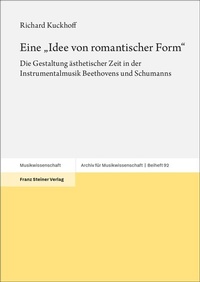
Eine "Idee von romantischer Form"
Description
Alles über E-Books | Antworten auf Fragen rund um E-Books, Kopierschutz und Dateiformate finden Sie in unserem Info- & Hilfebereich.
Um 1800 tritt insbesondere in der Romantheorie die "Idee der Prosa" als Movens einer komplexen, selbstreflexiven Form in den Vordergrund. Richard Kuckhoff untersucht, in welcher Weise sich diese als zeitstiftendes Moment von Instrumentalmusik ab dem frühen 19. Jahrhundert erweist.
Eine solche "Idee von romantischer Form", wie es in Friedrich Schlegels Brief über den Roman heißt, entspricht der Zeitlichkeitsproblematik des modernen Romans, die darin besteht, dass sich die endliche Form auf einen unendlichen Kontext hin öffnet. Mit dieser Konstellation rückt in der Ästhetikdiskussion zugleich die Instrumentalmusik als Zeitkunst in den Fokus. Mit Blick auf die Wechselwirkung von Roman und Instrumentalmusik wird der Frage nachgegangen, inwiefern Instrumentalkompositionen eine zeitstiftende Idee komplexer Form zugrunde liegt und sie damit romananalog eine Welt eröffnen. Die musikalische Zeitgestaltung in Instrumentalwerken Beethovens und Schumanns wird so aus einer dezidiert historischen Perspektive betrachtet. Der Autor zeigt, wie sich die musikalische Zeit durch eine "Idee von romantischer Form" um 1800 verändert und als vielschichtige und nicht-lineare Form der Zeit greifbar wird.
More details
Other editions
Additional editions
Person
ISNI: 0000 0005 2411 9599

Content
System requirements
File format: PDF
Copy protection: Watermark-DRM (Digital Rights Management)
System requirements:
- Computer (Windows; MacOS X; Linux): Use the free software Adobe Reader, Adobe Digital Editions, or any other PDF viewer of your choice (see eBook Help).
- Tablet/Smartphone (Android; iOS): Install the free app Adobe Digital Editions or another reading app for eBooks, e.g., PocketBook (see eBook Help).
- E-reader: Bookeen, Kobo, Pocketbook, Sony, Tolino and many more (only limited: Kindle).
The file format PDF always displays a book page identically on any hardware. This makes PDF suitable for complex layouts such as those used in textbooks and reference books (images, tables, columns, footnotes). Unfortunately, on the small screens of e-readers or smartphones, PDFs are rather annoying, requiring too much scrolling.
This eBook uses Watermark-DRM, a „soft” copy protection. This means that there are no technical restrictions to prevent illegal distribution. However, there is a personalised watermark embedded in the eBook that can be used to identify the purchaser of the eBook in the event of misuse and to provide evidence for legal purposes.
For more information, see our eBook Help page.