

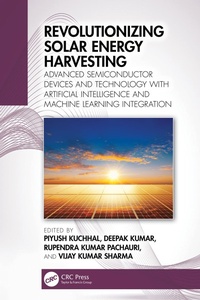
Revolutionizing Solar Energy Harvesting
Advanced Semiconductor Devices and Technology with Artificial Intelligence and Machine Learning Integration
Published on 30. September 2025
302 pages
978-1-040-42442-1 (ISBN)
Description

This book provides insights into emerging semiconductor device technology, challenges, and solutions for harnessing solar power to produce sustainable energy and meet the escalating demand for electricity generation.
Revolutionizing Solar Energy Harvesting provides desired exposure to the ever-growing field of semiconductor electronic devices and technologies to produce power by harnessing solar energy. The authors highlight the role of semiconductors and the process technologies in meeting global energy demand. They also explore international policies and standards for harnessing solar power. The authors then discuss the impact of semiconductor materials and architecture designs on photovoltaic performance. Finally, the authors then discuss manufacturing and selection of materials using artificial intelligence (AI)-machine learning (ML) techniques and emphasize enhancing the production of defect-free semiconductor materials by employing AI-ML techniques.
The book is intended for researcher professionals in the field of nanomaterials and semiconductor devices for harnessing solar power codesign issues, as well as undergraduate/postgraduate students within Electronics or Electrical Engineering programs.
Revolutionizing Solar Energy Harvesting provides desired exposure to the ever-growing field of semiconductor electronic devices and technologies to produce power by harnessing solar energy. The authors highlight the role of semiconductors and the process technologies in meeting global energy demand. They also explore international policies and standards for harnessing solar power. The authors then discuss the impact of semiconductor materials and architecture designs on photovoltaic performance. Finally, the authors then discuss manufacturing and selection of materials using artificial intelligence (AI)-machine learning (ML) techniques and emphasize enhancing the production of defect-free semiconductor materials by employing AI-ML techniques.
The book is intended for researcher professionals in the field of nanomaterials and semiconductor devices for harnessing solar power codesign issues, as well as undergraduate/postgraduate students within Electronics or Electrical Engineering programs.
More details
Language
English
Place of publication
London
United Kingdom
Publishing group
Taylor & Francis Ltd
Target group
College/higher education
Professional and scholarly
Illustrations
48 Tables, black and white; 21 Line drawings, color; 92 Line drawings, black and white; 1 Halftones, color; 7 Halftones, black and white; 22 Illustrations, color; 99 Illustrations, black and white
File size
12,28 MB
ISBN-13
978-1-040-42442-1 (9781040424421)
Copyright in bibliographic data and cover images is held by Nielsen Book Services Limited or by the publishers or by their respective licensors: all rights reserved.
Schweitzer Classification
Other editions
Additional editions
Piyush Kuchhal | Deepak Kumar | Rupendra Kumar Pachauri
Revolutionizing Solar Energy Harvesting
Advanced Semiconductor Devices and Technology with Artificial Intelligence and Machine Learning Integration
Book
09/2025
1st Edition
CRC Press
€189.60
Shipment within 10-20 days
Persons
Dr. Piyush Kuchhal has extensive experience in education, research, and administration. He holds a Ph.D. in Physics from the IIT Roorkee and an M.S. in Physics with a concentration in Engineering Physics from the same institution. He has overseen operations, curriculum design, and academic quality as Cluster-Head of Electrical and Electronics Engineering at UPES. He has also held the positions of Academic Coordinator, Associate Dean of Applied Sciences, and Department Head of Physics.
Dr. Deepak Kumar is currently a research associate at the Technische Universitaet Dresden Germany, Chair for Electron Devices and Integrated Circuits. He has continued his research with DFG (Deutsche Forschungsgemeinschaft) funded project "Experimental characterization and compact modeling of high-field effects in CNTFET channels". He has worked as an IEEE student Branch Counsellor at UPES and faculty coordinator for spoken tutorial-IITB. He is also serving as an active member at Germany Chip Design program. He is working in solar cell technology, semiconductor devices and compact modelling for self-heating in CNTFETs. He has also completed the virtual teacher final project from Coursera in collaboration with University of California Irvine (UCI).
Dr. Rupendra Kumar Pachauri is an expert in renewable energy technology and electrical hybrid power generation systems (Micro-grid advancements). His research is based on hydrogen fuel cell power generation, energy management, advanced strategies for photovoltaic systems (stand-alone: ground-mounted and floating photovoltaic systems) for power enhancement during adverse environmental conditions (dust aerosol, partial shading conditions) and power generation forecasting using Artificial intelligence and Machine learning techniques. Dr. Pachauri is a distinguished academic and an Associate Professor holding an esteemed position within the Department of Electrical and Electronics Engineering at UPES in Dehradun, India.
Dr Vijay Kumar Sharma is a Program Manager and Senior Scientist at the School of Electrical and Electronic Engineering, Nanyang Technological University, Singapore. He has a PhD degree in Physics (UGC-CSIR Junior Research Fellowship) from Indian Institute of Technology Roorkee, India. (2005-10), MSc and BSc in Physics with specialization in Electronics from University of Delhi, India.
Dr. Deepak Kumar is currently a research associate at the Technische Universitaet Dresden Germany, Chair for Electron Devices and Integrated Circuits. He has continued his research with DFG (Deutsche Forschungsgemeinschaft) funded project "Experimental characterization and compact modeling of high-field effects in CNTFET channels". He has worked as an IEEE student Branch Counsellor at UPES and faculty coordinator for spoken tutorial-IITB. He is also serving as an active member at Germany Chip Design program. He is working in solar cell technology, semiconductor devices and compact modelling for self-heating in CNTFETs. He has also completed the virtual teacher final project from Coursera in collaboration with University of California Irvine (UCI).
Dr. Rupendra Kumar Pachauri is an expert in renewable energy technology and electrical hybrid power generation systems (Micro-grid advancements). His research is based on hydrogen fuel cell power generation, energy management, advanced strategies for photovoltaic systems (stand-alone: ground-mounted and floating photovoltaic systems) for power enhancement during adverse environmental conditions (dust aerosol, partial shading conditions) and power generation forecasting using Artificial intelligence and Machine learning techniques. Dr. Pachauri is a distinguished academic and an Associate Professor holding an esteemed position within the Department of Electrical and Electronics Engineering at UPES in Dehradun, India.
Dr Vijay Kumar Sharma is a Program Manager and Senior Scientist at the School of Electrical and Electronic Engineering, Nanyang Technological University, Singapore. He has a PhD degree in Physics (UGC-CSIR Junior Research Fellowship) from Indian Institute of Technology Roorkee, India. (2005-10), MSc and BSc in Physics with specialization in Electronics from University of Delhi, India.
Content
Chapter 1 An Overview of AI-ML Powered Systems with Computer Vision for Wafer Inspections for Solar Cells Applications Chapter 2 Introduction to Characterization and Fabrication Techniques Employed for Advanced Solar Cell Structures Chapter 3 Global Penetration and Recent Developments in Semiconductor Devices for Solar Harvesting: A Review Chapter 4 Using Artificial Intelligence and Computer Vision for Solar Cell Wafer Inspection Chapter 5 Introduction to Characterization and Fabrication Techniques Employed for Advanced Solar Cell Structures Chapter 6 AI-ML Powered Systems with Computer Vision for Wafer Inspections of Solar Cells: Technological Scenario, Implementation, Advantages, and Challenges Chapter 7 Principles, Methods, and Industrial Applications of Perovskite Silicon Tandem Solar Cell Chapter 8 Enhancing Solar Cell Defect Detection through a Generalized Hybrid Transfer Learning Model Synergized with Machine Learning Classifier Chapter 9 Printable Solar Cells-Advancing Flexible and Sustainable Energy Solutions
