

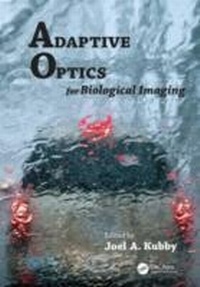
Adaptive Optics for Biological Imaging
1st Edition
Published on 26. April 2013
388 pages
978-1-4398-5019-0 (ISBN)
Description

Adaptive Optics for Biological Imaging brings together groundbreaking research on the use of adaptive optics for biological imaging. The book builds on prior work in astronomy and vision science. Featuring contributions by leaders in this emerging field, it takes an interdisciplinary approach that makes the subject accessible to nonspecialists who
Reviews / Votes
"Overall, this is an excellent book, which achieves its stated primary goal. ... Without reservations, this is a book I would recommend to anyone who wishes to start learning about the principles and potential of AO in this field."-Biomedical Engineering OnLine
"The strength of the book is the delicate balance of theory and instrumentation and applications. ... Another example of the comprehensive nature of the chapters is a critical discussion of the adaptive optical elements. ... Adaptive Optics for Biological Imaging is a good place to start to understand the problem (aberrations induced by the instrument, the objective, and the specimen and its preparation and mounting in the microscope), and the various instrumental and computational approaches to approach a solution (minimize the significant aberrations)."
-Barry R. Masters, Journal of Biomedical Optics, Volume 18, July 2013
"This book is a broad and comprehensive introduction to the use of adaptive optics (AO) in biological microscopy. It provides a much-needed entree to the field and includes not only the basics and general principles but also discussion of practical implementations and key application areas."
-From the Foreword by Professor Austin Roorda, University of California at Berkeley, and Professor Claire Max, University of California at Santa Cruz
More details
Language
English
Place of publication
Baton Rouge
United States
Publishing group
Taylor & Francis Inc
Target group
College/higher education
.
Illustrations
242 s/w Abbildungen, 14 s/w Tabellen
242 b/w images, 14 tables and 148
File size
47,96 MB
ISBN-13
978-1-4398-5019-0 (9781439850190)
Copyright in bibliographic data and cover images is held by Nielsen Book Services Limited or by the publishers or by their respective licensors: all rights reserved.
Schweitzer Classification
Other editions
Additional editions
Joel A. Kubby
Adaptive Optics for Biological Imaging
Book
06/2020
1st Edition
CRC Press
€71.50
Shipment within 15-20 days
Joel A. Kubby
Adaptive Optics for Biological Imaging
Book
04/2013
1st Edition
CRC Press
€173.32
Shipment within 15-20 days
Person
Joel Kubby is the Department Chair of Electrical Engineering in the Baskin School of Engineering at the University of California at Santa Cruz. His research is in the area of microelectromechanical systems (MEMS) with applications in optics, fluidics, and BioMEMS. Before joining the University of California at Santa Cruz in 2005, he was an area manager with the Wilson Center for Research and Technology and a member of technical staff in the Xerox Research Center Webster in Rochester, New York (1987-2005). Prior to Xerox, he was at the Bell Telephone Laboratories in Murray Hill, New Jersey, working in the area of scanning tunneling microscopy.
Content
Principles: Principles of Wave Optics. Principles of Geometric Optics. Theory of Image Formation. Methods: Aberrations and Benefit of Their Correction in Confocal Microscopy. Specimen-Induced Geometrical Distortions. Simulation of Aberrations. Overview of Adaptive Optics in Biological Imaging. Wavefront Correctors. Adaptive Optics System Alignment and Assembly. Applications: Indirect Wavefront Sensing: Sensorless Adaptive Optics for Microscopy. Implementation of Adaptive Optics in Nonlinear Microscopy for Biological Samples Using Optimization Algorithms. AO Two-Photon Fluorescence Microscopy Using Stochastic Parallel Descent Algorithm with Zernike Polynomial Basis. Pupil-Segmentation-Based Adaptive Optics for Microscopy. Applications: Direct Wavefront Sensing: Coherence-Gated Wavefront Sensing. Adaptive Optics in Wide-Field Microscopy. Biological Imaging and Adaptive Optics in Microscopy. Adaptive Optical Microscopy Using Direct Wavefront Measurements. Index.
